Guest Post: “Good Newes from ye olde World”

banner-redehjaHere at The Junto, we like to hear from early Americanists at work around the world. Today’s guest post comes from Lauric Henneton, Associate Professor at the Université de Versailles Saint-Quentin and Vice Président of the Réseau pour le Développement Européen de l’Histoire de la Jeune Amérique (REDEHJA)

In case the honorable readers of The Junto were wondering, we do Early American and Atlantic history in the “Old World” and not just in good old “Blighty.” This post is about how the Réseau pour le Développement Européen de l’Histoire de la Jeune Amérique (REDEHJA) came together and what we’ve done over the last few years. This is the story of a group of friends/colleagues who decided to come together institutionally after a few years holding small-scale events in and around Paris. Continue reading
Promised Land

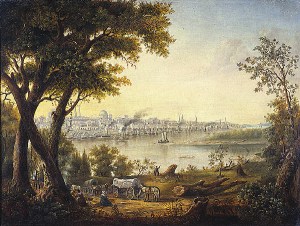
Henry_Lewis_-_Saint_Louis_in_1846

“Saint Louis in 1846”
Henry Lewis

This week, The Junto spoke with Lea VanderVelde, the Josephine R. Witte Professor of Law at the University of Iowa College of Law, a Guggenheim Fellow in Constitutional Studies, and principal investigator of the Law of the Antebellum Frontier project, which “seeks to digitally analyze the legal and economic mechanisms at work on the American frontier in the early 1800s.” She kindly took our questions on her work-in-progress, and why digital research transforms the early American legal history of how the West was run. Continue reading

Guest Post: Working for the Library

Today’s post is by guest blogger, David J. Gary, who received his MLS from Queen’s College (CUNY) in 2011 and his PhD in History from the CUNY Graduate Center in 2013. He is currently an adjunct assistant professor at the Graduate School of Library and Information Studies at Queens College (CUNY). He blogs at Function Follows Forme.

I am grateful to The Junto for this chance to reflect on my experiences earning both a Master’s in Library Science and a PhD in American history and to advocate for others to consider joining me.  Continue reading
Plagiarism, Cheating, and Craigslist

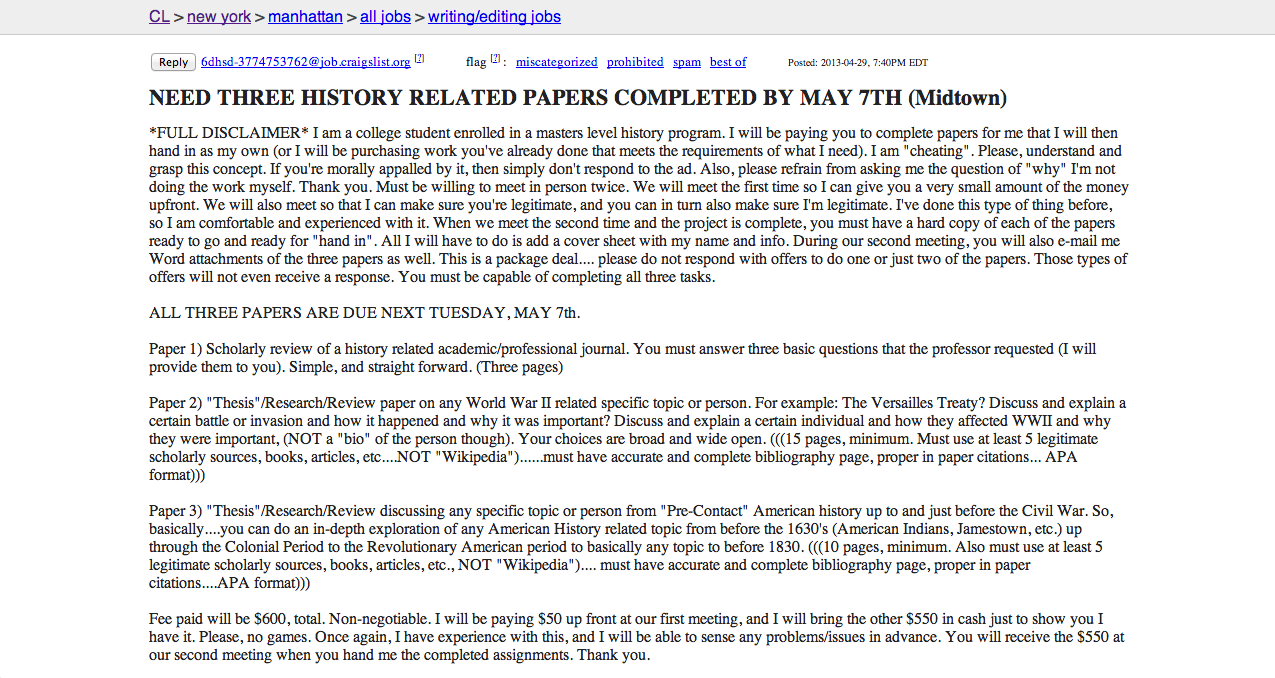
Craigslist adBefore reading this post, take a moment to read this genuine, recent ad from Craigslist (click picture for full size). It is from a student in New York and the assignment(s) are due today, one of which is an early American history paper.

As I wrote last week, I am currently finishing up my coursework and in the fall will begin my first teaching assistantship. Because teaching has been on my mind anyway, the ad above struck me a bit harder than I imagine it would have done before. I’ve heard stories of cheating and plagiarism from my professors and my peers in my own program now in their teaching years, but the ad above really “takes the cake” for me. Continue reading

New Journal Launch: J19: The Journal of Nineteenth-Century Americanists

J19Though chronologically speaking only half of their content is relevant to The Junto, we are thrilled to welcome a new journal into the fray: J19: The Journal of Nineteenth-Century Americanists. What originated as an email list and loosely-based organization emerged to host two fabulous (from what I hear) conferences, and now what promises to be a solid journal. Continue reading

Coursework: How Much is Enough?

Following on from last week’s post by Michael Blaakman, in which he reflected on his experiences preparing for oral exams and their practical value, I would like to take this opportunity to reflect on another aspect of graduate education. Today—two years, four semesters, twelve courses, a couple hundred books, two research papers, and a dissertation prospectus draft later—I am attending the last seminar session of my coursework. Now, it’s nowhere near the equivalent of reaching ABD, but it is something of a milestone, for me at least. I was a non-traditional student who began my undergraduate work at the age of 32 and went straight from undergrad to a PhD program. So today marks the end of what was effectively six years of coursework.

Continue reading

The Comprehensive Exam: A Reflection, with Qualifiers

BooksThe three or four minutes between when my qualifying exam ended and when I found out I had passed rank among the weirdest of my life. Not because I feared I had failed. In fact, immediately following the exam, which I took last Tuesday and which consisted solely of a two-hour oral interrogation, I encountered a calm and a confidence that I hadn’t known in months. Instead, the moment’s weirdness stemmed from a sort of whiplash. Ideas, arguments, and anxieties had been cramming themselves into every corner of my brain for over a year. Suddenly, they were free—unleashed and dissipated in the space a two-hour conversation. It felt more than a bit anticlimactic. A disappointing question seemed to cloud out any sense of accomplishment or pride: “That was it?” A week later, I’m feeling prouder—and still celebrating—but the question remains. Continue reading
Historians and Documentary Editing

PBFOn this—the 223rd anniversary of the death of Benjamin Franklin—I thought I would use this space to say a few words about my experience over the last year working at the Papers of Benjamin Franklin here at Yale University from the perspective of a graduate student. Last June, I was fortunate enough to be given a regular (part-time) position at the Franklin Papers. Officially, I am a Research Assistant and have done a number of small research projects designed to provide the editors with reference materials on Pennsylvania in the 1780s as they finish up the volumes covering Franklin’s stay in Paris. I have also been given the opportunity to tackle more editorial-type duties including fact-checking, drafting annotations, and proofreading transcriptions. Through these experiences and my innumerable conversations with the chief Editor, Ellen Cohn, I have gotten an inside look at scholarly editing, which often goes either unnoticed or under-appreciated by academic historians. Continue reading
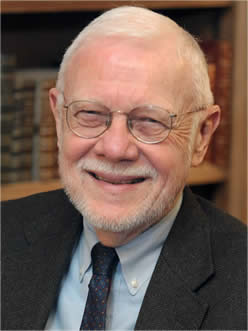
Pulling a “Butler”: Reflections on “Historiographical Heresy: A Conference on the Legacy of Jon Butler”

Jon ButlerLast saturday, I woke up at an ungodly hour (especially for a weekend!) in order to make the 2 1/2 hour drive down to New Haven in time for the start of “Historiographical Heresy: A Conference on the Legacy of Jon Butler” (program here). The brainchild of James Bennett and Amy Koehlinger, and spearheaded on the ground by Kathryn Lofton, the one-day event commemorated the retirement of one of American religious history’s major figures. All participants were in some way students of Butler–some claimed him as their dissertation adviser, others as one of their committee members, and at least one as just an informal advisor; it was stated that this was more of a “family reunion” than a conference. Though I have zero attachment to Yale and no direct connection to Butler (besides being strongly influenced by his writing), I was warmly welcomed as an outsider and thoroughly enjoyed both the stimulating papers and discussions as well as the comraderie. Continue reading

The Week in Early American History

TWEAHHappy Easter and Passover to all celebrating!

With all the excitement around the Junto’s March Madness tournament (we even have a hashtag!), it’s a useful reminder that there are other things going on this week around the blogosphere. Once you’ve found all the Easter eggs (or, if you hid it really well on Monday, the afikoman), sit down and try out a few of these posts and stories.

Continue reading