Alejandra Dubcovsky, Informed Power: Communication in the Early American South (Cambridge: Harvard University Press, 2016).
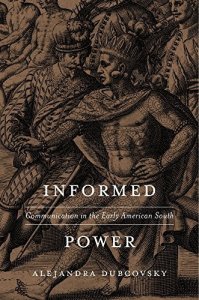 Alejandra Dubcovsky’s Informed Power: Communication in the Early American South is an ambitious book. She analyzes how information was communicated throughout the early South, a region that was without a regular mail system or print culture prior to 1730. The “early South,” as Dubcovsky acknowledges, is an “ambiguous” term (3). Her “early South” includes much of the lands from the Jamestown settlement south, and from the Mississippi River east. The result is a vibrant blend of Native American peoples, Africans, and European interactions that both complicate and enrich her analysis. Her sources include not only English, French, and Spanish, but also a number of Native American sources, including Timucua. She draws not only on written sources, but linguistic and archaeological evidence as well. This interdisciplinary approach allowed for broader inclusion of non-European networks than appears in many studies. Networks, as Dubcovsky defines them, are a “pattern of ties connecting discrete places or peoples”(4) She discusses a number of different types of networks—economic, political, religious, diplomatic, subaltern—but depicts all nodes as uniform in size. While some might take issue with this approach, the uniformness of the nodes makes sense, given the book’s goal of decentralizing European power structures, and does not detract. Continue reading
 Right after I agreed to review Sam Haselby’s The Origins of American Religious Nationalism for the

 Between 1650 and 1750, the courts of Maine, Rhode Island, and Essex County, Massachusetts heard 1,843 cases concerning sexual misconduct. These suits, which concerned matters including rape, sodomy, adultery, and sex outside of marriage, are the subject of
 Social networks are having a moment in history. They are another approach to understanding how people came together either via proximity, social status, values, or goals, with the analytical focus on what serves as the bond in the relationship(s).[1] Social theorists have ascribed a 4-part process which entails a) similar people coming together, b) influence within these groups making its members more alike, c) people winding up in the same place, and d) shared space making people more alike.[2] In short, networks are primarily about building consensus. For historians, networks are “messy,” “fragile,” “fluid,” and disregard geographic boundaries.[3]
  Yesterday, Chris Minty
 Religion was an “engine of politics” in the early American republic. Jonathan Den Hartog explains how religion energized (and then, ironically, diverted energy from) Federalist politics, and how the national vision of Federalists changed American religion. He considers northern evangelical Federalists such as John Jay (and his two sons), Caleb Strong, and Elias Boudinot, Unitarian Federalists including John Adams, and Federalists with a southern accent, Henry De Saussure and Charles Pinckney. These individuals are located, through impressive archival research, in a web of interpersonal relationships.
  Beyond any new discoveries of evidence and perhaps new technological capacities, every new generation of historians has something unique to contribute to the study of the past—a consciousness of its own time and place. History is written on a tightrope between then and now. Even telling the same story again will always come out differently. Each time you walk the tightrope, there’s a slightly different view. In Nick Bunker’s recent trade book,
  The Junto