 On February 18, 2014, Tom Cutterham asked, “Was the American Revolution a Civil War?” According to Cutterham, understanding the Revolution that way might be useful. If we did, he suggested, “we’d better understand the way the modern world—the nexus of state, citizen, and property—was born in and determined by violence.”[1] Continue reading
Category Archives: Commentary
Guest Post: On Publishing Journal Articles
Update: The Junto is sorry to report that C. Dallett Hemphill passed away on Friday, 3 July, after a brief illness. Hemphill received her BA from Princeton, and her PhD in American Civilization from Brandeis University. Through her own scholarly work, contributions to the McNeil Center for Early American Studies, and her position as Editor of Early American Studies, she was a big supporter of junior scholars. She is remembered both for her contributions to the field and profession and as a warm and generous scholar. This was her recent guest post for The Junto, in which she offered advice to junior scholars on publishing journal articles.
Guest Poster C. Dallett Hemphill is Professor of History at Ursinus College. She is also Editor of Early American Studies, which is published by the University of Pennsylvania Press for the McNeil Center for Early American Studies.
 I’m grateful to The Junto blog for inviting me to discuss how to publish a journal article. Although the views that follow are my own and the details of the process vary somewhat from journal to journal, I know from conversations with other editors that there is consensus on the essentials.
The Early American Digital World
This post builds on the conversation begun by Joseph Adelman’s post on early American history blogging the other day, and a panel on the topic at the OIEAHC/SEA conference yesterday. A version of these remarks were delivered at a panel entitled, “Early American Worlds: A State-of-the-Field Conversation” at the 2015 Organization of American Historians Annual Meeting on April 17, 2015 in St. Louis, MO.
 For longer than I’ve been alive, our field in a structural sense has been organized through the efforts of the main institutions in the field, i.e., the Omohundro Institute of Early American History and Culture and, later, the McNeil Center for Early American Studies and the Society for Historians of the Early American Republic. From fellowships to seminars to conferences, these institutions gave to the field the significant sense of community it had. And I would argue that the new early American “digital world” is not changing that but expanding upon (or around) it. Social media and blogs are adding an additional layer of social infrastructure within the field itself, creating spaces that foster an even broader and more inclusive sense of community in the field, largely through the ability to include people who for whatever reason don’t have access to or are outside the immediate orbit of those institutions and the field’s traditional channels of community-building. Continue reading
The Charleston Shooting and the Potent Symbol of the Black Church in America
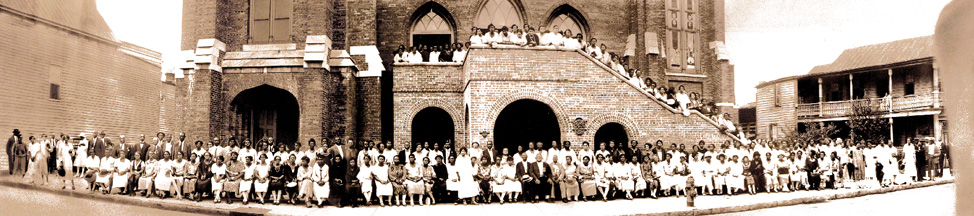 Last night, Dylann Storm Roof entered the historic Emanuel African Methodist Episcopal Church in downtown Charleston, South Carolina, sat through an hour-long meeting, and then opened fire on those in attendance. Reverend Clementa Pinckney, a state senator, was among nine individuals who were killed. Many are shocked at not only the grisly nature of the shooting, but also its location. “There is no greater coward,” Cornell William Brooks, president of the N.A.A.C.P, declared in a statement, “than a criminal who enters a house of God and slaughters innocent people engaged in the study of scripture.” Yet this experience is unfortunately, and infuriatingly, far from new: while black churches have long been seen as a powerful symbol of African American community, they have also served as a flashpoint for hatred from those who fear black solidarity, and as a result these edifices have been the location for many of our nation’s most egregious racial terrorist acts. Continue reading
The Week in Early American History
 Welcome to another addition of The Week in Early American History! Continue reading
Guest Post: Incorporating History and the Humanities into International Business
Chryssa Sharp is an Associate Professor of International Business in the Robert W. Plaster School of Business and Entrepreneurship at Lindenwood University in St. Charles, Missouri. She earned a PhD in Management from the University of Calgary in Canada and an MBA in International Management from the Thunderbird School of Global Management. Dr. Sharp’s industry experiences encompass aspects of marketing, strategic planning, and cross-cultural communications. She has also been involved with developing programs to support small business exporting.
 Historical knowledge plays an important role in the international business field. Ironically, as programs in the humanities are forced to justify their relevance to administrators, elected officials, and the general public, we, as a society, are in need of those fields’ contributions to creating the desired “global citizen.”
Ballin’ Ben Franklin, Father Knickerbocker, and Lucky the Leprechaun: Representations of Early American History in NBA Team Logos
 Big news out of Philadelphia earlier this week, as the city’s NBA team, the 76ers, introduced an “updated brand identity.”[1] For now, the team has released the new logo set, though updated uniforms are also reportedly in the works. That new logo set amounts mostly to slight revisions of existing logos, but also includes a secondary logo featuring a bespectacled Benjamin Franklin donning a blue jacket emblazoned with “76,” red culottes so as to expose knee high and team colored-striped socks, and blue sneakers. Suffice it to say that my excitement about my prospective move to Philadelphia this fall just increased ten-fold. Continue reading
Guest Post: African Americans, Mobility, and the Law
Today’s guest poster is Robert Gamble, Visiting Assistant Professor of History at the University of Kansas. He is currently at work on a manuscript entitled “The Civic Economy: Regulating Urban Space and Capitalism in the Early American Republic,” and has written a chapter on secondhand goods for Capitalism by Gaslight: Illuminating the Economy of Nineteenth-Century America (Brian Luskey and Wendy Woloson, eds.).
 The death of Freddie Gray three weeks ago and the ensuing protests prompted many people to seek richer historical context for what happened. Consider that Seth Rockman’s twelve-year-old Common-place essay on rioting in early Baltimore had garnered some one million re-tweets by last Tuesday afternoon, according to his estimate. Justly concerned about half-baked historical parallels, Rockman doubts “the 1830s is [the] most useful context for now.” Certainly, there are more recent sources and contexts to consider: the real estate and lending practices that fortified segregation, reeling public school systems, eroding city tax bases, deindustrialization and the exportation of jobs, transit systems that bypass largely black neighborhoods, a deteriorating housing stock encased in lead paint, the mutual distrust sown by the War on Drugs, militarization of the police, and so on. Baltimore’s bank riot of 1835, though a nice lesson in shifting attitudes toward capitalism and urban order, does little to make the issues of 2015 any more coherent.
Race, Riot, and Rebellion: A Bibliography
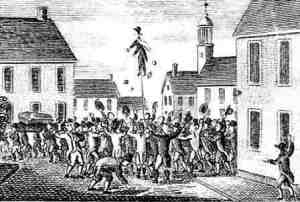 This morning on the other side of the Atlantic, I woke up early in preparation for a seminar on William Otter, whose History of My Own Times closes the list of our readings in my Revolutionary America class. Essentially, Otter was a brawling, violent, white man in the 1800s, living variously in New York, Pennsylvania, and Maryland. He jumped from job to job while engaging in various aggressive “sprees” against African Americans, Irishmen, and anyone else who seemed a likely candidate before becoming a burgess of Emmitsburg, Maryland.[1] And instead of getting up to prep this morning, I remained in bed, glued to the #BaltimoreUprising and #BlackLivesMatter hashtag on Twitter, as, I’m sure, were many of you during the late hours of the night. During times like these, it’s part of our jobs as historians to acknowledge that different types of violence have specific meanings that change over time. And so Juntoists have compiled a bibliography for our mutual education. Continue reading
The “Suddenness” of the “Alteration”: Some Afterthoughts on #RevReborn2
 As most, if not all, of our readers are aware, this past weekend was the “So Sudden an Alteration” conference hosted by the Massachusetts Historical Society in commemoration of the 250th anniversary of the Stamp Act.[1] It was the second of three conferences dedicated to rebirthing Revolution studies, hence, the hashtag #RevReborn2. (NB: You can find the immense backchannel coverage of the conference Storified here: Day 1, Day 2, and Day 3. You can also find Joseph Adelman’s interactive TAGSExplorer that chronicled the Twitter coverage). This post is not intended to be a standard Junto-type conference recap. Instead, I just want to offer some afterthoughts on the conference, specifically in light of the piece I wrote before the conference, entitled “Have Cultural Historians Lost the Revolution?” as well as numerous other pieces I have written about the historiography of the Revolution and the state of Revolution studies for the blog, particularly before the first #RevReborn conference back in 2013. Continue reading
 The Junto