Following the Fashions: A Basic American Pastime

AJ1Today’s #ColonialCouture post is by Amy Sopcak-Joseph, a doctoral candidate in American history at the University of Connecticut. She is working on her dissertation, “Fashioning American Women: Godey’s Lady’s Book, Female Consumers, and Periodical Publishing in the Nineteenth Century.” Follow her @AmySopcakJoseph.

It’s that time of year again: time to stash away all of your white pants and head to the nearest Starbucks for a PSL. Love it or hate it, that sugary “Pumpkin Spice Latte” is more than just a drink that allows us to ingest autumn. The PSL reached cultural-icon status when it became the trendy accessory of someone “basic”–a term encompassing a larger set of consumer choices linked to appearance, food, and leisure activities that signal an uncritical devotion to trends. Calling someone “basic” became a kind of epithet against people who like things that are mainstream or, as some writers have suggested, feminine.[1] Some women have taken ownership of “basic,” embracing it as an identity (see social media posts enthusiastically tagged #basic).

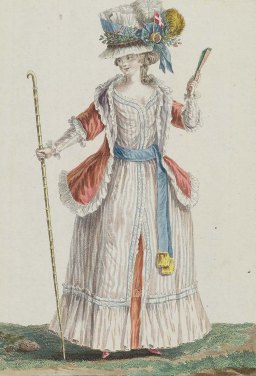
Is being “basic” really that bad? Is someone superior–morally or intellectually–for not liking things that are mainstream? Judging other people’s consumer choices and assigning them political or cultural meaning is as American as apple (or pumpkin?) pie. In the 1820s, 1830s, and 1840s, when the United States was transitioning from an agrarian economy to a capitalist one, considerable anxiety emerged about the consumer choices of the burgeoning middle class. Not unlike the criticisms of 21st-century women whose tastes and identity might be called “basic,” some found women’s purchases and self-fashioning to be particularly alarming. Ministers and reformers argued that these choices demonstrated women’s uncritical adherence to the “tyranny” or “evils” of fashion, a devotion that could negatively shape the future of the republic. Continue reading
In Touch with the Dutch, or, Fashioning Colonial New York’s Merchant Elite

CK1

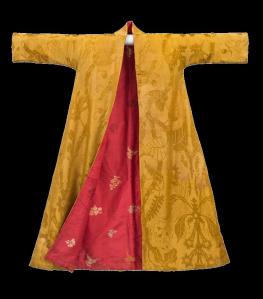
Man’s Gown. English. ca. 1700-1720. Gold silk damask (likely Chinese; ca. 1690-1720); lining: red brocaded silk (likely Persian; ca. 1700-1720); collar and cuffs: red silk damask (English; ca. 1700-1720); wool padding. Cora Ginsburg LLC.

Today’s #ColonialCouture post is by Cynthia Kok, a doctoral student in art history at Yale University. She is interested in trade and craftsmanship under European colonial governance and imitative material practices inspired by encounters with foreign cultures.

“I like my money right where I can see it…hanging in my closet.” –Carrie Bradshaw

Centuries before New York became known as a fashion capital— and Carrie Bradshaw emerged as a style icon— the city’s colonial-era merchants anticipated the words of Sex and the City’s lead character by investing newly earned wealth in clothing made from luxurious fabrics. And, like today’s Rich Kids of Instagram, they documented their exclusive material success through portraiture. Painted at the turn of the eighteenth century, that of Isaac de Peyster (1662-1728), the son of an affluent Dutch-American mercantile family, presented both his physical features and a luxurious silk robe patterned with rocks and spindly vegetation. The artist captured the soft, luminous sheen of the gold silk and hinted at the robe’s lining with a flash of red along an upturned sleeve. Continue reading

An Indian Chintz Gown: Slavery and Fashion

Today’s #ColonialCouture post is by Jennifer Van Horn, assistant professor of art history and history at the University of Delaware. She specializes in the fields of early American art and material culture, and she is the author of   The Power of Objects in Eighteenth-Century British America.

VH1

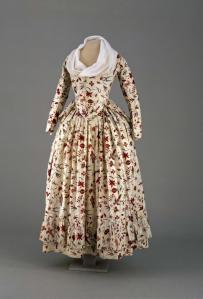
Figure 1. Woman’s Jacket and Petticoat worn by Ann Van Rensselaer, c. 1790. Albany, NY. Textile: India. Cotton chintz, mordant painted and dyed; tabby linen bodice and sleeve linings. The Colonial Williamsburg Foundation. Gift of Mrs. Cora Ginsburg.
Acc. No. 1990-10,1.

Walking down the street in Alexandria, Virginia, in 1786, a white woman spotted a gown that had been stolen from her two years before on the body of an enslaved woman. The gown was a fashionable one: an “Indian Chintz, white Ground, with Stripes and Figures of different Sorts of red, if not other Colours.” It might have resembled the chintz jacket and petticoat worn by Ann Van Rensselaer in New York about 1790 (fig 1), or the more delicately-patterned robe à l’anglaise donned by an unknown American woman around the same time (fig 2). Indian chintz—a light-weight cotton fabric painted or dyed with intricate organic designs and manufactured in India—was popular throughout the Atlantic world for clothing, bed hangings, and upholstery.[1]

The chintz gown’s original owner, Mrs. MacIver, was the wife of an Alexandria ferry owner. She claimed that a white seamstress, to whom she gave “a Night’s Quarters” after hearing “a Tale of feigned Distress,” stole the garment along with two other “elegant, well trimm’d Gowns.” The seamstress sold the Indian chintz to a “Negro of Dr Stewart’s,” who then “sold it to a Negroe Woman belonging to” George Washington. Mrs. MacIver discovered which enslaved woman—Charlotte—when she saw her strolling in Alexandria. Charlotte, then in her early to mid-twenties, was a seamstress for Martha Washington at Mount Vernon.[2] Continue reading

Creole Comforts and French Connections: A Case Study in Caribbean Dress

Today’s #ColonialCouture post is by Philippe Halbert. Follow him @plbhalbert.

1

“Vêtement dit à la creole,” Galerie des modes et costumes français, Charles Emmanuel Patas after Pierre Thomas Leclerc, 1779, Museum of Fine Arts, Boston

In 1779, a fashion plate depicting a woman’s garment “in the creole style” was published in Paris. Consisting of a lightweight muslin gown with wrist-length sleeves, the dress was “in the style of a chemise,” the basic female undergarment of the period.[1] Worn over a petticoat, the gown was to be pinned at the bust and loosely closed with a sash or belt. In addition to enumerating its various components, which included a separate caraco jacket, the engraving’s caption remarked that the fantastic ensemble was “of the sort worn by our French Ladies in America.” At the end of the Seven Years’ War in 1763, French colonial possessions in the Americas were largely confined to the Caribbean Basin, a region where interactions between people of indigenous, European, and African descent brought about innovations in everything from architecture to foodways. Although the inhabitants of French-controlled islands like Guadeloupe, Martinique, and Saint-Domingue, or Haiti, were not beyond the reach of Parisian novelty, the heat and humidity necessitated certain sartorial adaptations. Continue reading

“We Are One”: The Confinement and Consent of Colonial American Busks

Busk Photo 1_

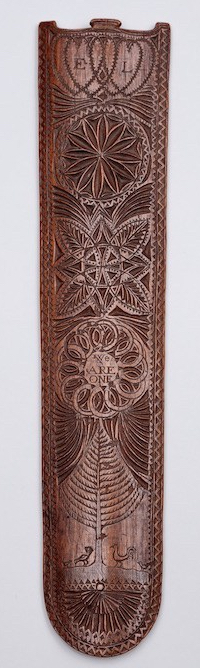
A busk for a woman’s stays, wood, American-made in Canada, 1782. Photo courtesy of the Museum of the American Revolution.


Welcome to #ColonialCouture, our second annual roundtable on fashion in early America and material culture in the Atlantic World, which will run here for the next two weeks.

Today’s post is by Cynthia Chin, a doctoral student at Georgetown University who is researching eighteenth-century material culture, with a particular focus on what Martha Washington’s surviving extant gowns tell us about her, and the world in which she lived. Follow her @cynthiawriter.

Off with that happy busk, which I envy…” John Donne, To His Mistress Going to Bed

While Fashion Week Fall 2018 finds iconic designer John Galliano (ironically, and not so ironically) “liberating men with corsets[1] – the women of eighteenth-century British America were confined and complexly bound by stays and busks. Women during this period wore stays[2], often with a busk inserted inside. A busk is a flat, stiff, oblong object, and in eighteenth-century British America, most frequently carved from wood.[3] Providing additional structure and shaping to a pair of stays, a busk would be slipped inside a vertical channel in the stay’s center-front.[4] The wearing of a busk ensured that a woman achieved the fashionable (and socially prescribed) straight, flat, conical, enlongated torso that dominated the female aesthetic in the long eighteenth century. Continue reading

Guest Post: Elizabeth Seton and Me: Or, How I Almost Wrote a Book about a Saint Without Mentioning God

Today’s guest post is authored by Catherine O’Donnell. Her book, Elizabeth Seton: American Saint was published this month by Cornell University Press. She is also the author of Men of Letters in the Early Republic (UNC Press, 2008) and is an associate professor of history at Arizona State University.
When I arrived at the archive in Emmitsburg, Maryland, my heart sank. My subject was Elizabeth Seton, woman of the early American republic and saint in the Roman Catholic Church, and the archives to which I’d traveled are held on the grounds of her shrine. In order to be at the archives first thing Monday, I’d arrived on a Sunday and decided to see what was happening nearby. The building adjacent to the archives is a minor basilica, so what was happening was Mass. When a guide asked whether I’d visited the Altar of Relics, I winced. I felt oddly guilty about bring my historian’s purposes and questions into this reverent world. I also knew that biographers pride themselves on not writing hagiographies, and that many academic historians pride themselves on not being biographers at all. I felt I was blaspheming both a faith and a profession. Continue reading

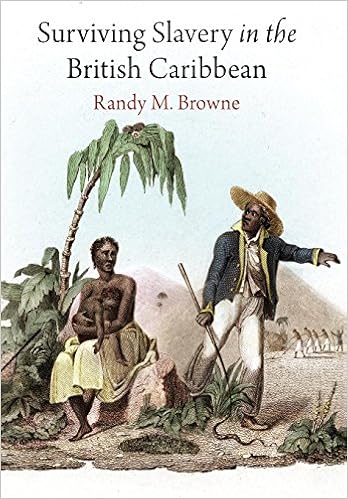
Q&A with Randy M. Browne, author of Surviving Slavery in the British Caribbean

Randy M. Browne is a historian of slavery and colonialism in the Atlantic world, especially the Caribbean. He is an Associate Professor of History at Xaverian University (Cincinnati). Surviving Slavery in the British Caribbean is his first book and he discusses it here with Jessica Parr. Continue reading
Review: Wim Klooster, Revolutions in the Atlantic World: A Comparative History, New Edition

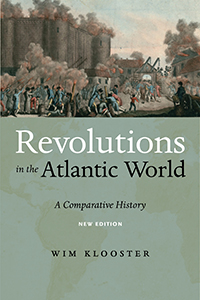
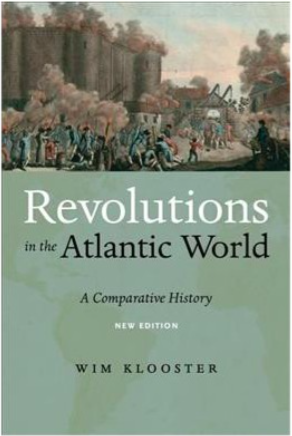
Wim Klooster, Revolutions in the Atlantic World: A Comparative History: New Edition (New York: New York University Press, 2018).

A few years ago, I found myself speaking briefly to a graduate student in another discipline who happened to share both my first and last names. He politely asked what I studied, and I vaguely explained that my dissertation related to the Age of Revolutions. Other Jordan considered this for a moment, and then asked “So what causes revolutions?” I’m embarrassed to say that this most straightforward of questions left me a bit flat footed. I could tell him what several historians thought about the particular revolutions they studied, but “revolutions” more generally? That was a big question. I think I muttered something about Arendt (as you do) and excused myself. Continue reading

Q&A with Wim Klooster, author of Revolutions in the Atlantic World: A Comparative History, 2nd Edition

9781479857173_fullWhen Wim Klooster’s Revolutions in the Atlantic World: A Comparative History was published in 2009, it was one of the first monographs to bring together the American, French, Haitian, and Spanish American revolutions in a single English-language volume. Revolutions in the Atlantic World quickly became a seminal text, finding its way on many Atlantic history syllabi, comprehensive exam reading lists, and on researchers’ shelves. In January 2018, New York University Press released a second edition that incorporates historiography from the past nine years, including scholarship on indigenous peoples and privateers. Tomorrow, Jordan Taylor will have his review of this second edition. Today, The Junto’s Julia M. Gossard interviews Klooster about the book’s second edition, the Enlightenment, and the Age of Revolutions.

Continue reading

Sarah Parker Remond: Black Abolitionist Diplomat

The meaning of the American Civil War has been, and still is, one of the most contentious issues facing the United States today. An aspect of the war that seems to be less spoken about though, was the role of Black women internationally during the Civil War. Wars of the scale of the American Civil War rarely lack an internationalist component. For the already internationalist American abolitionist movement, when the Civil War began in 1861, the abolitionist struggle shifted south with the work of women like Harriet Tubman and Charlotte Forten, but there were still important battles being waged internationally over the war and its meaning.  

The Black woman who took the international abolitionist stage during the Civil War was Salem, Massachusetts’ Sarah Parker Remond. After having been in the British Isles for almost two years prior to the war, Remond’s abolitionist tour expressed a stronger sense of urgency, as the war provided a tangible arena for potential ending of slavery. While doing so, she developed notions of performative citizenship. Performative citizenship was an aspirational basis of struggle for realized citizenship based on Black abolitionist women’s proclamations of African-American identities. Those identities were based on economic and intellectual analyses of the central role their race’s plunder played in American economic growth. Continue reading