 “Had a map been drawn . . . of Mr. Smith’s movements through the streets of New-York. . . a tangled hydra indeed would have been revealed,” begins the second chapter of Francis Spufford’s book Golden Hill (53). As my fellow Junto reviewers have discussed, Spufford’s exhilarating read follows Mr. Smith through the escapades and perils of mid-eighteenth-century New York as he attempts to convince those he encounters of his “credit worthiness.” As he meanders through the tangled web of city streets, Smith’s journey from the island’s southern tip to its northern outposts is filled with adventures and twists at every turn. The reader soon learns that many of the men and women he encounters have secrets to hide. There is much to like about Golden Hill. For this urban historian, one of the most enjoyable aspects is the book’s sense of place. Continue reading
Category Archives: Uncategorized
Golden Hill Roundtable: Courage and Cowardice?
This guest post is the third entry in our week-long roundtable on Francis Spufford’s novel, Golden Hill. Its author is Hannah Farber, an assistant professor at Columbia University. Her scholarship has appeared in the New England Quarterly, Early American Studies and the Journal of the Early Republic; she is at work on a monograph on marine insurance, tentatively titled Underwriters of the United States.
 What a pleasure it is to wander around mid-eighteenth-century New York City with Francis Spufford, admiring the city’s homes with their “stepped Dutchwork eaves” (17) and their “blue-gray pediment[s] of Connecticut pine” (11). What a pleasure, too, to join him in pawing through the humbler artifacts of daily life in the colonial city. Pap (1). Milk punch (42). A bog-wig (2). Every page of Golden Hill overflows with weird stuff like this, and it’s just great. Continue reading
Black Women Intellectuals and the Politics of Dislocation
In light of the recent tragic stories of family separation occurring on the Mexico-United States border, what instantly came to my mind was America’s history of dislocation through American slavery. From the United States’s conception, the place of the country’s Black population, enslaved and free, was centered in debates on who this country was ultimately built for. There were factions that saw slavery as antithetical to the founding principles of “freedom, liberty, and the pursuit of happiness.” During the Revolutionary War, even British orators like Samuel Johnson, clearly saw this dichotomy. In his 1775 pamphlet Taxation No Tyranny: An Answer To The Resolutions And Address Of The American Congress, Johnson juxtaposed the colonist’s “Declaration of Rights,” and equivocated “If [s]lavery be thus fatally contagious, how is it that we hear the loudest yelps of for liberty among the drivers of negroes.”[1] Not all factions of the founding generation decidedly occupied one camp of pro-slavery or anti-slavery though. America’s first and third presidents denoted this friction. Washington and Jefferson’s stories denoted both held surface level anti-slavery positions, yet also owned hundreds of bondswomen and men; very similar to what Johnson characterized. This complication stemmed from the generation’s refusal to resolve the “slavery question” that plagued the new nation. Political compromises, like the counting of enslaved peoples as three-fifths a person, prolonged America’s reckoning, but only temporarily. However, a middle ground emerged by the early 19th century: colonization. Continue reading
“Trans-American Crossings” Conference Recap
Over the weekend, an international group of scholars met on the campus of Brown University to participate in a conference focused on various forms of enslaved migrations throughout the Americas from the seventeenth through the nineteenth centuries. Sponsored by the Omohundro Institute and the John Carter Brown Library, the meeting represented the fifth in a series of conferences about the transatlantic slave trade that have been organized by the OI.
For anyone who couldn’t make it to Providence[1], the panels were live-tweeted and can be found #TransAmCrossings. While the tweets of my colleagues give a great sense of the flow of the conversations over the weekend, what follows here are some of my reflections on the broader questions and themes that drove intellectual exchanges during and after the panels. Continue reading
A Survey of Assumptions
 With spring well underway, many of us are experiencing the satisfaction of marking the last grade on the final blue book of the semester, with an eye toward the approaching summer months and the freedom to work on our own research projects.[1] This makes it a foolhardy moment to entice Junto readers into thinking about teaching the survey, but it also presents an opportunity to reflect on our students and how their backgrounds should shape our approach in the classroom. Continue reading
Review: Craig Bruce Smith, American Honor
Craig Bruce Smith, American Honor: The Creation of the Nation’s Ideals during the Revolutionary Era (Chapel Hill: University of North Carolina Press, 2018).
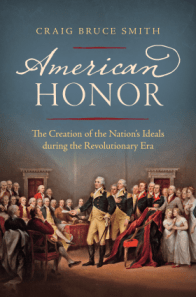 In American Honor, Craig Bruce Smith places morals, virtue, and ethics at the center of the American Revolution. Smith argues that in the late-colonial period, understandings of honor transformed. Instead of something hereditable, honor became based on merit. That “ethical transformation” helped bring about the Revolution. Independence then allowed Americans to realize its potential. In a phrase, you might say the American Revolution was “made on honor, sold on merit.”[1] Continue reading
CFP: The Fourteenth Annual Yale University American Art Graduate Symposium
We are pleased to share the following call for papers for The Fourteenth Annual Yale University American Art Graduate Symposium. Continue reading
Roundtable on How NOT To Write Your Second Book: Kathleen DuVal, “Treating Your Second Book as a Job”
We continue our roundtable on “How NOT To Write Your Second Book” with a post by Kathleen DuVal, Gray Distinguished Term Professor at the University of North Carolina and author of Independence Lost: Lives on the Edge of the American Revolution.
If you are reading this, you probably have a goal for yourself that in a certain number of years from now—say ten—you won’t be saying to yourself or others, “I don’t feel any closer to finishing my second book than I was ten years ago.” But you probably also don’t want to be saying, “All I have done for most of my adult life is to try to work on a book every spare minute, or feel guilty about not working on a book.”
In hopes of keeping either of those from happening, I suggest thinking of the second book as a job. I mean that in two ways. First, (if you really do want to write a second book) researching and writing it should feel like work that is part of your job, work that you have to do. But second, this book should feel like part of your job in that your job is just part of your life, alongside the other important pieces of your particular life. Continue reading
Roundtable: Teaching with a Historical Sense and Respect
This is the first entry in our series on Teaching Amid Political Tension. Today’s post is by Tara Strauch, who is an Assistant Professor of History at Centre College in Danville, KY. You can find her blogging at Teaching United States History, and Centre Trail (where she will soon also have podcasts.) Find her on Twitter @historian_tara.
I teach at a small liberal arts college in Kentucky. Like many academics, I spend most of my time teaching, thinking about teaching, and mentoring. I genuinely enjoy my students; they are smart, thoughtful, engaged, and generally eager to learn new things. And while the past year has been an interesting one to spend on a college campus, my students haven’t seemed remotely surprised about the political, racial, and class tensions that have occasionally swept across campus.
“We lost our appetite for food”: Why Eighteenth-Century Hangriness Might Not Be a Thing
The following post has been cross-posted from an ongoing series about diet and nutrition over at Nursing Clio. I am grateful for permission to re-post it here; if you have time, definitely go read the other blog posts!
In August 2015, Oxford Dictionaries declared that the word “hangry” had entered our common vocabulary. Surely most people living in the twenty-first century have experienced the sense of being simultaneously hungry and angry. During the eighteenth and nineteenth centuries, hunger was also everywhere. A recent NPR essay examines how slaveholders withheld food from enslaved people, such as Frederick Douglass, because hunger gave them greater control over people of African descent. Historian Alan Taylor has written about periods of famine after the American Revolution. During some of these years of food shortages that Taylor describes, Iroquois clan mothers pressured other Native Americans into ceding land because they wanted “peace and food relief,” as they did in 1785 at Fort Herkimer.[1] Hunger has been, and continues to be, a key facet of power relations. Continue reading

