Guest Post: Things Colloquial: Material Culture at the 2013 Conference of the Society of Early Americanists

Today’s guest poster, Zara Anishanslin, is Assistant Professor of History at the College of Staten Island/City University of New York.  She received her PhD in the History of American Civilization at the University of Delaware in 2009, and from 2009-2010 was the Patrick Henry Postdoctoral Fellow in the Department of History at Johns Hopkins University. She’s at work on her first book, Embedded Empire: Hidden Histories of Labor, Landscape, and Luxury in the British Atlantic World (Yale University Press, forthcoming).  Embedded Empire uses a single object—the portrait of a woman in a silk dress—and the four people who made it (the textile designer, the silk weaver, the colonial merchant’s wife, and the painter), to tell transatlantic material histories that challenge traditional narratives of emulative consumption.  She also serves as Co-Chair of the Seminar in Early American History and Culture at Columbia University.

Savannah is one of those southern cities where historic atmosphere and charm drape over everything like Spanish moss on live oaks. But amidst all this atmospheric charm, one of the sights I remember most was a distinctly uncharming thing: the desiccated body of a dead squirrel on a tray, tucked away in the attic of the Davenport House. I visited iconic Davenport House because it was the site of the Material Culture Colloquium at this year’s Society of Early Americanists’ conference.  (For a report on the conference, see Rachel Herrmann’s blog post).

Continue reading

Junto March Madness: Round One Results

The following are results from the first round of voting. Thanks to everyone that participated! Each matchup received an average of 170 votes, so we are pleased with the turnout. After listing the results, I’ll ask some questions and then hope to get some discussion in the comments.

Round Two starts tomorrow! Continue reading

Junto March Madness Round 1, Day 2: Brackets 3 and 4

The first day of voting, which included the first round of brackets one and two, is found here. Results for yesterday’s and today’s voting will be announced tomorrow. Just like the first post, this will include a handful of quick takes on the brackets in question, followed by voting. For the entire brackets, and overall rules, see here.

Please add your answers to the questions, as well as any general thoughts on today’s brackets, in the comments. Continue reading

Junto March Madness Round 1, Day 1: Brackets 1 and 2

Michael Buffer placed his money on a Morgan vs. Brown championship match.

Michael Buffer placed his money on a Morgan vs. Brown championship match.

The time for predictions is past; the time for voting is now.

(For the entire bracket, as well as an overview of the tournament, see here.)

At the end of this post, you will have the opportunity to vote on all the first round match-ups from Brackets 1 and 2. We would ask that everyone votes just once, though we encourage you to get friends, family, and people using the computers next to you to vote as well. Voting will close at midnight, eastern time. Continue reading

The Week in Early American History

TWEAHI’d like to start this week’s roundup by reminding everyone that the Junto March Madness begins tomorrow. In case you live under a rock (or—shudder at the thought—have a life outside books and blogs), we here at The Junto are combining two of our favorite things: basketball and historiography. On Thursday, we asked readers to nominate five books each to help fill out NCAA tournament-style brackets. One three-hour Google Hangout later and the brackets were set. Check here for a full explanation of Junto March Madness  and here to download the brackets. Voting in Brackets 1 & 2 begin tomorrow and will continue through subsequent rounds into next week (see John Fea’s predictions here).  I cannot stress enough that this should not be taken too seriously (particularly the “seedings”). The primary purpose of it—unlike the actual NCAA tournament—is not to find a winner; it is to spark discussion between the blog members and our readers.
Continue reading

The Junto March Madness: The Bracket Is Here!

Today is the day you’ve all been waiting for with eager anticipation–the official unveiling of the Junto’s March Madness bracket! Thank you to all who nominated books yesterday–this whole project wouldn’t have been possible without it.

The response to yesterday’s call for nominations was overwhelming, with over 150 books receiving nominations, and over half of those receiving more than one mention. As such, The Junto’s Selection Committee had a difficult task whittling down the nominees to a bracket of 64, and an even tougher time organizing it into something resembling the NCAA tournament.

Continue reading

The Junto March Madness: Nominating Books for the Early American History Brackets

What happens when you mix early American history nerdyness with basketball geekyness? Junto March Madness!

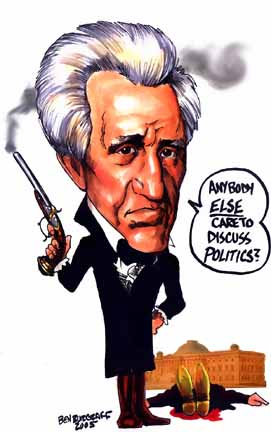
Jackson would obviously have won any physical competition, likely by cheating, but will any books dealing with Jacksonian America win the historiographical tournament?

Jackson would obviously have won any physical competition, likely by cheating, but will any books dealing with Jacksonian America win the historiographical tournament?

In honor of the NCAA Tournament games tipping off in a few hours, and in reaction to the recent announcement of Bancroft Prize winners (which tragically did not include any book explicitly dedicated to early America), we here at the Junto decided to jump in on the competition atmosphere with brackets of our own: a several-bracket-tournament of books in early American history. Today, we submit competitors. The Junto team will then narrow the field to either 32 or, if we get enough submissions, 64, and rank them in brackets. (The organization of brackets is still up in the air—we could go with thematic regions like political, cultural, religious, and synthetic, or we could even go chronological with colonial, revolutionary, early republic, or Civil War-era, or we could even go with histiographical eras—and largely depends on the submissions. We are very open to suggestions, though, so please chime in in the comments!)

IMPORTANT NOTICE: The beauty of this competition depends on being fun, so the first and most important rule is not to take it too seriously. Deciding the winner is purely subjective and based on what are likely a widely variegated criteria of excellence including, but not limited to, most influential, best-written, most sophisticated, or even most popular. When in question, go with your gut reaction. Or, just go with your favorite. A debate between Laurel Ulrich’s A Midwife’s Tale and Eric Foner’s The Fiery Trial is, of course, silly, because both books can be categorized as the top of the field yet they examine completely different issues through very different approaches. But it is, nonetheless, fun to compare, debate, and, indeed, vote. This is designed to be fun, people, so once again: DO NOT TAKE THIS SERIOUSLY. (But we still expect the winner to add this great accolade to the top of her/his C.V.) Continue reading

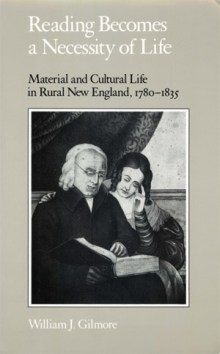
Reading Becomes a Necessity of Life

cover

William J. Gilmore’s Reading Becomes a Necessity of Life is an odd book. Published by University of Tennessee Press in 1989, it was not particularly well reviewed—its oddness frustrated readers. Gilmore set out to “learn how the American version of modern civilization began to influence the lives of the overwhelming majority of rural Americans” by making a fine-grained, comprehensive study of the reading, purchasing, and—less comprehensively—thinking habits of the people who lived in the Upper Connecticut River Valley between 1780 and 1835 (xx). Along the way, there are references to contemporary events Iran and Iraq, Isaac Asimov, corn-husking frolics, and the meaning of human happiness. Paul Johnson, with characteristic precision and wit, summarized the book’s problems in his JAH review (September 1990): Continue reading

“The Empire of Romance”: Some Notes on Novels in an Extensive Republic

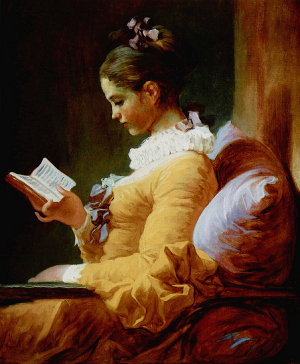
woman-reading-FragonardThe current issue of the Journal of the Early Republic includes Andrew Cayton’s SHEAR presidential address on the novel’s place in the postrevolutionary Atlantic world: “The Authority of the Imagination in an Age of Wonder.” The essay makes a case for the usefulness of period novels to early-republic historians. Cayton gives us three reasons novels are useful as historical sources:

  1. “The people we study paid attention to them.” Novels were significant parts of people’s lives, and they illuminate “the shifting structure of discourse and discourse communities” in early-nineteenth-century America.
  2. “They challenge our preoccupation with categories.” Novels were experiments in defining and redefining people.
  3. Novels reveal that many people conceived of liberty socially, “as a voluntary location of one’s self within overlapping social networks” (25-26). [1] Continue reading

Policy and Constitutional Principle

As a Brit teaching early American history in the US, I’m often asked how I came to be fascinated by the American Revolution. My answer is generally some version of the following: I’m fascinated by the American Revolution because there are so many reasons why it shouldn’t have ended with the creation of an American republic. Not only was the notion of independence from Britain a daring and risky move, but there were many reasons why the North American colonies could not cohere once they had broken with the mother country. Investigating the ways in which Americans tried to bridge the many gaps between themselves to create powerful and lasting governmental structures is one of the key themes of my research.

A large part of the answer to that conundrum, at least once historical focus shifts to the early republic, is the Constitution. Though, as I have written elsewhere, the mechanics of writing and ratifying the Constitution were scarcely the pristine and perfect process of popular imagination, the longevity of the Constitution must rank as one of the most significant achievements of the revolutionary era. Yet a close look at pretty much any period of American history sees the Constitution wielded as a partisan weapon as often as it is venerated as a ligature holding the separate states together. That is a curious paradox, for there is an implicit and serious criticism in describing a governmental act as “unconstitutional.” It suggests a lack of patriotism and a lack of common feeling; it implies mistrust, rather than emphasizing shared responsibility. Continue reading