 A few months ago, a New York Times investigation uncovered the secret economies of social media bots. C-list celebrities such as Paul Hollywood, John Leguizamo, and Michael Symon, purveyors of “fake news,” and several businesses have boosted their Twitter profiles by purchasing fake follower “bots” and retweets from these accounts. The Times estimated that perhaps as many as 48 million Twitter accounts are bots, with around 60 million similar accounts on Facebook. Continue reading
The Month in Early American History
 Rise and shine, it’s time to relaunch our regular(ish) roundup of breaking news from early America. To the links!
First up, enjoy a walk through life after the American Revolution with this podcast series charting the life and times of William Hamilton of The Woodlands, who “made the estate an architectural and botanical showpiece of early America.” Or put presidential parades in historical context, via Lindsay Chervinsky’s essay on George Washington’s reticence for public pomp and grandeur: “Why, then, did Washington, a man intensely proud of his military service and revered for it, reject the trappings of military honor?” In conference news, the Omohundro Institute of Early American History and Culture unveiled the program for next month’s meeting. Elsewhere in the blogosphere, check out John Fea’s reflections on a decade(!) of posting, and what it means to teach “Public History for a Democracy.” Or flip through the newly digitized papers of polymath Benjamin Franklin. Continue reading
Guest Review: Benjamin Park, American Nationalisms
Skye Montgomery is a historian of the nineteenth-century United States, specializing in Anglo-American relations and the transformation of American national identity. She is currently completing a postdoctoral fellowship at the Kinder Institute on Constitutional Democracy at the University of Missouri-Columbia. Skye earned her DPhil in History at Corpus Christi College, Oxford, and is revising a book manuscript entitled, Imagined Families: Anglo-American Kinship and the Formation of Southern Identity, 1830-1890.
Benjamin E. Park, American Nationalisms: Imagining Union in the Age of Revolutions, 1783-1833 (New York: Cambridge University Press, 2018).
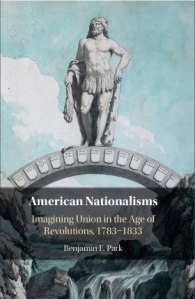
In his seminal 1882 lecture, Ernest Renan posed the deceptively straightforward question, “What is a Nation?” Although recent historiography is generally more concerned with answering the adjacent questions of how and why nations come to be, scholars of European history have produced myriad reflections on Renan’s question in the decades since the Second World War. In contrast, however, histories of early America taking nationalism as their primary category of analysis have been relatively few and focused primarily upon understandings of nationalism yoked to the nation-state. Benjamin Park’s new volume, American Nationalisms: Imagining Union in the Age of Revolutions, 1783-1833, offers a convincing explanation for this omission and makes commendable strides towards rectifying it. Continue reading
Q&A: Benjamin Park, author of American Nationalisms
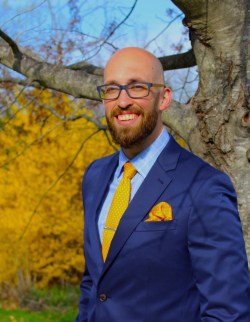 Today’s interviewee hardly needs introduction for readers of The Junto. Ben Park is an assistant professor of history at Sam Houston State University in Texas; he earned his PhD in Britain’s second-best history department, at Cambridge University; and went on to hold a postdoctoral fellowship at the Kinder Institute on Constitutional Democracy. Far more importantly, of course, he is also the founder of this blog, and author of the recent monograph American Nationalisms: Imagining Union in the Age of Revolutions, 1783-1833 (Cambridge University Press, 2018). Ahead of our review of the book tomorrow, I asked him a few questions about it. Continue reading
Geographies of Power on Land and Water: Space, People, and Borders
 I recently spoke at an event for Early Career Researchers hosted jointly by the British Group in Early American History, the British American Nineteenth Century Historians, and the Institute of Historical Research about funding initiatives for Americanists based in the UK.[1] I was there to talk about applying for and winning a networking grant (in the UK, it’s called a “networking scheme grant,” which I LOVE because it makes me feel extra sneaky) with my co-investigator, Jessica Roney. On the assumption that some of the advice I offered there might be helpful to our readers, I wanted to rehash some of those ideas in a blog post here today.
But first, I must rant a little bit about the state of immigration in the United Kingdom—a problem not unique here, by any means, but one of relevance to non-British Americanists working in the UK. Continue reading
A President, a Cardinal, and a Soldier walk into a bar…
The Council, Episode One: The Mad Ones by Big Bad Wolf [PC, PS4, XBOX One]
[NB: This article contains significant story spoilers for the first episode of the video game The Council by Big Bad Wolf]
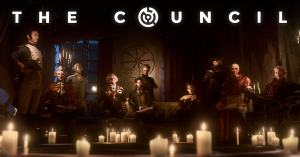
What if John Adams had a secret, occult daughter with a period inappropriate haircut?
This is one of the central plot points of the first episode Big Bad Wolf’s historical episodic video game The Council. Set in 1793 the player takes control of a twenty-something blank slate with a cool jacket, named Louis de Richet. Louis is seeking to uncover a mystery relating to Sarah, his ice queen secret agent mother. Invited to a “private island” off the English coast by Lord Mortimer, a British aristo whose aesthetic is a Regency Bond villain mixed with Eyes Wide Shut, Louis is works to uncover why Sarah vanished from one of Mortimer’s smashing shindigs. Mortimer’s shtick, you see, is hosting gatherings of the best and brightest of the late eighteenth century Euro-American world. Once Louis arrives at Mortimer’s latest fete that you discover just how vast The Council’s world is, for guess who is waiting for you by the fire?
None other than George Washington, a historical figure who our readers are likely quite familiar with. Continue reading
Q&A with Daniel Livesay, author of Children of Uncertain Fortune: Mixed-Race Jamaicans in Britain and the Atlantic Family, 1733-1833
 Daniel Livesay is Associate Professor of History at Claremont McKenna College in Claremont, CA. His research focuses on questions of race, slavery, and family in the colonial Atlantic World. His first book, Children of Uncertain Fortune: Mixed-Race Jamaicans in Britain and the Atlantic Family, 1733-1833 was published in January 2018 by the University of North Carolina Press for the Omohundro Institute. Casey Schmitt reviewed it yesterday here at The Junto. Daniel’s research has been supported by an NEH postdoctoral fellowship at the Omohundro Institute of Early American History and Culture, the Fulbright Foundation, the Institute of Historical Research, and the North American Conference on British Studies, as well as number of short-term fellowships. He is currently working on a book manuscript about enslaved individuals of advanced age in Virginia and Jamaica from 1776-1865 entitled, Endless Bondage: Old Age in New World Slavery. He graciously agreed to sit down and answer a few questions about his research.
Continue reading
Review: Atlantic Families, Race, and Empire
Daniel Livesay, Children of Uncertain Fortune: Mixed-Race Jamaicans in Britain and the Atlantic Family, 1733-1833 (Chapel Hill: University of North Carolina Press published for the Omohundro Institute of Early American History and Culture, 2018).
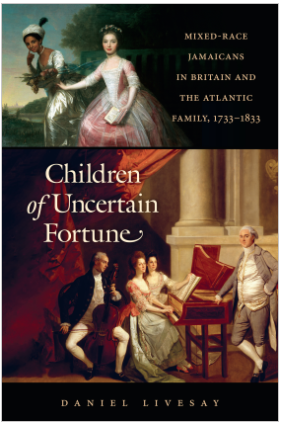 A central thread running through Daniel Livesay’s Children of Uncertain Fortune is deceptively simple: Atlantic families structured the development of ideologies surrounding race in the British empire during the long eighteenth century.[1] Woven through the book, however, is a richly nuanced exploration of what terms like Atlantic, family, race, and empire meant and how understandings of those terms changed over a pivotal hundred-year period starting in the 1730s. Through institutional records and family papers produced on both sides of the Atlantic, Livesay identifies 360 mixed-race people from Jamaica and traces the lived experiences of a handful of them as they navigated their social and economic position within transatlantic kin networks. Those individual narratives reveal how Britons experienced empire through family ties in ways that shaped their perceptions of race, colonialism, and belonging. Continue reading
How I Learned to Stop Worrying and Embrace Presentism

I’m trained as an early American historian, so I never anticipated that one day I’d teach a current-events course. And yet, in Fall 2017, I debuted a course called “Learning from the Past: Early America in the 21st Century.” New to my department, I had to market an early American studies course that would draw enrollments, and the best method I could think of was to convince students that the early American past had relevance to their lives. In graduate school, some of my professors argued that historians should not engage in presentism—that it would make our work seem dated to future generations of scholars. But our own political moment—I started teaching two weeks after far-right protests converged around Confederate monuments in Charlottesville—felt too urgent not to let our own moment into our discussions of the past. Instead of keeping the present in the subtext of my class, I brought it into the text. Continue reading
Why We Doubt Capable Children: Constructing Childhood in the Revolutionary Era
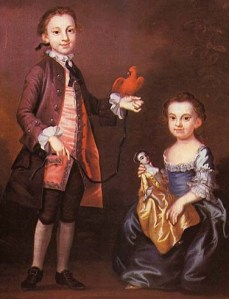 “My friends and I might still be 11, and we might still be in elementary school, but we know . . . that we have seven short years until we too have the right to vote.”[1] Speaking at the March for Our Lives event, 11-year old Naomi Wadler eloquently reminded us that childhood is ephemeral. Since they are future voters, she warned Capitol Hill to take the words, emotions, and pleas of children seriously. In many ways, she was also speaking to Florida State Representative Elizabeth Porter who recently exclaimed, “The adults make the law because we have the age, we has [sic] the wisdom, and we have the experience.”[2] For many like Rep. Porter, there has been something disturbing in this moment of youth activism. It cuts to the core of social stability based on the patriarchal family order—that children are subordinate, passive members of society. We inherited this idea from the eighteenth-century revolutionary era, a point in time when age became a main determinant in who could be considered a citizen and an adult. Continue reading

