Today’s guest poster, William S. Cossen, is an Atlanta-based historian of the nineteenth- and twentieth-century United States, specializing in the intersection of religion and nationalism. He serves as the book review editor for H-SHGAPE (Society for Historians of the Gilded Age and Progressive Era) and am a member of the faculty of The Gwinnett School of Mathematics, Science, and Technology, the top-ranked public high school in Georgia. Cossen received his PhD in History from The Pennsylvania State University and is currently revising a book manuscript entitled, Making Catholic America: Religious Nationalism in the Gilded Age and Progressive Era.
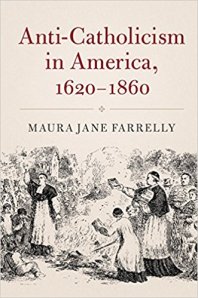 Whether John Higham was correct in describing anti-Catholicism as the “most luxuriant, tenacious tradition of paranoiac agitation in American history” is a matter of debate.[1] Not as disputed, though, is the reality that, until relatively recently, a great many Americans did view Catholicism as one of the principal threats to liberty and order in the United States. Maura Jane Farrelly’s masterful new volume, Anti-Catholicism in America, 1620-1860, traces the development of anti-Catholicism in the United States (or what would eventually become that country) from the establishment of Plymouth Colony to the coming of the Civil War. Farrelly’s work is at once a survey bringing together several decades of scholarly work on American religious, social, and political history, and an impressive example of primary-source research in its own right. For Farrelly, a professor of American studies at Brandeis University, the history of American anti-Catholicism extends beyond questions of religiosity, instead encompassing the meaning and composition of the nation. As she explains in the book’s introduction, “Any understanding of anti-Catholicism…requires us to interrogate the meaning of American freedom and, by extension, the promise of American identity.”[2] Continue reading →
 Hey, remember us?
 Greetings, faithful readers.
 BGEAH (British Group of Early American Historians), BrANCH (British American Nineteenth Century Historians) and HOTCUS (Historians of the Twentieth Century United States) are pleased to invite participation in a new survey exploring the conditions of study, recruitment and employment within the field of American history as practiced in the UK.
  I’ve had a blog, in one place or another, since 2002, and thus the distinction between “a blog” and “a blog post” is a hill on which I am willing to die. But before Ben Park approached me to be one of The Junto’s founding members, I hadn’t blogged extensively about history. Five years later, I still want to write about other topics in addition to history, but I firmly believe that my history teaching and history scholarship have benefitted from my membership here. That said, I think my role as a blogger for The Junto has changed since 2012, and will continue to transform in the future. Today, I want to reflect on some of these changes.
  Five years ago, The Junto was born. The immediate context was parochial: as a PhD student studying early American history at the University of Cambridge, I was lonely for fellow scholars. But the niche the blog filled was much more broad: there was a need for a digital space to serve as a hub for early American scholarship. The reception we’ve since received, and the readership we still welcome, has been overwhelming. The blog’s success is indicative of our field’s vibrancy.