 Hello and welcome to another slightly belated Week in Early American History!
Announcing the Junto Summer Book Club
 With summer upon us, many of us are turning our attention to reading lists, whether for upcoming graduate exams, syllabus preparation, research, or pleasure. For many, it’s an opportunity to catch up on new work that sat neglected during the push through the final weeks of the semester and exams, but it’s also an opportunity to return to more classic books that have shaped the field and deserve reconsideration. Plus, we at the Junto love nothing more than to discuss and argue about history. Therefore, we would like to introduce a new feature: the Junto Summer Book Club.
Guest Post: Is There a Revisionist Doctor in the House?
Carl Robert Keyes is a newly tenured Associate Professor of History at Assumption College in Worcester, Massachusetts. He is currently working on a book about advertising practices and consumer culture in eighteenth-century Philadelphia. An earlier version was delivered at the induction ceremony for the Phi Alpha Theta chapter at Framingham State University in April, 2014.
 Earlier this month I finished teaching my first public history course. I’ve long been concerned about how professional historians, especially academic historians, (often don’t) communicate with the public and, in turn, the general public’s misunderstanding of the historian’s craft. Teaching a public history course made these apprehensions central to my work in the classroom. My students and I grappled with a different kind of historiography, a less formal historiography consisting of public opinion, incomplete recollections of elementary and secondary history education, and a “master narrative” that usually dominates stories of the American past told by many public figures, a narrative steeped in patriotism, heritage, and commemoration. More than ever, I found myself challenging my students (in all my classes, not just the public history course) to take a three-part approach in their studies: learn about the past, learn about how professional historians have interpreted the past, and learn about how the general public understands the past. This became yet another way to demonstrate that course content has relevance outside the classroom and beyond the semester.
Guest Post: Authors, Athletes and Law’s Privilege
Today’s guest post is from Nora Slonimsky, a doctoral candidate in history at the CUNY Graduate Center. Her dissertation is on the relationship between literary property and politics in the Early Republic. She has previously blogged for the New York Public Library. For the 2013-2014 academic year Nora was co-chair of the CUNY Early American Republic Seminar.
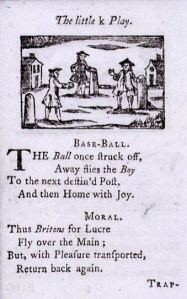 As most graduate students experience first-hand, the relationship between universities and unions can be complex. Our position as students, employees or a combination of the two varies largely by institution, particularly by whether or not our universities are public or private. However, if you’re a Division One football player with a potential NFL career in your future, the construct of a student-athlete underscores a specific question about the nature of labor in higher education. For those who participate in collegiate sports, are academic scholarships a privilege or a right, a special acknowledgement of their abilities on the field or a form of compensation for service to their institutions? Yet the tension between privileges and rights is as much about intellectual activity as it is about physical skills, dating all the way back to Andrew Law’s Privilege of 1781.
The Week in Early American History
Happy Memorial Day to our readers in the United States. This week’s links begin with reminders about the origins of the holiday. Continue reading
Taking Print from Print Culture & Leaving the Public Sphere Behind
Or how to make a causal argument about print, media, and communication in the eighteenth century
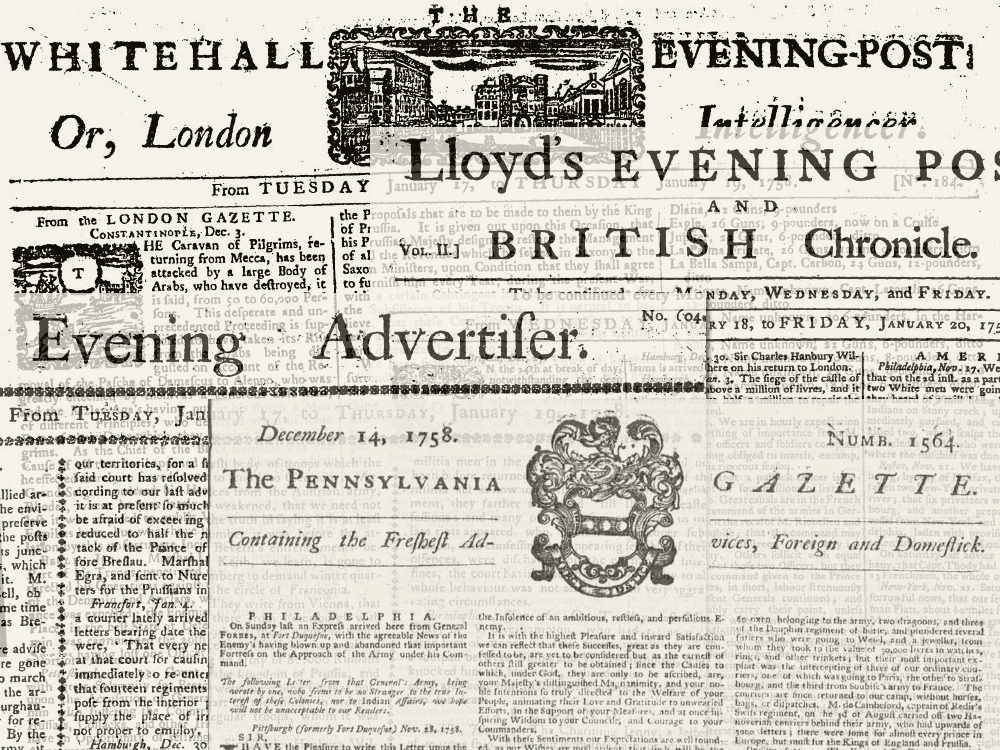 This post began as a brief response to Tom’s recent piece on the public sphere and to the conversation it generated in the comments section. As it turns out, brevity is not my strong suit, and I’ve got a few bones to pick. So all cards on the table: I’m more than a little invested in the importance of communication; I have a hard time watching print be stripped of its mechanistic or causal role; and I don’t believe we can possibly ever argue that changes in media didn’t cause social and political change.[1] Continue reading
Triggers in the Past
 Over the past few weeks, a discussion about trigger warnings has percolated across the blogosphere. Educators, op-ed columnists, and pundits have debated the use of these warnings about potentially upsetting content on syllabi or in the classroom (and leave it to the Chronicle to publish a disdainful mockery of the concept). As I’ve developed my courses, both at the survey and upper levels, I have confronted some of these same questions about the past: Is there anything in history from which we should shield our students? Or, to put it more broadly, how should we approach material that some of our students may find offensive, hurtful, or painful?
Herb Sloan’s Contributions to Scholarship on Jeffersonian America
 Last Tuesday, May 13, the Columbia University Seminar on Early American History and Culture and the Department of History hosted an evening in honor of Professor Herb Sloan of Barnard College. Herb, who is retiring this spring after 28 years as a member of Barnard’s history faculty, was the guest of honor at an evening commemorating both his contributions to the field of early American history, as well as a roundtable discussion on “Jeffersonian America.” Continue reading
Early America at the Berks
 Later this week, thousands of women’s and gender historians will convene in Toronto for triennial meeting of the Berkshire Conference on the History of Women. The Berks lineup attests to the vibrancy of scholarship in early American gender history. To help you navigate the 198-page conference program, we thought we’d spotlight panels with papers on early America and the early modern Atlantic World. Continue reading
The Week in Early American History
You’ve worked hard all week. Your reward? Links, of course… Continue reading
 The Junto