 In all the teaching orientations and training manuals I’ve encountered, they all advise instructors not to be afraid of silence. The average student, they say, takes up to 8 seconds to mentally prepare an answer to an analytical query. But what happens when the silence isn’t because students are choosing which of their brilliant thoughts to share with the class but because most of them failed to do the reading? I suspect every college teacher has had a class session in which most questions were met with complete silence. What can we, as the instructors, do in such situations? And how can we better incentivize students to take their assigned reading seriously? Continue reading
The Week in Early American History
 Welcome to another of The Junto‘s weekly round-ups of things that caught our eye in the rest of the Internet this week. Find the links after the jump! Continue reading
Guest Post: Weather Talk
Today’s guest post comes from Cambridge Ridley Lynch, a PhD student at the Graduate Center, CUNY. She is currently working on a project that links American weather study with larger shifts in American science and politics.
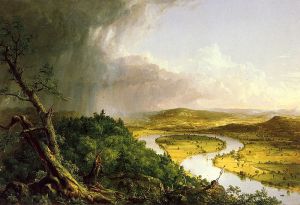
In their recent recap of the MCEAS’ “Traces of Early America” conference, Sara Damiano and Michael Blaakman spoke of the need to examine “processes, events, ideas, and dynamics that subsequent history has largely obscured, and that often pose significant evidentiary problems for those who wish to write about them.” Clearly, the work presented at the conference did much to flesh out adumbrations left throughout the historical record, often by focusing on close reading of specific events, personages, and texts. But what about a factor that is so ubiquitous so as to hardly be thought of at all, one that every single person in a historical moment and place experiences at the same time, and yet goes largely unremarked upon in historical texts? Naturally, I’m talking about the weather. Continue reading
Historical Heroes
 I don’t like Abraham Lincoln. Working in Springfield, Illinois, that’s not an especially popular viewpoint to hold. Yet it is working in Springfield, Illinois, that has really led me to that conclusion. It’s almost impossible to escape the shadow of Honest Abe here. Bronze statues sit prominently in downtown; all sorts of programs and buildings at my university bear Lincoln’s name. His face even peers out from every license plate in the state. It’s a historical cult of personality that can feel alienating to a revolutionary specialist.
(Though he does have a good nose for sniffing out dodgy car dealers.) Continue reading
Guest Post: A New Forum Dedicated to the Study of the Dorr Rebellion and Constitutional Reform in Rhode Island
We at The Junto are thrilled to host this guest post from Erik J. Chaput and Russell J. DeSimone, who are the historians-in-residence on the Dorr Rebellion Project Site sponsored by Providence College. Chaput is the author of The People’s Martyr: Thomas Wilson Dorr and His 1842 Rhode Island Rebellion (University Press of Kansas, 2013). DeSimone is the author of Rhode Island’s Rebellion (Bartlett Press, 2009). Chaput and DeSimone have collaborated on a number of projects, including this article on Common-place.org. Chaput and DeSimone welcome feedback on the site. They can be contacted at: echaput@providence.edu and russbook1@cox.net.
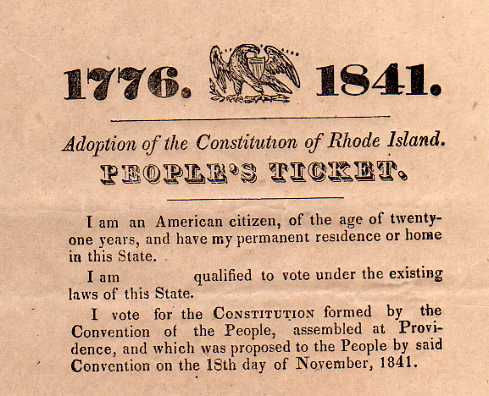
The “People’s Ticket,” with a direct reference to 1776, served as a connection between the American and Dorr Rebellions.
When Rhode Island finally ratified the U.S. Constitution in May 1790, the state sent back to Congress eighteen amendments. These amendments revealed a deep suspicion of the new central establishment, a suspicion that had been increased by the failure to include a bill of rights. The first line of the lengthy third amendment declared that “the powers of government may be reassumed by the people, whensoever it shall become necessary to their happiness.” Continue reading
Epilogue or Prologue? The Royal Proclamation Turns 250
 If you’ve heard of the Royal Proclamation of 1763, it’s probably in the form of the “Proclamation Line,” the imaginary line of masking tape across the Appalachian Mountains dividing English colonists along the coast from native populations in the interior of North America. According to a group of historians gathered at the Old State House in Boston this past Friday, it may have far greater significance. (Or not.)
The Week in Early American History
 Thanks to the United States Congress, it’s been a good week for the Founders—or a bad one, depending on your point of view. Continue reading
New Horizons @ AAS
 Happy American Archives Month! This week, The Junto spoke with Molly O’Hagan Hardy, Digital Humanities Curator and ACLS Public Fellow at the American Antiquarian Society. Continue reading
Traces of Early America: Conference Recap
Today’s post is a joint effort between two contributors to The Junto: Michael Blaakman and Sara Damiano.
Three years ago, during a graduate-seminar discussion of Prospero’s America, Walter Woodward’s study of Puritans and alchemy, John Demos made a bold and challenging point.[1] After a century or so of professional scholarship, many of American history’s most obvious stories have been told in the ways it seems easiest to tell them. One of the greatest tasks for the rising generation of historians, Demos suggested, is to search beneath the surface of things for stories yet untold—for processes, events, ideas, and dynamics that subsequent history has largely obscured, and that often pose significant evidentiary problems for those who wish to write about them. In other words, the next generation of scholars will have to try harder than their predecessors to ask new questions and to find new methods for wringing answers out of the sources. Continue reading
The JuntoCast, Episode 5: The Constitution
 The Junto is happy to present the fifth episode of “The JuntoCast,” a monthly podcast in which members of The Junto discuss issues of both academic and general interest related to early American history, pedagogy, and public history. Continue reading
 The Junto