 “There are few sights more pleasant to the eye,” wrote Solomon Northup, “than a wide cotton field when it is in bloom. It presents an appearance of purity, like an immaculate expanse of light, newly-fallen snow.” For Quentin Tarantino, such a beguiling simulation of chastity, of endless untroubled whiteness, could merit only one response: blood must be spilt on it. Practically the only scene in which cotton figures in 2012’s Django Unchained comes when an overseer, galloping across a blooming field, receives a rifle shot to the torso. The newly fallen snow of cotton gleams pink with fresh blood. Continue reading
The Week in Early American History
 The biggest early-America news in popular culture this week may be the film adaptation of 12 Years a Slave, which will enter wide release in the US on November 1. In an interview with Terry Gross, director Steve McQueen says he wants Solomon Northup’s story to enter public consciousness the way Anne Frank’s diary has. David Blight discussed it with Terry Gross and recommended 12 Years a Slave as “a very good corrective” to ordinary Hollywood treatments of slavery. In the New Yorker, Annette Gordon-Reed uses the film to discuss some of the opportunities and problems slave narratives present to historians. At Grandland, Wesley Morris describes how the film “presents savagery in civil terms.”
Research in Timelines
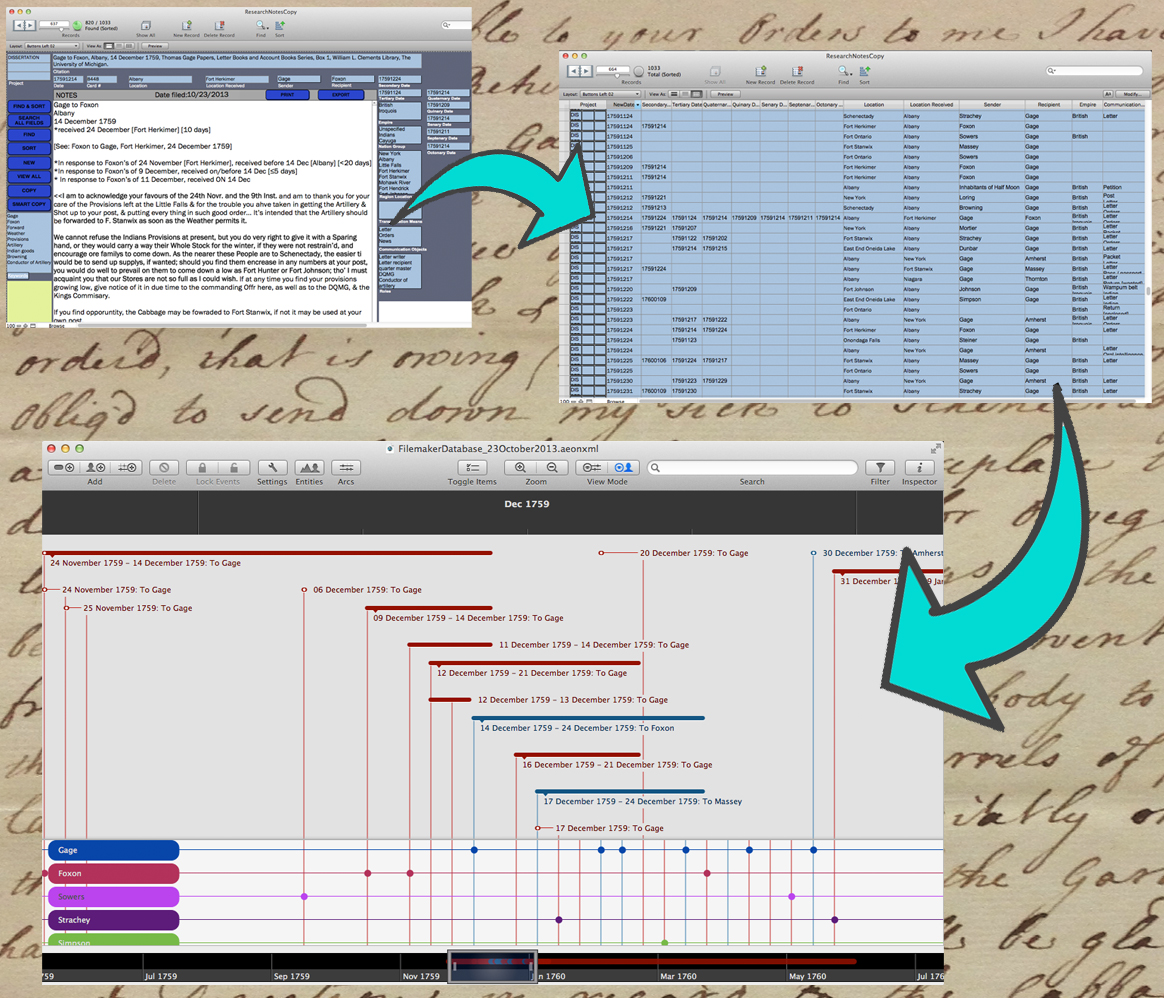 Methodology and note-taking have been popular topics at The Junto, opinions and preferences ranging from Rachel Herrmann’s defense of good-olde-fashioned index cards, to Michael Hattem’s detailed tour of his digital workflow. I’d like to throw my hat into the ring and suggest yet another tool: timeline software.
I’m a visual person, and while a table is technically a “visual,” nothing makes me happier than seeing those rows and columns transform into something a bit more appealing.
Minor admission: I’m years late to the timeline game. But since I began using chronology software this summer—having finally leaped into the archives with little more than a macbook and a dream—my master timeline has become my best friend, my go-to reference guide. Why? Because timelines gives me easy access to, and visualization of, each and every who, what, where, and when of my project. And then some. It’s my very own personalized tool to quickly know (or estimate) where any individual or object in my project is at a given time.
What The Oatmeal Missed
NB: This post was originally published in 2013.
 When did you realize Christopher Columbus was a jerk?[1]
I’m not sure if I actually received the “traditional,” Samuel Eliot Morrison and Daniel Boorstin-inflected education on Columbus, during my child and young adulthood.[2] I remember that my high school history course (c. the early 2000s) sped through Columbus and discussed a bit about his bad human rights record. My excellent college-level history courses, of course, provided the standard explaination, found in virtually every modern textbook of repute, of the Columbian Exchange unleashed by early European exploration and conquests in the Americas.[3] I imbibed, during my childhood, the general story about Columbus in American culture—that “he sailed the ocean blue in 1492” and “discovered” America—but, if there were any lies my teachers told me, it certainly wasn’t about the earliest encounters between Native Americans and Europeans in the Caribbean.[4]
“Charles Beard at 100”: A Roundtable Recap
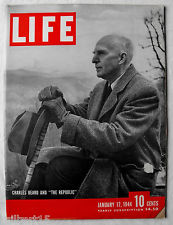 On October 14, Columbia University’s Center for American Studies sponsored the “Charles Beard at 100” roundtable to commemorate the centennial of Beard’s An Economic Interpretation of the Constitution of the United States. The event, organized by Columbia Historian and Director of the American Studies program Casey Blake, featured Eric Foner (Columbia), Jan Lewis (Rutgers), and David Waldstreicher (Temple) as panelists, with Herb Sloan (Barnard) as moderator. The following blog post synthesizes some of the main themes of the roundtable. I hope that many of the excellent points raised by the panelists can serve as a basis for discussion here on The Junto.
The Week in Early American History
 It’s Sunday morning and that means . . . links!
Guest Post: Introducing “The American Yawp”
Today’s guest post comes from Ben Wright, a doctoral candidate at Rice University, who focuses on religious conversion and early American antislavery. He is the co-editor of Apocalypse and the Millennium in the Era of the American Civil War (LSU, 2013), the editor of the Teaching United States History blog, and co-editor of The American Yawp.
 Like many of you, I find myself teaching the first half of the U.S. history survey this fall. The first few times through the course, I used a textbook and appreciated the clear organizational structure and built-in pacing. Teaching with a textbook felt like teaching with training wheels, and I certainly needed them for my first few laps. But as my confidence grew, so did my desire to assign primary sources, articles, monographs, museum catalogs, and other readings. While I am impressed with the quality of many texts – Eric Foner’s Give Me Liberty, and Kevin Schultz’s HIST are among my favorites – I cannot justify assigning an (often outrageously) expensive textbook if it is not going to be the cornerstone of my course. But my course evaluations often include requests for textbooks, particularly among athletes or other students with serial absences. I have tried placing a textbook on reserve, but in the three semesters of doing so, no one has ever checked out the book. It seems like our discipline could use an affordable, synthetic safety net for students who would like one. Continue reading
Guest Post: The Dutch Revolt and New Netherland: 36th Annual New Netherland Seminar
Elizabeth M. Covart (PhD, UC-Davis, 2011) is an independent historian located in Boston, Massachusetts, who specializes in early American history. She also blogs at Uncommonplace Book: An Independent Historian’s Blog and is a Contributing Editor for the Journal of the Early Americas and contributor to the Journal of the American Revolution.
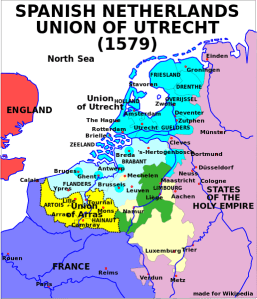
As my book project explores the cultural legacy of New Netherlanders who lived in Albany, NY, I attended the 36th Annual New Netherland Seminar on Saturday, October 5 at the New-York Historical Society. I admit that I attended the conference as an interloper; I study the revolutionary and early republic periods.
Interviews with Historians: Brett Rushforth
 Brett Rushforth is Associate Professor of History at the College of William and Mary, where he teaches courses on the history of early America, American Indians, and comparative race and slavery. He is the co-editor, with Paul Mapp, of Colonial North America and the Atlantic World: A History in Documents (Pearson/Prentice-Hall, 2008), and he currently serves as Book Review Editor for the William and Mary Quarterly. His first monograph, Bonds of Alliance: Indigenous and Atlantic Slaveries in New France was published by University of North Carolina Press for the Omohundro Institute of Early American History and Culture in 2012, and has won several awards, including the 2013 Merle Curti Award in Social History (Organization of American Historians), 2013 FEEGI Biennial Book Prize (Forum on European Expansion and Global Interaction), and 2013 Mary Alice and Philip Boucher Prize (French Colonial Historical Society). It was also recently named a finalist for the 2013 Frederick Douglass Book Prize (Gilder Lehrman Center for the Study of Slavery, Resistance, and Abolition). Dr. Rushforth is currently at work, with Christopher Hodson, on a general history of the early modern French Atlantic. Under contract with Basic Books, its working title is Discovering Empire: France and the Atlantic World from the Crusades to the Age of Revolution. Continue reading
Notes from #BrANCH13
 This last weekend I visited Cambridge’s lovely Madingly Hall to attend the conference for British American Nineteenth Century Historians, or BrANCH. I teach Fridays, so I missed Pekka Hämäläinen’s plenary lecture on Indians, empires, and states in North America. People who attended thought it provided a very nice, sweeping overview of questions in Native American history, and I wish that I’d caught it. Due to “signalling problems” I didn’t make it to the Saturday morning panels, either—so what follows is a reflection on the sessions I attended.[1] Continue reading
 The Junto