 Last Wednesday, the Brown Bag series at the McNeil Center for Early American Studies hosted a conversation with Dallett Hemphill, the current editor of Early American Studies. For those who were not able to attend, we at The Junto wanted to summarize the discussion and invite you to participate.
The Week in Early American History
 Happy weekend, all…to the links! Continue reading
Autumn Reads
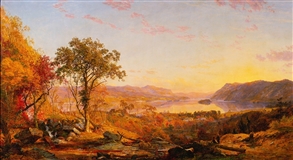
It’s a glorious fall in New England, and that means it’s time to scout out a few good reads for the snowy days ahead. Here’s a sampling of new releases and forthcoming titles in early American history that I plan to check out. What’s on your fall reading list? And what can you recommend for us to review here?
Locating the Literati: Charles Brockden Brown in Philadelphia
 It’s hard to write about early American print culture or intellect without thinking a lot about geography. Scholars like Trish Loughran, Richard John, John Fea, John Brooke, and Mary Kelley have suggested, in all sorts of ways, that it’s often wise to understand “the” early American public as a web of fundamentally local reading and writing publics. Intellectual culture meant something different from what it means in an age of mass media. But tricky questions come up when you try to write a local history of ideas or culture. Just how local can we reasonably go? How much detail can we actually use in an intellectual map of the early United States without getting lost in coincidences and irrelevance?
Enemies Foreign and Domestic
 George Wythe represented the best of the Revolutionary-era Virginia gentry. Wythe, as a law professor, instructed and inspired many of the leading lights of the Patriot movement, including Thomas Jefferson. Wythe was also a racial liberal. After his wife’s death he freed the family’s slaves and even went as far as to adopt and pay for the education of one of their number, a young man named Michael Brown. By the opening years of the nineteenth century Wythe served as chancellor of Virginia’s court of equity where he handed down a monumental decision in the case of Wright v. Hudgins, which held that the burden of proof in cases of runaway slaves rested with the enslaver – not the accused runaway.
Guest Post: On the Past’s Presence: Historians against Slavery
Today’s guest post comes from Nathan Jérémie-Brink, a Ph.D. student at Loyola University Chicago. His current research examines African-American print culture as it relates to religious and antislavery movements. Nathan also currently serves as the new media assistant for Common-place.
 Sept. 19-21, 2013 marked the first annual conference of Historians Against Slavery, at the National Underground Railroad Freedom Center in Cincinnati, Ohio. It is true that very few historians today would endorse John C. Calhoun’s opinion that slavery was in history or is now “a positive good.” Even so, historians rarely consider the valuable role that our research, and our teaching may play in present-day antislavery movements. The fear of presentism remains an obstacle to the historian’s meaningful involvement in modern-day activism. Certainly, historians must avoid anachronistic descriptions of slavery that undermine the specific realities of the early-modern Atlantic world and the early American republic. But there ought to be openness in the academy and in the discipline to let the historical record elucidate comparisons or contrasts between slaveries of the past and the present. Continue reading
Thomas Jefferson’s Qur’an: Islam and the Founders
 I hope that Thomas Jefferson’s Qur’an: Islam and the Founders (New York: A. A. Knopf, 2013) gets picked up for a Fox News segment. Denise A. Spellberg (UT-Austin) has synthesized a large body of scholarship into a readable, teachable, and thoughtful look at the significance of Islam in the American founding era. Conservatives pounced on Spellberg during a dust-up over a novel about Muhammad’s wife a few years ago, and in this book she suggests both that the Founders were occasionally wrong and that some of them believed Islam could have its place in the American polity. So it seems possible to hope that the usual suspects will take notice. She deserves the publicity. Continue reading
The Week in Early American History

In looking at the weeks ahead, I note with some chagrin
That my work remains unfinished though my lectures must begin.
And so instead of planning class, which should engage my time,
I present the Week in History, to YOU! Today! In rhyme!
Howard & Me
Howard Zinn’s A People’s History of the United States changed my life.[1]
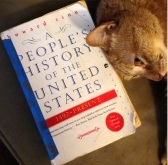
My personal copy of the 2003 edition of A People History of the United States. Also featured: my cat Marshall.
I grew up in very historically minded family. My recollections of my boyhood and tween years are filled with sweaty summer memories of traipsing with my mother and sister through every Revolutionary and Civil War battlefield between the mid-Atlantic and Upper South—from Gettysburg to Yorktown.[2] We regularly took the Orange Line into Washington to go to the National Museum of American History. The History Channel, when we had cable, was a regular fixture on our television.[3] All of this history education was very traditional—all Presidents, bloodshed, and American Exceptionalism.[4] My understanding of American history only became more traditional once I entered a conservative Catholic high school.
On Counting: A Reflection on Quantitative Research
 This summer, I counted. My dissertation, as my Contributor page at The Junto helpfully notes, includes both qualitative and quantitative analysis. And so, to enrich the latter portion of my project, I spent July at the archives, counting. Perhaps more so than most other forms of archival work, counting is an exercise in delayed gratification, the overall picture springing into focus only once the research and subsequent analysis are complete. This meant I had plenty of time to reflect on my methodology as I scanned through microfilm, paged through record books, examined case files, and counted, and counted, and counted. Continue reading
 The Junto