The Plains of Abraham and Annus Mirabilis

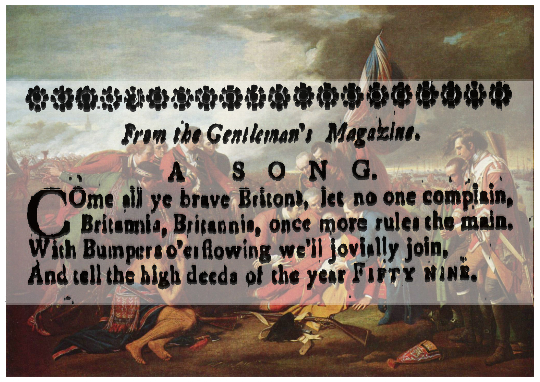
Or, how I came to realize my early America might not be so quintessentially American. Year Fifty-Nine Song

According to my calendar—everyone has alerts set to eighteenth-century military actions, right?—today is the 254th anniversary of the French surrender of Quebec. Forget Constitution Day, this is the hottest event of your week.

Continue reading

“Barbarities, Extortions and Monopolies”

American colonists’ protest against the 1773 Tea Act involved more than just the Boston Tea Party; and it was provoked by more than just a tax. What sharpened the edge of colonial frustration was the short shrift given to American business interests in the balancing-act of imperial administration—and the triumph, by contrast, of the East India Company. American merchants and smugglers were the big losers in a larger effort to bail out the struggling corporation. As John Dickinson put it in his second “Letter from the Country,” the British policy aimed “not only to enforce the Revenue Act but to establish a monopoly for the East India Company, who have espoused the cause of the ministry; and hope to repair their broken fortunes by the ruin of American freedom and liberty!”[1] Continue reading

The Week in Early American History

TWEAHThe semester is in full swing, at least in the United States (hang on, UK readers and Juntoists! It’ll be here before you know it!). And here in New England, after a brutal hot spell midweek, it seems that fall weather has finally arrived.  All of which means we’ve got a busy week to review for you. Without further ado, let’s get on with the links!

Continue reading

Guest Post: Rediscovering the Pamphlisphere

Today’s guest poster is Ariel Ron, who earned his PhD in history at the University of California, Berkeley, and is currently a visiting research associate at the McNeil Center for Early American Studies.
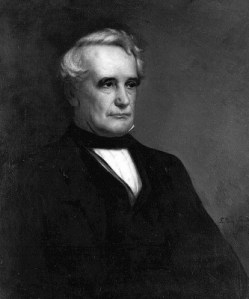
Henry Carey (National Portrait Gallery)

Three or four years ago, while doing research at the University of Pennsylvania’s Rare Book & Manuscript Library, I stumbled upon a lost cache of some ten-thousand pamphlets. I had been browsing the papers of Stephen Colwell, a nineteenth-century ironmaster and writer, when archivist John Pollack called me into the closed stacks behind the reading room. There he showed me Colwell’s personal pamphlet library, neatly bound into hundreds of volumes. The collection also included three thousand works from the library of Colwell’s friend, Henry C. Carey (see picture to right), without question the most important American political economist of the mid-nineteenth century. The sheer size of the corpus floored me. Continue reading

Guest Post: The Problem of Loyalism before the American Revolution

Today’s guest poster is Christopher Minty, a PhD candidate at the University of Stirling. His dissertation focuses on Loyalists in New York. 

Patriots and Loyalists

Over the past four years, I’ve been fortunate enough to work on a group of colonists who would go on to become Loyalists in the American Revolution. My dissertation examines 9,341 future Loyalists during the imperial crisis, 1763–1775, in New York and, essentially, tries to follow their collective paths to either voluntarily signing their name to a declaration, petition and/or subscription list affirming their continued allegiance to the prevailing political order or taking the oath of allegiance. Continue reading

Articles of Note: Spring and Summer 2013

Many months ago, I posted the first of what I hoped to be a quarterly series highlighting recent articles I enjoyed, and inviting readers to do the same. Sadly, life got in the way, and so I have a bit to make up. As a recap for this roundup’s purpose: there are so many journals publishing quality articles in the field of early American history that it is difficult, if not impossible, to keep up. So this list serves as a reminder that you need to catch up on new issues, a identify articles I found especially important, as well as a chance to highlight the work of young scholars and friends. Just because an article doesn’t make the list doesn’t mean I didn’t like it—in fact, I am way behind on my own reading—but it is an invitation to list your own favorite recent articles in the comments below.

The following articles were published between March and September, and obviously reflect my own interests and background. Also, remember the fantastic articles in the special WMQ issue on families and the Atlantic world that I highlighted a few months ago. Continue reading

The Week in Early American History

TWEAH

We’ll start the roundup this week by pointing readers to the recently revamped Teaching United States History blog, which featured a slew of posts over the last seven days. Be sure and check out Ben Wright’s post on teaching students the differences between academic, public and popular history and Blake Ellis’s thoughts on teaching US history in a diverse classroom. Of particular interest to (at least some) readers of The Junto will be Drew Bledsoe’s taxonomy of Civil War history studentsContinue reading

Guest Post: An Academic Bridge Across the Atlantic

Today’s guest post comes from Lauric Henneton, Associate Professor at the Université de Versailles Saint-Quentin and Vice Président of the Réseau pour le Développement Européen de l’Histoire de la Jeune Amérique (REDEHJA). Junto readers: Have you attended the Summer Academy of Atlantic History? Please share your reflections in the comments.

Continue reading

Was The American Revolution A Good Thing?

Readers of early American history blogs will undoubtedly have come across the recent kerfuffle regarding the divide between academic and public historians of the American Revolution, which stemmed from a series of posts by Peter Feinman assessing the conference. Much of the debate has centered around this post, in which Feinman chided academic historians for their failure to answer the question: “Was the American Revolution a good thing?” Roy Rogers posted an excellent response to this here last week; J.L. Bell at Boston 1775 had other reflections on Monday (and is continuing to address the topic in other posts).

Continue reading