Kathleen Duval, Independence Lost: Lives on the Edge of the American Revolution (New York: Random House, 2015).
 When most people think about the American Revolution and its cast of characters, names like Thomas Jefferson, John Adams, and George Washington spring to mind. On the British side, people might think of John André, Benedict Arnold, John Burgoyne, and, sometimes, Lord Dunmore. Though some of these people appear in Kathleen DuVal’s latest book, Independence Lost: Lives on the Edge of the American Revolution, most of DuVal’s narrative centers around people who seldom feature in books or articles on the American Revolution. It is not the American Revolution that most people know. Indeed, “The American Revolution on the Gulf Coast,” DuVal writes, “is a story without minutemen, without founding fathers, without rebels. It reveals a different war with unexpected participants, forgotten outcomes, and surprising winners and losers.” Continue reading


 In October of 1780, the governor of Quebec, Frederick Haldimand, warned against changing the laws and regulations of the British colony. It required “but Little Penetration,” he claimed, to reach the sobering conclusion that “had the System of Government Sollicited by the Old Subjects been adopted in Canada, this Colony would in 1775 have become one of the United States of America.” He continued, “Whoever Considers the Number of Old Subjects who in that Year corresponded with and Joined the Rebels, of those who abandoned the defense of Quebec… & of the many others who are now the avowed well wishers of the Revolted Colonies, must feel this Truth.”[1]
 Revolutionary America was a politicized society. All of the most important conflicts of the American Revolution, from the Stamp Act through Independence to the ratification of the Constitution, were sharply divisive events which demanded citizens take sides. Even neutrals were compelled to give outward displays of support to either patriots or loyalists (often both!). There were very little chances to avoid conflict over such weighty issues—they would reshape and redefine friendships, families, and communities.
  In thinking over my contribution to this roundtable, I realized that, in the last two years, I have written at least five posts and done
  This roundtable grew out of a sense that the study of the Revolution’s origins or causes has been neglected of late. Which seems true enough. At the very least, historians have proven more comfortable talking in more amorphous ways about the “the coming of the Revolution” or “the making of revolutionary America.” I am certainly guilty of that. Yet there are, I think, compelling reasons for approaching the Revolution this way.
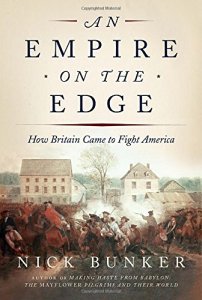 Beyond any new discoveries of evidence and perhaps new technological capacities, every new generation of historians has something unique to contribute to the study of the past—a consciousness of its own time and place. History is written on a tightrope between then and now. Even telling the same story again will always come out differently. Each time you walk the tightrope, there’s a slightly different view. In Nick Bunker’s recent trade book,
  The Junto