 This past semester I taught a course on “18th Century Atlantic Revolutions: America, France, and Haiti,” which included both undergraduate and graduate students. (I wrote about the assigned readings at my personal blog.) I’d like to highlight a central theme that I emphasized throughout the course as a way to discuss historiographical and pedagogical questions.
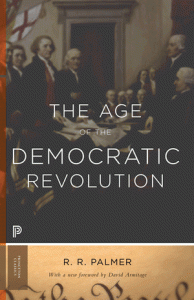
To give my grad students a sense of the field’s starting point, I had them read R. R. Palmer’s classic 2-volume The Age of Democratic Revolution: A Political History of Europe and America, 1760-1800 (1959, 1964; 2014), recently combined and re-published by Princeton University Press. Advancing through the semester and reading much more recent books, the dated nature of Palmer’s book is readily apparent. Most obvious is its avoidance of Haiti. (At an AHA panel on the Age of Revolutions last January, Nathaniel Perl-Rosenthal mention that it’s basically an academic ritual to mention this whenever discussing Age of Democratic Revolution.) Palmer also focuses on high-end (and male-centric) intellectual history, ignores economic interests and intersections, and only engages the nations whose revolutions “succeeded.” This last point is obviously problematic, of course, given what happens in France after their Revolution. But as Janet Polasky’s recent book shows, a more comprehensive view can be gleaned through looking at revolutionary moments that did not have successful outcomes. Like any book published over a half-century ago, even a classic book like Palmer’s, there are plenty of holes to acknowledge. Continue reading
 On Sunday, the United States Postal Service
 John Winthrop (1588-1649) and his son John Winthrop Jr. (1606-1676) are now known primarily as protagonists in the turbulent political history of early America. But in addition to shaping the government and theology of New England as governors of Massachusetts Bay and Connecticut (respectively), they and the rest of the Winthrop family also participated in a transatlantic and inter-generational bookish culture. Long before the Arbella sailed to Boston in 1630 to build a “city upon a hill”, generations of Winthrops began to talk about books, ways to read them and, as we will illustrate here, the difficulties and contingencies of collecting them—on both sides of the Atlantic.
  More than 30 scholars from three continents gathered at the Williamsburg Inn from October 16th through the 18th to present
  Yesterday, Jessica Parr
 The Junto