Articles of Note: Spring and Summer 2013

Many months ago, I posted the first of what I hoped to be a quarterly series highlighting recent articles I enjoyed, and inviting readers to do the same. Sadly, life got in the way, and so I have a bit to make up. As a recap for this roundup’s purpose: there are so many journals publishing quality articles in the field of early American history that it is difficult, if not impossible, to keep up. So this list serves as a reminder that you need to catch up on new issues, a identify articles I found especially important, as well as a chance to highlight the work of young scholars and friends. Just because an article doesn’t make the list doesn’t mean I didn’t like it—in fact, I am way behind on my own reading—but it is an invitation to list your own favorite recent articles in the comments below.

The following articles were published between March and September, and obviously reflect my own interests and background. Also, remember the fantastic articles in the special WMQ issue on families and the Atlantic world that I highlighted a few months ago. Continue reading

Buy, Sell, Read

How did eighteenth-century print networks really operate? This week, The Junto asked Jordan Goffin, Special Collections Librarian at the Providence Public Library, how mapping Rhode Island’s early book trade led to the creation of a new digital atlas. Continue reading

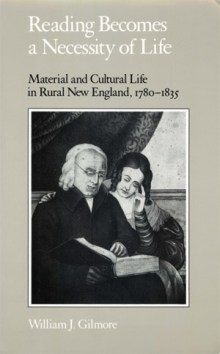
Reading Becomes a Necessity of Life

cover

William J. Gilmore’s Reading Becomes a Necessity of Life is an odd book. Published by University of Tennessee Press in 1989, it was not particularly well reviewed—its oddness frustrated readers. Gilmore set out to “learn how the American version of modern civilization began to influence the lives of the overwhelming majority of rural Americans” by making a fine-grained, comprehensive study of the reading, purchasing, and—less comprehensively—thinking habits of the people who lived in the Upper Connecticut River Valley between 1780 and 1835 (xx). Along the way, there are references to contemporary events Iran and Iraq, Isaac Asimov, corn-husking frolics, and the meaning of human happiness. Paul Johnson, with characteristic precision and wit, summarized the book’s problems in his JAH review (September 1990): Continue reading

About a Book

allen_bible_tp

Ceci n’est pas une book.

She was encased in stolen books, buried in them as if in dirt. The thought of the countless hundreds of thousands of names that surrounded her, vainly scrawled in top right-hand corners – the weight of all that ignored ink, the endless proclamations that this is mine this is mine, every one of them snubbed simply and imperiously….The ease with which those little commands were broken.

She felt as if all around her, morose ghosts were milling, unable to accept that the volumes were no longer theirs.

China Miéville, The Scar

So, on the heels of Christopher’s eloquent framing of the questions of historical distance, a material-texts take on the joys of negotiating that distance by using dead people’s books: Continue reading

“Anonymous and Cacophonous Pleasures”

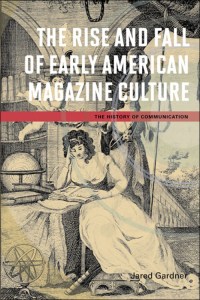
Jared Gardner, The Rise and Fall of Early American Magazine Culture. Urbana, Chicago, and Springfield: University of Illinois Press, 2012.

jaredgardner-riseandfallAlmost by definition, studying communications media means examining the nature of rationality and the meaning of citizenship. So literary historians generally see the novel, which privileges dialogue and individual subjectivity, as helping to constitute a liberal social order, while political historians see newspapers as essential to various expressions of republicanism and democracy. In The Rise and Fall of Early American Magazine Culture, Jared Gardner contributes to the history of American citizenship by arguing that early-national American literary intellectuals mostly had their minds on a different print medium – and that they embraced a neglected model of rational public discourse.

Continue reading