 I hope that Thomas Jefferson’s Qur’an: Islam and the Founders (New York: A. A. Knopf, 2013) gets picked up for a Fox News segment. Denise A. Spellberg (UT-Austin) has synthesized a large body of scholarship into a readable, teachable, and thoughtful look at the significance of Islam in the American founding era. Conservatives pounced on Spellberg during a dust-up over a novel about Muhammad’s wife a few years ago, and in this book she suggests both that the Founders were occasionally wrong and that some of them believed Islam could have its place in the American polity. So it seems possible to hope that the usual suspects will take notice. She deserves the publicity. Continue reading
Tag Archives: religion
The JuntoCast, Episode 4: Religion in Early America
 The Junto is happy to present the fourth episode of “The JuntoCast.” In case you missed our first three episodes, “The JuntoCast” is a monthly podcast in which members of The Junto discuss issues of both academic and general interest related to early American history, pedagogy, and public history.
In this month’s episode, Ken Owen, Michael Hattem, and Roy Rogers discuss religion in early America, including its relationship to the American Revolution, historiographical developments, and, being the history nerds that they are, which 18th-century Protestant denomination’s theology best represents each panelist’s pedagogical style.
You can click here to listen to the mp3 in a new window or right-click to download and save for later. You can also subscribe to the podcast in iTunes.
The Week in Early American History
 It’s been an exciting week for history in the news. First, we learned that Karen Nipps has discovered buried treasure in Harvard’s Houghton Library–650 signatures of Boston citizens pledging to boycott British goods taxed by the Townshend Acts in 1767. The signatories include Paul Revere, John Wheatley (owner of Phillis), and several of Boston’s women.
Looking for Religion in all the Right (and Wrong) Places
James P. Byrd, Sacred Scripture, Sacred War: The Bible and the American Revolution. New York: Oxford University Press, 2013.
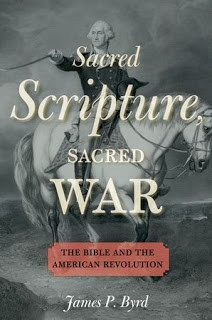 “The Revolution may be the most important event in American history,” James P. Byrd reminds us. Many of the readers of this blog will likely agree with him in that. Fewer, perhaps, will agree with one of the central arguments of his (very) recent Sacred Scripture, Sacred War: The Bible and the American Revolution that “the Bible was arguably its [the Revolution’s] most influential book.”[1] At the recent OIEAHC conference in Baltimore I was able to get my hands on a copy of this excellent new book and Sacred Scripture, Sacred War has given me a lot (despite it’s relatively conciseness) to chew on over the last two weeks.
Continue reading
The Week in Early American History
Happy Summer to all of our readers. Another week has come and gone, and we’re back with the latest installment of This Week in Early American History. Feel free to weigh in on posted links or share any interesting stories and newsworthy items we might’ve missed. Let’s jump right into it:
Remembering “Jefferson’s Statute”
 Few documents in the history of American religious freedom are as famous as Virginia’s “[A]ct for establishing religious freedom” – also known as Virginia’s Statute for Religious Freedom or (more colloquially) as Jefferson’s Statute. A quick glance at Jefferson’s text (carefully edited by the Virginia General Assembly) shows us why. Few other documents are such a clear and powerful exposition on the need for freedom of conscience.[1] The text has also aged well and appeals both sides of our modern church-state conflicts. On one hand the Statute suggests that religious freedom is a gift from god, for the “Almighty God hath created the mind free,” and on the other argues that religious beliefs are no different from “our opinions in physics or geometry.” In the Statute what the twenty-first century reader would think of as distinct “religious” and “secular” discourses are melded with spiritual coercion denounced as both “sinful and tyrannical.”[2] Who can disagree with that? It is no wonder why, then, that Jefferson had his role in drafting Virginia’s Statute for Religious Freedom engraved on his tombstone. Continue reading
The Week in Early American History
Happy Sunday! Let’s get right to the links.
Pulling a “Butler”: Reflections on “Historiographical Heresy: A Conference on the Legacy of Jon Butler”
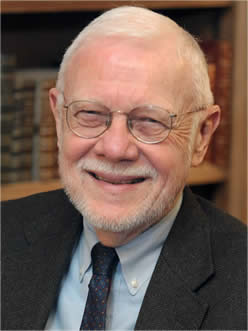 Last saturday, I woke up at an ungodly hour (especially for a weekend!) in order to make the 2 1/2 hour drive down to New Haven in time for the start of “Historiographical Heresy: A Conference on the Legacy of Jon Butler” (program here). The brainchild of James Bennett and Amy Koehlinger, and spearheaded on the ground by Kathryn Lofton, the one-day event commemorated the retirement of one of American religious history’s major figures. All participants were in some way students of Butler–some claimed him as their dissertation adviser, others as one of their committee members, and at least one as just an informal advisor; it was stated that this was more of a “family reunion” than a conference. Though I have zero attachment to Yale and no direct connection to Butler (besides being strongly influenced by his writing), I was warmly welcomed as an outsider and thoroughly enjoyed both the stimulating papers and discussions as well as the comraderie. Continue reading
After Democratization?
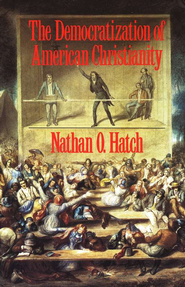 Next year marks the twenty-fifth anniversary of the publication of Nathan Hatch’s seminal The Democratization of American Christianity.[1] Few books have had as wide an influence and impact in my field of the cultural and political history of religiosity in the early American republic. In his masterwork Hatch achieves what most scholars yearn for throughout their entire careers. Democratization crystallized an interpretative scheme (the “democratization thesis”) and shoved its rival interpretation into the historiographical abyss. Continue reading
The Week in Early American History
 This week brings a rich harvest of material on slavery, memory, and public history.
First, we have two fascinating filmed conversations. At the Graduate Center at CUNY, James Oakes talks to Sean Wilentz about his new book, Freedom National: The Destruction of Slavery in the United States, 1861-1865. And at the New-York Historical Society, Harold Holzer speaks with Tony Kushner on the subject of Lincoln (and, of course, Lincoln).
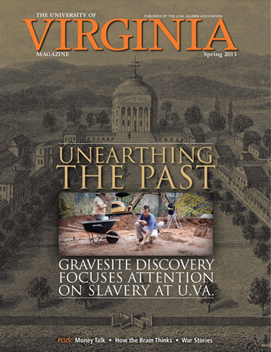
Next, we take a look into slavery at Jefferson’s university. In an article in University of Virginia Magazine and a blogpost for Encyclopedia Virginia, Brendan Wolfe contextualizes a recent archaeological discovery.
In the Washington Post, meanwhile, J. Freedom du Lac reports on Colonial Williamsburg’s difficulty recruiting slave interpreters. And how did 19th-century African American portray their own emancipations? Good interviews Deborah Willis and Barbara Krauthamer about their photographic history.
 The Junto