
Oglala Sioux Shield, ca. 1846
Consider the sixth-grader of 1907. Gertrude F. Greene’s syllabus passed over Plato, sidelined Scottish ballads, and resisted the Alaskan derring-do of The Fur-Seal’s Tooth. At the top of her reading list—first to devour on a snowy winter break from the old Belcher School—she ranked Francis Parkman’s Oregon Trail (1849). In under a century, Parkman had gone from cliffhanger to canon. Why? What might students learn from a 23-year-old romantic historian’s rambles in the Indian country of 1846? Glints of Parkman’s early artistry shone through, but only when you shook up the story a bit. His sketch of life with the Oglala Sioux melded ethnography and emotion, sense and sensation. His Oregon Trail had been greatly curated, edited, and revised in the retelling. And yet Ms. Greene’s sixth-graders missed out on the juicier bits. What Parkman saw (“a strange variety of characters”), what Parkman heard (“harsh and guttaral” dialects), and what Parkman ate (buffalo, fish, dog) on the road filled his private journals, first made available to readers in the 1940s. There, stashed away in the “no-filter” notebooks that Parkman used to piece together his first blockbuster, lay the real adventure. Continue reading

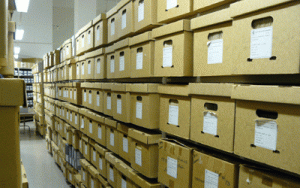 As funding budgets shrink, many historians face increased pressure to make the most of their time in distant archives. For a number of years now, a lot of researchers have favored a good digital camera, which (theoretically) allows for a faster gathering of primary source materials than traditional note-taking methods. Of course, as historian Larry Cebula humorously observed, failure to exercise good digital stewardship with your own personal archives
 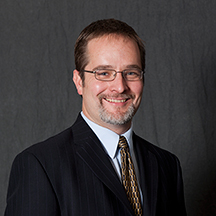 The following is an interview with Kyle Bulthuis, an assistant professor of history at Utah State University. Jonathan Wilson’s
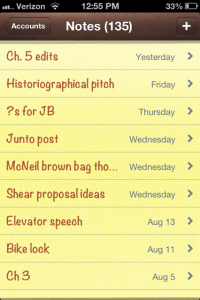 A few weeks ago, I dropped my iPhone in water. If you were wondering, those things do not float. As I pulled the phone out and dried it as best I could, all I could think about was my dissertation. I was in the throes of finishing a chapter, and I had a lot of really good ideas on that phone. In this post, I want to explain why my phone has become so important to my scholarly life.

 The Junto