Materializing Race: An Unconference on Objects and Identity in #VastEarlyAmerica
August 24 and 25, 2020
1 PM EST both days (Zoom)
Proposals due by August 1, 2020
Organized by Cynthia Chin and Philippe Halbert
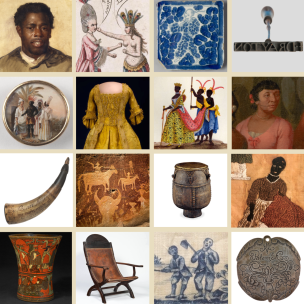 In a commitment to fostering nuanced interpretations of early American objects and meaningful dialogue on historical constructions of race and their legacies, we propose a virtual ‘unconference’ to share and discuss scholarship on the intersections of identity and material culture in #VastEarlyAmerica. This participant-driven, lightning round-style event will be held via Zoom, with two approximately two-hour afternoon sessions conducted in English. Energized by Dr. Karin Wulf’s call for broader, more inclusive histories of early America, we seek to promote a diverse cross-section of scholarship focused on North, Central, and South America and the Caribbean before 1830.
We welcome a variety of approaches and methodologies including historical, art historical, anthropological, archaeological, visual analysis, and experimental/experiential archaeological. Proposals should be object-focused and include a brief abstract (250 words with one relevant image) for a 10-15-minute presentation, along with a short CV of no more than 2 pages. Potential questions and themes for presentations might include:
- What is the next chapter in the discussion of race, ethnicity, identity, and early American material culture?
- What are potential methodological approaches and revisions/additions to existing material culture frameworks? How can #VastEarlyAmerica work to expand the traditional American material culture canon?
- What were some of the threads or outcomes of the 1619 Project dialogue (and other relevant publications/discussions) that relate/interact/tessellate with material culture studies? How can the 1619 Project and its surrounding narratives broaden the impact of material culture studies?
- Can the outcomes or discussions surrounding this dialogue engender new approaches/methodologies and discussions in material culture studies? How might it affect the way we as historians and curators interact with and publicly present objects? Does it present the ability to see “legacy” objects and historical figures/narratives differently as a result?
- Historians and material culture specialists as genealogists: how do our own personal family/ancestral narratives intersect with our study of early American history and material culture; the historian as biographer; the biographical object and the object biography
- Public history: new thoughts on old things, from the exhibition and display of objects in museum settings to historical and character interpretation, to include historic trades and foodways
- Object Case Studies: New interpretations of early American objects related to race, ethnicity, and identity
- The influence of historical anniversaries and commemorations: Jamestown 2007, the New Orleans Tricentennial Commission, Plimoth Patuxet and Mayflower 400, the 500th anniversary of the Spanish invasion of Mexico in 2019 and the 2021 bicentennial of Mexican independence, etc.
This event is co-convened by Dr. Cynthia Chin (Fred W. Smith National Library for the Study of George Washington) and Philippe Halbert (Yale History of Art). For more information, submission requirements, and audience registration details, please visit the Materializing Race website.
 1966 was a transformative year in popular music. The Beatles released Revolver; Dylan put out Blonde on Blonde; and the Beach Boys dropped Pet Sounds. Even fifty years later, those three albums sit atop many respectable lists of the best all time albums. 1966 was also a transformative year in early American history. Fifty years later, it gets my vote for one of the top 5 most historiographically innovative years the field ever had.
  Two weeks ago, 175 historians descended upon the Massachusetts Historical Society (MHS) in Boston for a three-day conference that considered the political, social, economic, and global parameters of the American Revolution. The conference consisted of eight panels (with pre-circulated papers), two keynotes, and some special presentations on digital projects. The conference proceedings were live-tweeted under #RevReborn2, and fellow Juntoist Joseph Adelman provided some
  We’re happy to bring you the fourteenth episode of “The JuntoCast.”
  The following is an interview with Kyle Bulthuis, an assistant professor of history at Utah State University. Jonathan Wilson’s
  It is not often that historiographical essays have a hero. But, in Al Young’s essay, “American Historians Confront ‘The Transforming Hand of Revolution’,” it’s hard not to see J. Franklin Jameson that way. Jameson was a New Englander by birth and character who helped found the American Historical Association in 1884. Never a prolific historian (or teacher, for that matter), Jameson’s greatest impact—beyond the important structural role he played in the emergence of History as a modern academic and professional discipline in the United States—came in the form of a small collection of four lectures originally written in 1895 but published largely in the form they were given at Princeton 30 years later. That small book, The American Revolution Considered as a Social Movement, is not just the starting point for Young’s assessment of the historiography of the American Revolution in the twentieth century, it is quite literally its genesis.
  I’ve admired Alfred Young’s wonderful, if unwieldy, Masquerade: The Life and Times of Deborah Sampson, Continental Soldier (New York: Knopf, 2004) since I first encountered the book in an undergraduate classroom a decade ago. Young’s biography of Sampson, which covers the life, career, and memory of this remarkable woman who “passed” as a man in the Continental Army for seventeen months, shares much in common with its intellectual sibling,
  Such is the line that Alfred Young opened his classic The Shoemaker and the Tea Party: Memory and the American Revolution (Boston: Beacon Press, 1999). In a way, the phrase captures much of his overall scholarship. Other contributions to this roundtable have/will cover(ed) how he did this in his influential books, essays, and edited collection. In my post, I want to focus on how he translated his approach into a work that is probably read more than any of his other books. Indeed, Shoemaker and the Tea Party is a popular book in the classroom, both undergrad and graduate, since it tells a fascinating tale with an important message.
 The Junto