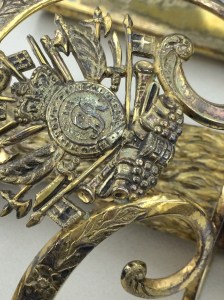
 Paper soldiers on the march, and tin men tilting at swordpoint: these were the first battle ranks that Grenville Howland Norcross, aged 11 in Civil War Boston, led to glory. Between phantom invasions and replays of Antietam with “relics” received as gifts, Norcross gobbled up the military heroics popularized by the era’s dime novels. In a childhood diary that illustrates how “lowbrow” literature grabbed the imagination of a warsick homefront, Norcross chronicled his progress through the antics of Kate Sharp, Old Hal Williams, and Crazy Dan. By 1875, Norcross had outgrown his toy battalions, graduated Harvard, and stepped into a law career. An avid autograph collector, from his Commonwealth Avenue perch Norcross nurtured the city’s flourishing history culture, taking a leading role at the New England Historic and Genealogical Society, the American Antiquarian Society, and the Bostonian Society. He rose to serve as Cabinet-Keeper for the Massachusetts Historical Society, supervising the intake and cataloguing of major collections including, by April 1920, the library of historian Henry Adams. At the Society’s next meeting, held in the midafternoon of 10 June, Grenville Norcross reported on the Cabinet’s newest curiosity, which has proven a royal mystery ever since:
Author Archives: Sara Georgini
Spring Reads
 Here’s our seasonal roundup of new and forthcoming titles. Share your finds below! Continue reading
Retelling “A Tale”: An Interview with Richard S. Dunn
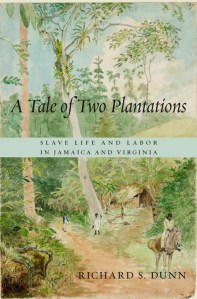 Wrapping up our roundtable review of A Tale of Two Plantations, The Junto chats with Richard S. Dunn about microhistory as a “healthy antidote to top-down history,” and the archival surprises that reshaped his work. If you are near Harvard University on February 5th, come and hear more about the project. Continue reading
Reviewing Digital History
 Today, The Junto interviews Dr. Jeffrey W. McClurken, Professor of History and American Studies & Special Assistant to the Provost for Teaching, Technology, and Innovation at University of Mary Washington. McClurken (Ph.D., John Hopkins University, 2003) is Contributing Editor for Digital History Reviews, Journal of American History. Continue reading
The Spy Who Came in from the Confederacy
![1862_LON_14_1862_NPL_P385[SVC1]](https://earlyamericanists.com/wp-content/uploads/2014/12/1862_lon_14_1862_npl_p385svc1.jpg?w=550) He was, at first, another young shadow hurrying through Westminster Hall. He carried flimsier credentials than most, papers hastily sent by a new nation called the Confederate States of America. It was November 1862, and, since spring, he had stretched expenses to accommodate the bare $750 granted to fund his secretive mission. Still, regular sightings of the worn, 29 year-old Swiss-American stranger, who had shipped to London via the fiery newsrooms of Richmond and Mobile, caused a flutter of concern among British peers. Within weeks, the constant American shadow near Parliament became a very real worry. “He is but a private gentleman, it is true,” one M.P. fretted, “yet he may leave his card at the Foreign Office, and possibly find his way upstairs.” Continue reading
He was, at first, another young shadow hurrying through Westminster Hall. He carried flimsier credentials than most, papers hastily sent by a new nation called the Confederate States of America. It was November 1862, and, since spring, he had stretched expenses to accommodate the bare $750 granted to fund his secretive mission. Still, regular sightings of the worn, 29 year-old Swiss-American stranger, who had shipped to London via the fiery newsrooms of Richmond and Mobile, caused a flutter of concern among British peers. Within weeks, the constant American shadow near Parliament became a very real worry. “He is but a private gentleman, it is true,” one M.P. fretted, “yet he may leave his card at the Foreign Office, and possibly find his way upstairs.” Continue reading
Winter Reads
Just in time for your holiday shopping list, here’s our preview of new titles—share your finds in the comments! Continue reading
Contested Rites
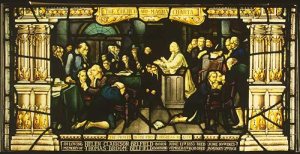 Joseph Yesurun Pinto, a 31 year-old Anglo-Dutch émigré in the autumn of 1760, had led New York’s Shearith Israel synagogue for barely a year when the second notice appeared in the papers. To re-commemorate the British conquest of Canada, all “Christian societies” and “houses of worship” would celebrate a day of thanksgiving on Thursday, October 23d. Over the past decade, New Englanders and their neighbors had held at least 50 fast days, many to lament God’s judgments against America, or to reform their wayward behavior. The proclamation of a thanksgiving day likely brought some measure of relief and joy.
Guest Post: “Fear in the Revolutionary Americas” Conference Recap
Elizabeth M. Covart is an early American historian, writer, and podcaster. Presently she is working on her first book manuscript about cultural community creation in Albany, New York, 1614-1830. Liz also writes a practical blog about history and how to make it more accessible at Uncommonplacebook.com and her new podcast, “Ben Franklin’s World: A Podcast About Early American History,” seeks to bring the work of academic and public historians to history lovers everywhere.
 October 31, 2014. On the most fearsome day of the year, Tufts University convened “Fear in the Revolutionary Americas, 1776-1865,” a one-day conference designed to explore the question: What role did fear play in the revolutions that occurred in North and South America between 1776 and 1865? Continue reading
Empire/State
 In 1967, Alfred F. Young transformed his Northwestern doctoral dissertation into a dense saga of New York’s Revolutionary power players and their roiling class wars, entitled The Democratic Republicans of New York: The Origins, 1763-1797 (Chapel Hill: Published for the Institute of Early American History and Culture at Williamsburg, Va., by the University of North Carolina Press). Young’s work, in many ways, spoke both to the colonial past that he studied and to the America of President Lyndon Johnson, a nation beset by party strife over civil rights, the Vietnam War, and a range of social issues. And, tucked away near the volume’s end, Young shared a few bright-lines of inquiry for any student of political history—no matter that his focus here is firmly fixed on New York State. “I have been interested in politics as it is organized by the leaders,” Young writes, “how it appears up front to the voters, how it all turns out in the elections, and what the elected do with political power” (596). Continue reading
The Week in Early American History
 Welcome back to the week(s) in early American history! Continue reading
 The Junto