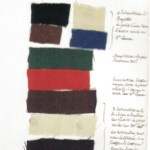
This Colonial Couture post is by Laura E. Johnson, associate curator at Historic New England. The exhibition Mementos: Jewelry of Life and Love from Historic New England, which she curated, will open at the Eustis Estate Museum in Milton, Massachusetts, in May 2017.

“Echatillons Etouffes d’angleterre a l’usage des Espagnolesen Europe y en Amerique,” (Samples of English stuffs in use by the Spanish in Europe and America), Joseph Downs Collection, Winterthur Museum and Library
I’d like to build on Kimberly Alexander’s question from last week, “How can we write history when we do not have the original object?” There are many ways to examine a textile and its context without the physical object, as she demonstrated so ably. Much of my research on Native peoples, identity construction, and the Atlantic textile trade is based by necessity on a combination of archival resources, rare portraits, and archaeological evidence. Trade records, price lists, descriptions of treaty meetings, and other archival sources offer a wide range of evidence about textiles and how Natives consumed them, even in the absence of the pieces themselves.
Textiles were among the most lucrative and desirable of imported objects in the early Atlantic economy.[1] The French, Dutch, and British all relied heavily on textile production for a substantial portion of their national revenue. Woolens and linens raised, spun, woven and finished in these areas drove international commerce from the 13th century.[2] Native Americans presented an enormous potential market for their products as the domestic market became increasingly saturated. As one scholar has stated, it could have been termed the “cloth trade as easily as the deerskin trade.”[3] Continue reading →
 In February 2017, The Junto sent out a call to historians working outside the professoriate to join us in a conversation about career diversity for early American history PhDs.[1] The response was exciting and full of interesting conversations with curators, scholars, archivists, librarians, and public historians who have chosen to pursue their passion for research, writing, and teaching in a variety of settings and occupations.
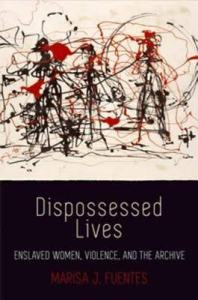 Marisa J. Fuentes is Associate Professor of Women’s and Gender Studies and History at Rutgers University, New Brunswick. Dispossessed Lives: Enslaved Women, Violence, and the Archives is her first book. Casey Schmitt previously reviewed
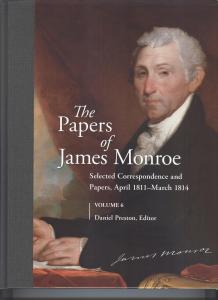 The latest volume of
  Welcome one and all to the 5th annual Junto March Madness (#JMM17). This year’s tournament will cover books in early American history (broadly defined) published since 2014. There are, however, a few key differences from past years. First, this year’s tournament will feature 32 books rather than 64. Moreover, we have decided to forego the open nomination process. The 32 works in the bracket below were selected by the 25 members of the blog. Before voting begins, let me also offer our usual disclaimer: JMM is meant to be fun and to expose more people to excellent recent scholarship on early America. It is not meant to determine the “best” book on early American history since 2014 but to show the favorites of our readers. As always, we encourage participants to use both the comments here on the blog and our hashtag (#JMM17) to discuss these works. With that out of the way, here is this year’s bracket (click for full-size):
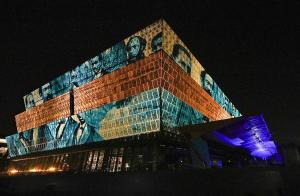 arly on a cold, frigid morning in Washington, D.C., my husband and I stood at the tail end of a long, winding line to get into the Museum of African American History and Culture. It was too cold to walk around to view the architecture so we hustled over to the entry line as soon as we exited the cab. As we waited, clutching our prized full-page sized passes, we watched a line of yellow school buses deposit kids from elementary, middle, and high schools into the bright frigid air. Their peals of laughter and rambunctious playfulness resisted the cold air. Their faces, hues of browns and tans bundled in colorful puff jackets, were filled with excitement. In line, a group of about six or seven women of African descent stood behind us. This group was from Los Angeles, California and had centered their annual get together around the visit to the Museum. They also were uncomfortably cold yet visibly excited about being here, particularly at this moment of our political lives. I wanted to find out more about them, but because it was so cold or the line was already so long at 10:00 a.m., the Museum staff diverted half of our line to another entryway. We lost contact with them and the children as we sped down the plaza to a much shorter line and before we knew it we were inside the Museum.
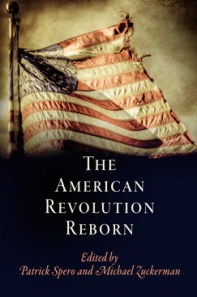 Following on from yesterday’s review of
 The Junto