Skye Montgomery is a historian of the nineteenth-century United States, specializing in Anglo-American relations and the transformation of American national identity. She is currently completing a postdoctoral fellowship at the Kinder Institute on Constitutional Democracy at the University of Missouri-Columbia. Skye earned her DPhil in History at Corpus Christi College, Oxford, and is revising a book manuscript entitled, Imagined Families: Anglo-American Kinship and the Formation of Southern Identity, 1830-1890.
Benjamin E. Park, American Nationalisms: Imagining Union in the Age of Revolutions, 1783-1833 (New York: Cambridge University Press, 2018).
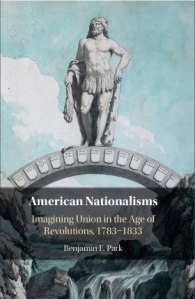
In his seminal 1882 lecture, Ernest Renan posed the deceptively straightforward question, “What is a Nation?” Although recent historiography is generally more concerned with answering the adjacent questions of how and why nations come to be, scholars of European history have produced myriad reflections on Renan’s question in the decades since the Second World War. In contrast, however, histories of early America taking nationalism as their primary category of analysis have been relatively few and focused primarily upon understandings of nationalism yoked to the nation-state. Benjamin Park’s new volume, American Nationalisms: Imagining Union in the Age of Revolutions, 1783-1833, offers a convincing explanation for this omission and makes commendable strides towards rectifying it. Continue reading →

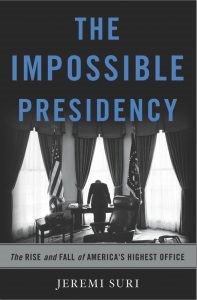 The question of whether the office of the Presidency is too unwieldy with its ever-expanding duties has once again engaged pundits. Most recently, journalist Scott Dickerson’s article raised the issue, a piece which includes the recent study by Jeremi Suri, The Impossible Presidency (New York: Basic Books, 2017). Presidents often used similar rhetorical messages–from Washington to Franklin D.Roosevelt. Suri views one of the mounting obstacles to the presidency as being a discursive problem. Interestingly, the use of language, so central to the presidency, with its surprisingly similar messaging overtime, produced unintended, and often times, inverted outcomes in its collision with capitalism and technology. Suri is currently Mack Brown Distinguished Chair for Leadership in Global Affairs and Professor in the Department of History and the LBJ School of Public Affairs at University of Texas, Austin.
  A few months ago, a New York Times investigation
  Rise and shine, it’s time to relaunch our regular(ish) roundup of breaking news from early America. To the links!
 Today’s interviewee hardly needs introduction for readers of The Junto. Ben Park is an assistant professor of history at Sam Houston State University in Texas; he earned his PhD in Britain’s second-best history department, at Cambridge University; and went on to hold a postdoctoral fellowship at the Kinder Institute on Constitutional Democracy. Far more importantly, of course, he is also the founder of this blog, and author of the recent monograph
  I recently spoke at an event for Early Career Researchers hosted jointly by the British Group in Early American History, the British American Nineteenth Century Historians, and the Institute of Historical Research about funding initiatives for Americanists based in the UK.

 The Junto