The Reintegration of South Carolina Loyalists after the Revolutionary War

Rebecca Brannon, From Revolution to Reunion: The Reintegration of the South Carolina Loyalists (University of South Carolina Press, 2016).
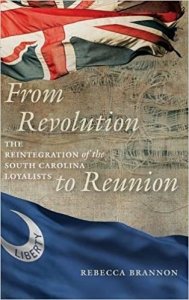
51rsxcybgfl-_sx312_bo1204203200_In her award-winning Liberty’s Exiles, Harvard University’s Maya Jasanoff offered a lively account of the Loyalist diaspora, those individuals who left the newly formed United States as a consequence of their Loyalism. In her highly anticipated appendix, Jasanoff stated that over 60,000 Loyalists left in search of a new home—but what of those who stayed? Until recently, the reintegration of some 400,000 Loyalists into American society has been an overlooked topic. As James Madison University’s Rebecca Brannon notes, “Historians of American Loyalism have long favored those who left . . . over those who stayed” (p. 5), and with her well-researched From Revolution to Reunion: The Reintegration of the South Carolina Loyalists (University of South Carolina Press, 2016), Brannon takes a major step to address this obvious historiographical oversight. Continue reading

Where Historians Work: Q&A with Anne Petersen of Santa Barbara Trust for Historic Preservation

“I went on to the doctorate because I didn’t want a ceiling on what I could achieve as a historian.” ~ Dr. Anne Petersen, Executive Director, Santa Barbara Trust for Historic Preservation

Anne PetersenWelcome back to the latest installment of “Where Historians Work: The View from Early America.” Today, we venture westward to California to feature a Q&A with Dr. Anne Petersen, the Executive Director of the Santa Barbara Trust for Historic Preservation. Katy and Anne discuss the dynamic history interpretation taking place at SBTHP, which focuses on the diverse cultures and communities that have called Santa Barbara home for centuries. The pair also consider the complexities of navigating a “dual identity” in graduate school when choosing to pursue an array of history careers. Continue reading
Review: William Hogeland, Autumn of the Black Snake

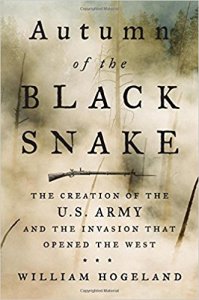
William Hogeland, Autumn of the Black Snake: The Creation of the U.S. Army and the Invasion That Opened the West (New York: Farrar, Strauss and Giroux, 2017).

It’s fair to say that military history isn’t known for its commitment to social and political critique—at least not the kind of military history you might find at the airport. Autumn of the Black Snake offers much of what readers might want from that kind of book. It is unashamedly narrative-driven; carefully constructed for maximum tension and dramatic payoff; and there’s a fair amount of blood on the page too. But it is also designed to pose a challenge. Just what kind of entity was the newborn United States? From William Hogeland’s perspective, it was less an asylum of liberty than a super-powered successor to colonial land companies like the one that shaped the young George Washington. Continue reading

Where Historians Work: Q&A with David Gary of the American Philosophical Society

“During graduate school, you have to be very focused on a topic. But in libraries you’re a generalist in many ways. In all the jobs I’ve had, I’ve had to learn new skills and topics.” ~ Dr. David Gary, the American Philosophical Society

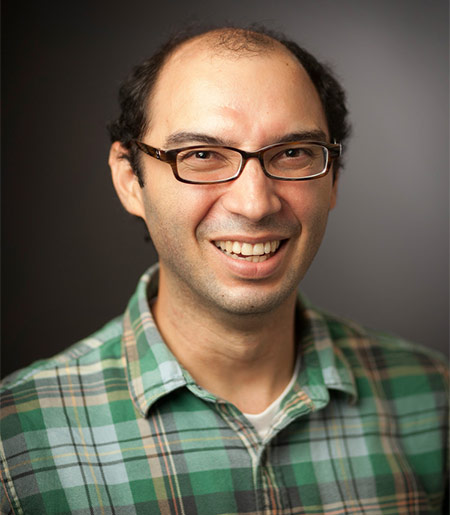
David Gary - Head ShotGood morning, Junto readers! As we head into July 4th weekend, what better city to visit than Philadelphia? Today, we discuss the exciting intellectual opportunities that accompany the curation of printed collections, with Dr. David Gary, Curator of Printed Materials at the American Philosophical Society.
Dave’s story highlights the vibrancy and variety of the history profession, as well as the many paths scholars can take, both during and after graduate school, to find themselves in fulfilling occupations. Continue reading

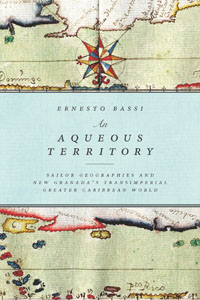
Q&A: Ernesto Bassi, author of An Aqueous Territory

Following up on James Hill’s review of Ernesto Bassi’s An Aqueous Territory: Sailor Geographies and New Granada’s Transimperial Greater Caribbean World (Durham: Duke University Press, 2017), we’re pleased to post this Q&A with Ernesto about his book and future research. Bassi is Assistant Professor of History at Cornell University. He is a historian of Latin America, the Caribbean, and the Atlantic world during the Age of Revolutions, whose work transgresses conventionally defined geographic units of analysis. Ernesto can be reached at eb577@cornell.edu. Continue reading

Guest Post: Review of Bassi, An Aqueous Territory

Today’s review is by James Hill, who received his Ph.D. from the College of William & Mary in 2016 and is currently an Assistant Professor of History at the University of the Bahamas. He has published articles in Early American Studies (Winter 2014) and the Florida Historical Quarterly (Fall 2014). His dissertation, “Muskogee Internationalism in an Age of Revolution, 1763-1818,” analyzes Creek and Seminole diplomacy. This will be followed tomorrow by a Q&A with the author.

Ernesto Bassi, An Aqueous Territory: Sailor Geographies and New Granada’s Transimperial Greater Caribbean World (Durham: Duke University Press, 2016).

For decades, the historiographies of the Caribbean and the mainland Americas largely remained separate, with the modern constructions of nation-states influencing how scholars have framed the geographical parameters of their works, with some notable exceptions (New Spain, Guyana, Suriname). In recent years this has begun to change in the case of North America’s early modern ties to the Caribbean. Scholars such as Jane Landers, J. R. McNeil, and Shannon Lee Dawdy have emphasized transnational and transimperial connections between various Caribbean islands and the territories that eventually encompass the United States. Continue reading

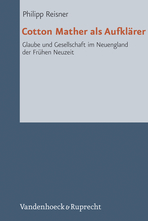
Guest Post: Cotton Mather and the Enlightenment in New England: Redefining the Holy Spirit

Philipp Reisner received his PhD from and teaches as a lecturer in the American Studies  Department at Heinrich Heine University in Düsseldorf, Germany. He approaches research multidisciplinarily and is particularly interested in New English and American literature, cultures, and theologies. His first book, Cotton Mather als Aufklärer. Glaube und Gesellschaft im Neuengland der Frühen Neuzeit, deals with the theological role that the New English theologian Cotton Mather (1663–1728) played in the context of early modern society and was published in the Reformed Historical Theology series with Vandenhoeck & Ruprecht in 2012.

1008508

My book Cotton Mather als Aufklärer. Glaube und Gesellschaft im Neuengland der Frühen Neuzeit examines Cotton Mather’s writings, identifying him as participating in Enlightenment thought through his various societal roles as pastor, physician, politician, and scientist. Mather studies have become an important part of early modern studies, not least because they touch on so many disciplines—such as natural and life sciences, philosophy, history, philology, and theology—and the ways these disciplines were transformed throughout the early eighteenth century. His oeuvre is currently undergoing revision, attention being drawn to his theology through the first publication of his Bible commentary Biblia Americana; this revision tends to reinterpret him as an early evangelical. It has not been fully recognized to what extent this reinterpretation depends on his pneumatology. In my book, I examine his pneumatology in his Bible commentary and his many publications in order to show how Mather’s redefinition of the Holy Spirit posits itself in relation to the unfolding of Enlightenment thought. Continue reading

Call for Papers: Women and Religion in the Early Americas

Reposting this from our good friend Historiann:

Call For Papers: Women and Religion in the Early Americas

For a special issue in honor of the life and career of Mary Maples Dunn, Early American Studies seeks article-length contributions from scholars working on the history of women and religion in the early Americas. Mary Maples Dunn (1931-2017) was a leading practitioner of women’s history, as a scholar, as a teacher, and in her life as a university leader. She worked in a variety of fields from early American women’s history; to colonial Latin American history; to the history of religious women; to the history of women’s education as well as, of course, the worlds of William Penn and early Philadelphia. Continue reading

Where Historians Work: Q&A with Margaret Bendroth of the Congregational Library and Archives

“I’ve learned so much about how historians talk to the general public … If you tell a good story you can get people to hang in and keep listening.” ~ Dr. Margaret Bendroth, Executive Director of the Congregational Library & Archives.

Library-10.jpgFor today’s “Where Historians Work: The View from Early America,” Katy chats with Dr. Margaret Bendroth, the Executive Director of the Congregational Library & Archives in Boston, Massachusetts. They discuss the importance of story telling and having an “entrepreneurial” frame of mind, when it comes to a vibrant career in history.

Continue reading

Research at the Bodleian: A Guide

ba8733d8047fd5c07ef03275c12de66f

A few summers ago, I wrote a guide to navigating London-area archives, as part of a roundtable The Junto published about research. I have updated that piece, but today, I wanted to share some thoughts on doing research at the Bodleian Libraries in Oxford. Continue reading