Guest poster Neil Oatsvall is a History and Social Science Instructor at the Arkansas School for Mathematics, Sciences and the Arts. His work has appeared, or is forthcoming, in Environment and History, Agricultural History, Essays in History, and the edited collection Proving Grounds (University of Washington Press, 2015). His book manuscript, “Atomic Environments: Nuclear Technologies, the Natural World, and Policymaking, 1945-1960,” is under advanced contract with the NEXUS series of the University of Alabama Press. His Twitter handle is @DctrNO.
Return guest poster Vaughn Scribner is an Assistant Professor of Early American History at the University of Central Arkansas. His work has appeared, or is forthcoming, in Atlantic Studies: Global Currents, the Journal of Early American History, Early American Studies, the Journal of Social History, Urban History, Agricultural History, and the edited volume, Order and Civility in the Early Modern Chesapeake. His Twitter handle is @VScrib86.
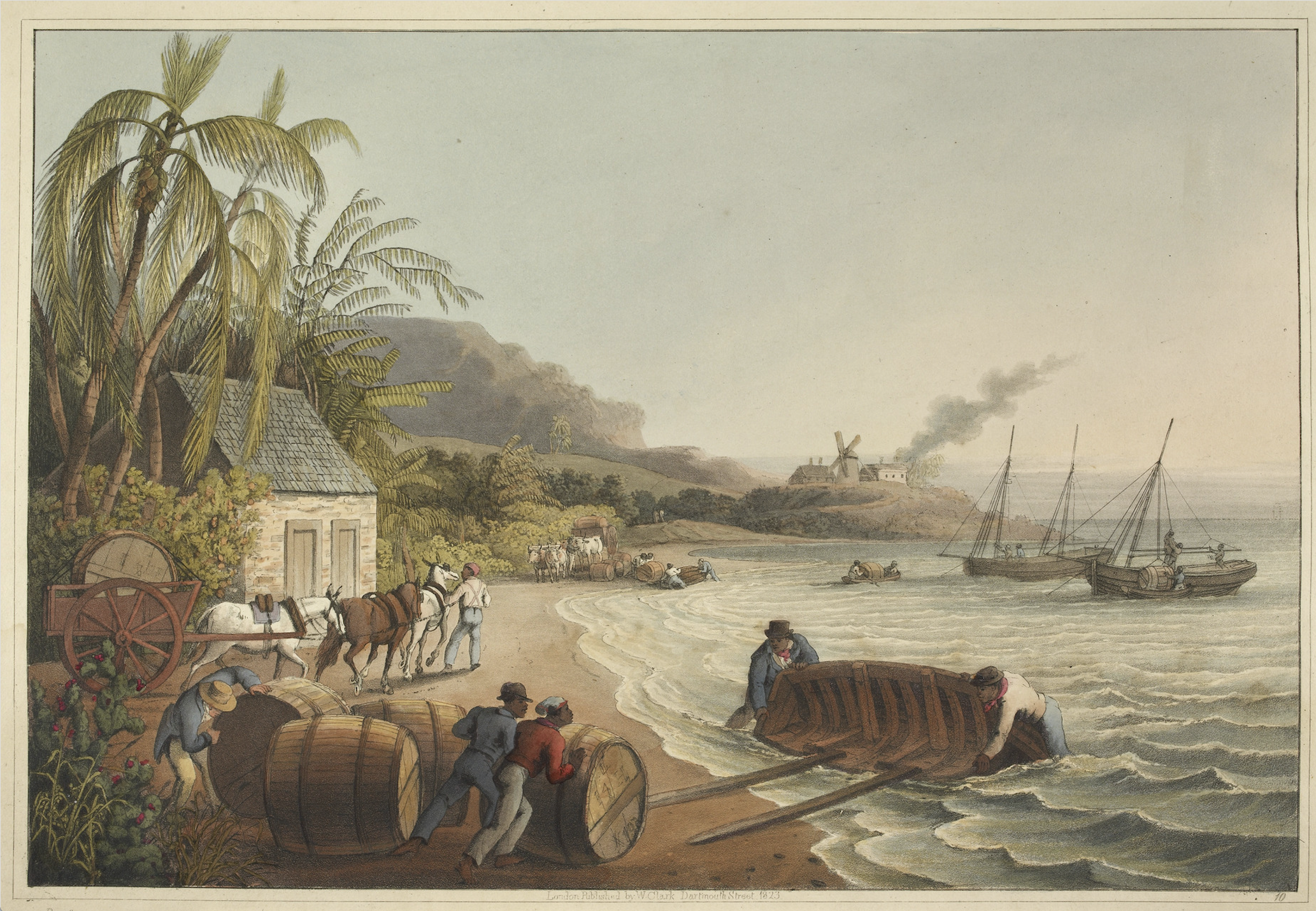
“Shipping the Sugar,” from William Clark, Ten Views in the Island of Antigua, in which are Represented the Process of Sugar Making…From Drawings Made by William Clark, During a Residence of Three Years in the West Indies (London, 1823).
While co-authoring in the sciences or social sciences is the norm (and often expected), many scholars in the humanities tend to practice the Lone Wolf strategy. We huddle in our den, surrounded by piles of books, cultivating the nagging fear that someone might be researching something too similar to us. But maybe it’s time to move on from our seclusion. Maybe, in the words of Alan Garner from The Hangover, it’s time to grow your wolf pack (link might be slightly NSFW, as it’s from a rated R film). Continue reading
 On May 21, 1796, as George and Martha Washington ate their supper in the Philadelphia Executive Mansion, their twenty-two year old house slave, Ona Judge, walked out of the house and into freedom. With the help of the free black community in Philadelphia, Judge made her way to Portsmouth, New Hampshire where the free black community and white supporters provided refuge.