 Looking forward to attending one of the largest conferences on the American Revolution in a generation this week in Philadelphia, I thought I would take a moment to reflect on the title of the conference—”The American Revolution Reborn“—and its historiographical purchase.
Tag Archives: historiography
New William and Mary Quarterly Special Issue: Centering Families in Atlantic History
 I planned on doing another “Articles of Note” post for today since it’s been a few months since the last one, and lots of new articles are indeed noteworthy, but I’m feeling lazy today. Plus, as a more legitimate excuse, the William and Mary Quarterly just put out an issue that is worth highlighting by itself. What originated as a conference sponsored by the OIEAHC and the Institute for Historical Studies at the University of Texas at Austin, “Centering Families in Atlantic History” addresses an important (and often neglected) issue in the vibrant, popular, yet often uneven field of study based around the Atlantic Ocean. In brief, two of the lessons that stood out the most to me were 1) the importance of family connectedness within an era usually dominated by an emphasis on empires and states, and 2) the much-needed diversification that encompasses much more than just Anglo-America (perhaps the biggest problem with the “Atlantic History” field.)
If you or your institution have a subscription to JSTOR, you can download the entire issue here. Hopefully we can have a more in-depth and substative review of some or all of the excellent articles in this issue, but for the time being I’ll just post the titles and abstracts here. Continue reading
Charles Beard: A Conference Recap
 In spite of the unrestful Beardian ghost recently invoked by Saul Cornell, with which I introduced the topic of the Charles Beard, Economic Interpretation and History Conference here a few months ago, not every participant was convinced, going in, that Beard was really worth the trouble of a two-day international conference. By the end, we were able to say that whatever we thought of Beard himself, his work could certainly provoke plenty of insight and discussion. It would be wrong to say the event was a celebration of Beard, or held in his honour. Instead, like his vision of history, it was characterised more by conflict than consensus–at least, if friendly scholarly disagreement really counts as conflict. Continue reading
The Comprehensive Exam: A Reflection, with Qualifiers
 The three or four minutes between when my qualifying exam ended and when I found out I had passed rank among the weirdest of my life. Not because I feared I had failed. In fact, immediately following the exam, which I took last Tuesday and which consisted solely of a two-hour oral interrogation, I encountered a calm and a confidence that I hadn’t known in months. Instead, the moment’s weirdness stemmed from a sort of whiplash. Ideas, arguments, and anxieties had been cramming themselves into every corner of my brain for over a year. Suddenly, they were free—unleashed and dissipated in the space a two-hour conversation. It felt more than a bit anticlimactic. A disappointing question seemed to cloud out any sense of accomplishment or pride: “That was it?” A week later, I’m feeling prouder—and still celebrating—but the question remains. Continue reading
On Popularity and Self-Publishing

My wife is a knitter, and she’s explained to me the subtle difference observed, among those in her guild, when referring to someone’s work as “handmade” or “homemade.” Both acknowledge the difference between the sweater you spent months on and something mass-produced. The former, though, implies that for the piece in question that difference is measured in care and craftsmanship, while the latter measures it in imperfections. It’s the difference between, “You made that yourself?!” and “You made that yourself, huh?” Continue reading
Junto March Madness: Some Reflections

Colonial historians celebrating Morgan’s victory.
The final outcome of the Junto March Madness wasn’t really a surprise. Edmund Morgan’s American Slavery: American Freedom was the most heavily nominated book when we compiled the bracket, and no challenger really came close to defeating it as it stormed through the tournament like a juggernaut. Morgan’s easy victory invites reflection on why the book remains such a well-loved classic. Today, I am going to offer a few preliminary thoughts as to what we can can learn from the tournament, with all usual caveats about the unscientific nature of the process still in force. Continue reading
The Junto March Madness: The Bracket Is Here!
Today is the day you’ve all been waiting for with eager anticipation–the official unveiling of the Junto’s March Madness bracket! Thank you to all who nominated books yesterday–this whole project wouldn’t have been possible without it.
The response to yesterday’s call for nominations was overwhelming, with over 150 books receiving nominations, and over half of those receiving more than one mention. As such, The Junto’s Selection Committee had a difficult task whittling down the nominees to a bracket of 64, and an even tougher time organizing it into something resembling the NCAA tournament.
The Junto March Madness: Nominating Books for the Early American History Brackets
What happens when you mix early American history nerdyness with basketball geekyness? Junto March Madness!
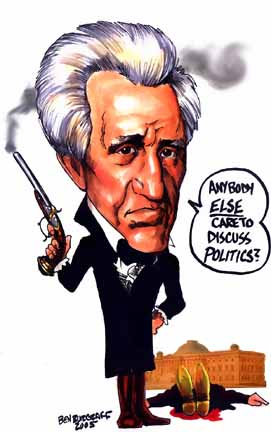
Jackson would obviously have won any physical competition, likely by cheating, but will any books dealing with Jacksonian America win the historiographical tournament?
In honor of the NCAA Tournament games tipping off in a few hours, and in reaction to the recent announcement of Bancroft Prize winners (which tragically did not include any book explicitly dedicated to early America), we here at the Junto decided to jump in on the competition atmosphere with brackets of our own: a several-bracket-tournament of books in early American history. Today, we submit competitors. The Junto team will then narrow the field to either 32 or, if we get enough submissions, 64, and rank them in brackets. (The organization of brackets is still up in the air—we could go with thematic regions like political, cultural, religious, and synthetic, or we could even go chronological with colonial, revolutionary, early republic, or Civil War-era, or we could even go with histiographical eras—and largely depends on the submissions. We are very open to suggestions, though, so please chime in in the comments!)
IMPORTANT NOTICE: The beauty of this competition depends on being fun, so the first and most important rule is not to take it too seriously. Deciding the winner is purely subjective and based on what are likely a widely variegated criteria of excellence including, but not limited to, most influential, best-written, most sophisticated, or even most popular. When in question, go with your gut reaction. Or, just go with your favorite. A debate between Laurel Ulrich’s A Midwife’s Tale and Eric Foner’s The Fiery Trial is, of course, silly, because both books can be categorized as the top of the field yet they examine completely different issues through very different approaches. But it is, nonetheless, fun to compare, debate, and, indeed, vote. This is designed to be fun, people, so once again: DO NOT TAKE THIS SERIOUSLY. (But we still expect the winner to add this great accolade to the top of her/his C.V.) Continue reading
Reading Becomes a Necessity of Life
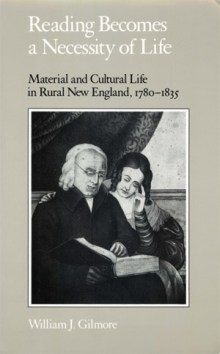
William J. Gilmore’s Reading Becomes a Necessity of Life is an odd book. Published by University of Tennessee Press in 1989, it was not particularly well reviewed—its oddness frustrated readers. Gilmore set out to “learn how the American version of modern civilization began to influence the lives of the overwhelming majority of rural Americans” by making a fine-grained, comprehensive study of the reading, purchasing, and—less comprehensively—thinking habits of the people who lived in the Upper Connecticut River Valley between 1780 and 1835 (xx). Along the way, there are references to contemporary events Iran and Iraq, Isaac Asimov, corn-husking frolics, and the meaning of human happiness. Paul Johnson, with characteristic precision and wit, summarized the book’s problems in his JAH review (September 1990): Continue reading
After Democratization?
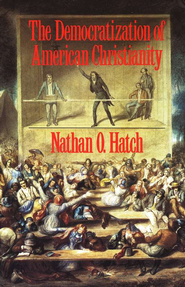 Next year marks the twenty-fifth anniversary of the publication of Nathan Hatch’s seminal The Democratization of American Christianity.[1] Few books have had as wide an influence and impact in my field of the cultural and political history of religiosity in the early American republic. In his masterwork Hatch achieves what most scholars yearn for throughout their entire careers. Democratization crystallized an interpretative scheme (the “democratization thesis”) and shoved its rival interpretation into the historiographical abyss. Continue reading
 The Junto