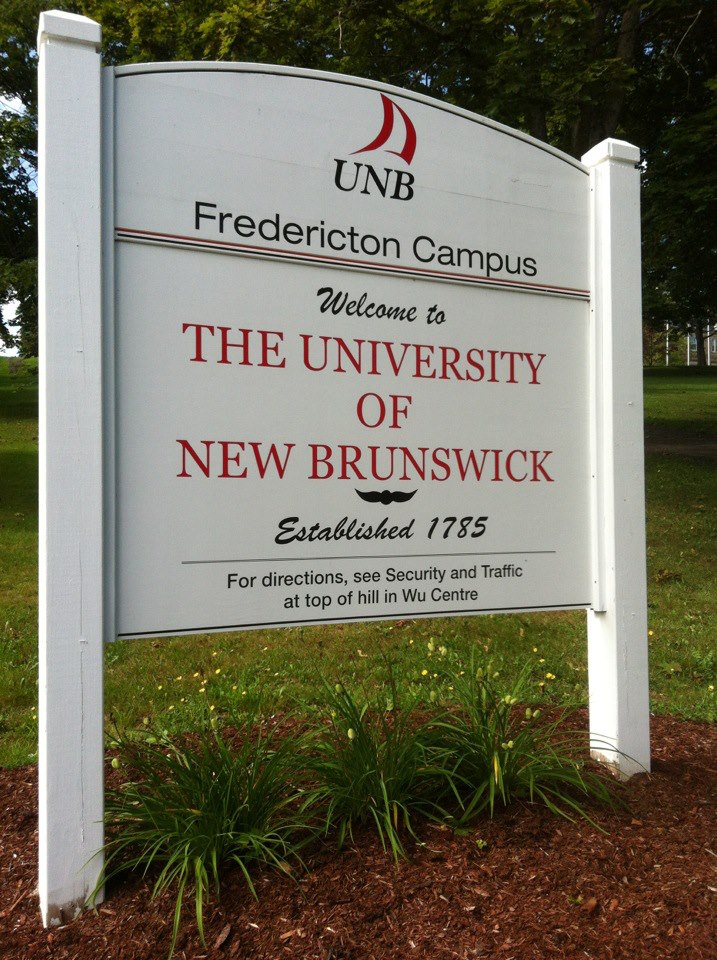
 This week, several Juntoists have offered useful guides for archival work in Spain, France, and England. Today, we are offering something slightly different—a guide to researching in North America! After all, not all early Americanists are American, and planning transatlantic trips can be daunting. Continue reading
Tag Archives: research
Research in London
 Casey Schmitt kicked off the week with a discussion of doing research in Seville, Spain. Hannah Bailey continued our forum yesterday, with a discussion of research in France. I’m going to continue the conversation with reflections on doing research in London. (For those interested in research gear, see my post from last summer.) Since there are quite a few archives libraries and archives that are potentially of interest to Early Americanists, I will primarily focus on the logistics, such as navigating London and finding accommodations. I’ve provided basic information on a few major archives near the end.
Early America en Français
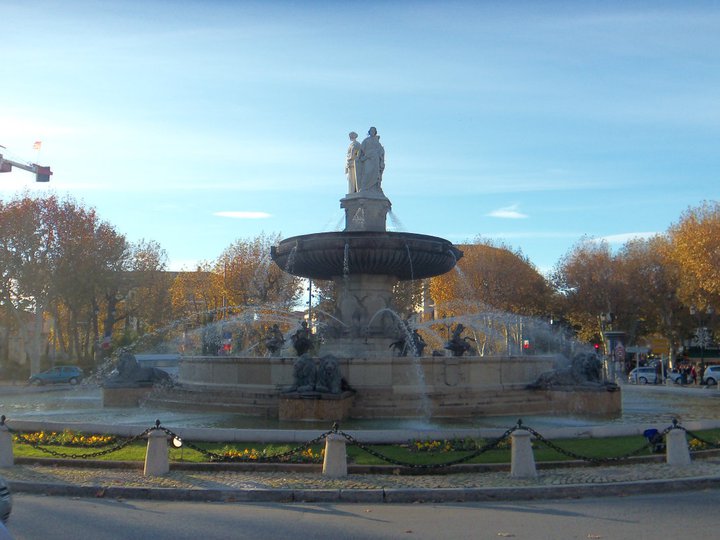 Yesterday, Casey Schmitt began our “Archives around the Atlantic” roundtable with an extremely helpful guide to the Archivo General de Indias in Sevilla. If you have not yet read her piece, you will want to do so here. My hope is that my post can be useful to two (potentially overlapping) audiences: one that is interested in general tips for doing research in French archives online, and one that will be lucky enough to be physically present in French archives in the near future.
Here are a few tips for delving into the French Atlantic from the comfort of your own internet: Continue reading
Early America in Español
This week, The Junto will explore, “Archives around the Atlantic.” As research projects frequently plunge early Americanists into far-flung archival settings, over the course of the next five days we will draw from the wide experience of our contributing editors to offer advice for approaching research abroad. It is our hope that this forum and the comments sections below might also tap into the collective expertise of The Junto readership with the common goal of making foreign archives accessible and productive.
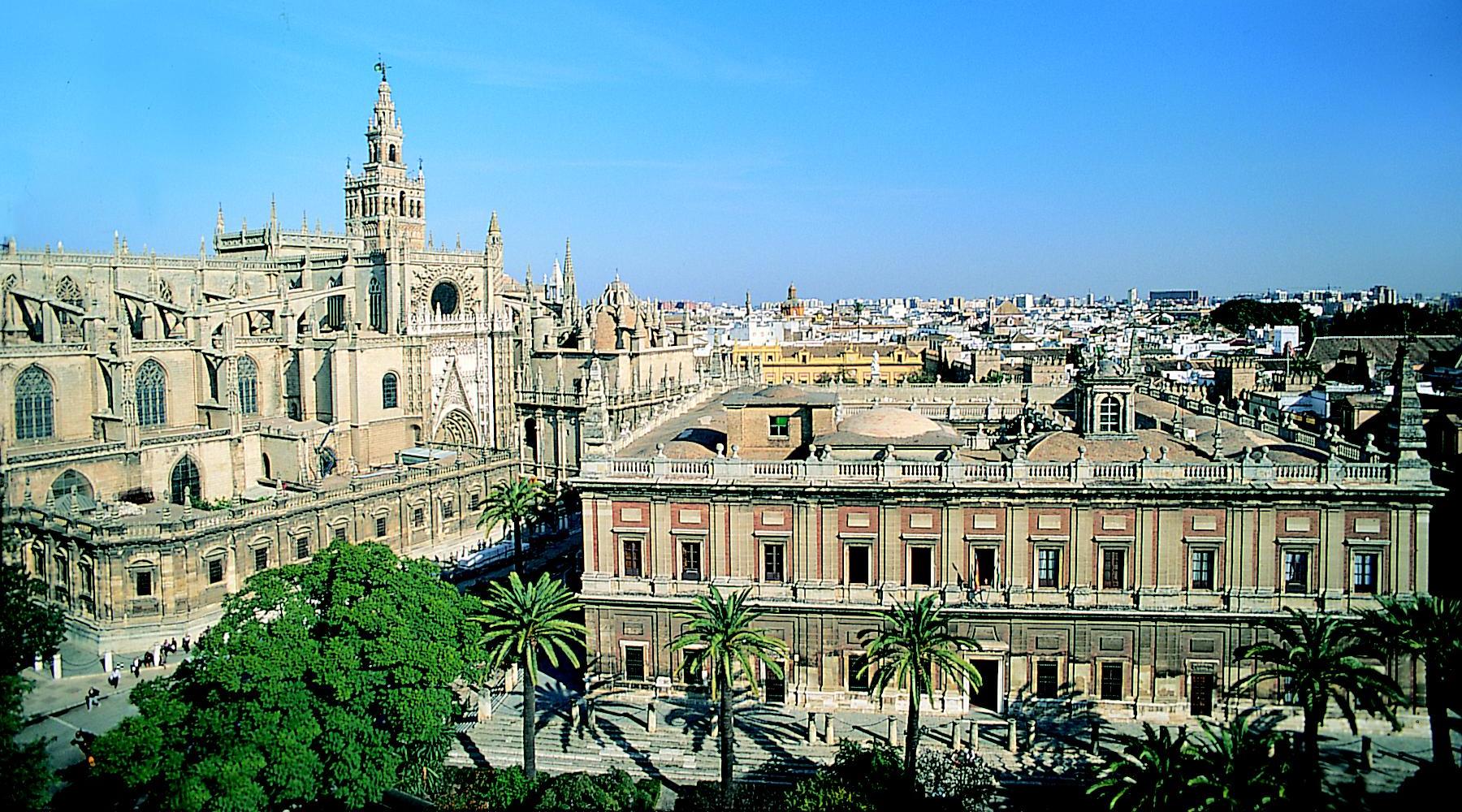 While the Archivo General de Indias in Sevilla remains the primary destination for scholars working on projects relating the Spain’s colonial empire, the collections infrequently receive the attention they deserve from historians north of the Río Grande. This, despite Kristen Block and Jenny Shaw’s proclamation that, “colonial records in the Spanish archives reveal a wealth of reportage” about moments in early American history for which few extant documents remain elsewhere.[1] In fact, Block and Shaw’s 2011 article, “Subjects without an Empire: The Irish in the Early Modern Caribbean,” forces a reconsideration of the contours of Anglo-Irish relations in the early Caribbean by reading Spanish and English language documents side-by-side. Uncovering the lived experience of Don Juan Morfa—an Irish translator for the governor of Santo Domingo and linchpin in the defense of the island against Cromwell’s Western Design—depended on reading documents housed in the AGI. Continue reading
Building Intellectual Community at SHEAR
 Students of the early American republic: I urge you to apply to SHEAR 2016’s Graduate Research Seminars!
The program, which debuted last year, brings together grad students and senior faculty clustered around four “hot” themes in the field for an hour and a half or so of small-group discussion. Lunch is free. The sessions are open to current graduate students and those who earned a Ph.D. during the 2015-16 academic year. A one-page dissertation abstract is all it takes to apply. Best of all, this year’s lineup of topics and faculty is just as wonderful as 2015’s was. Continue reading
Guest Post: Native American History & the Explanatory Potential of Settler Colonialism
Today’s post comes from Bryan Rindfleisch, Assistant Professor of History at Marquette University. Bryan received his Ph.D. from the University of Oklahoma in 2014. He is currently working on a book that examines the intersections of colonial, Native, imperial, and Atlantic histories, peoples, and places in eighteenth-century North America. This is his second post for The Junto. The first can be found here.
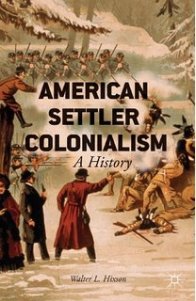 One of the trending themes in Native American history is “Settler Colonialism.” From Patrick Wolfe’s foundational essay, to recent works by historians and literary scholars—Bethel Saler, Jodi Byrd, Gregory Smithers, David Preston, and Lisa Ford, for instance—this theoretical model has attracted significant attention within the field.[1]
In fact, I’ve deployed this concept as the framework for my upper-division class, “A History of Native America, 1491–Present,” at Marquette. But over the past several weeks it has become evident that settler colonialism is a bit of a minefield. Nevertheless, I find it to be an apt, if not critical, theory for researching and teaching Native American history. But it must be understood, and it must be used responsibly. Continue reading
An Interview with Daniel K. Richter

Daniel K. Richter, from the OAH’s website
Daniel K. Richter is the Richard S. Dunn Director of the McNeil Center for Early American Studies and Roy F. and Jeannette P. Nichols Professor of American History at the University of Pennsylvania. Most recently, he has published Trade, Land, Power: The Struggle for Eastern North America. He has also written Before the Revolution: America’s Ancient Pasts, Facing East from Indian Country: A Native History of Early America, and The Ordeal of the Longhouse: The Peoples of the Iroquois League in the Era of European Colonization. He is currently researching English colonization during the Restoration era, for a book tentatively titled The Lords Proprietors: Feudal Dreams in English America, 1660-1689, under contract with Harvard University Press. Today he speaks with The Junto about teaching and directing the McNeil Center, and he offers advice for potential fellowship applicants. Continue reading
Careful Hands, Epistolary Spaces: Review of The Opened Letter
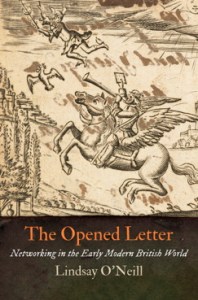
Lindsay O’Neill, The Opened Letter: Networking in the Early Modern British World (Philadelphia: University of Pennsylvania Press, 2015).
 Social networks are having a moment in history. They are another approach to understanding how people came together either via proximity, social status, values, or goals, with the analytical focus on what serves as the bond in the relationship(s).[1] Social theorists have ascribed a 4-part process which entails a) similar people coming together, b) influence within these groups making its members more alike, c) people winding up in the same place, and d) shared space making people more alike.[2] In short, networks are primarily about building consensus. For historians, networks are “messy,” “fragile,” “fluid,” and disregard geographic boundaries.[3] Continue reading
Digital Pedagogy Roundtable, Part 1: Students’ Access to Sources
This week, The Junto will feature a roundtable on digital pedagogy, in which we discuss our different approaches to using digital sources in the classroom. Today, Rachel Herrmann talks about the challenge of access. Jessica Parr, Joseph Adelman, and Ken Owen will also contribute.
A Wordle made from sources my undergraduates located for our in-class source-finding competition
Let me preface this post by saying that I’d hesitate to call myself a digital humanist; I don’t code or map or mine texts. As Lincoln Mullen pointed out a while back, however, digital practices exist on a spectrum. There are some things I do for my own research and in the classroom—tweeting, running my department’s social media accounts, using Amazon’s “Look Inside” feature to chase up a footnote so as not to use up one of my precious Interlibrary Loan requests, and of course, blogging for The Junto—that digital humanists also do. These approaches have been helpful in my teaching for three problems related to access to sources. Continue reading
Making the Most of Your Time in the Archives: Research Technology
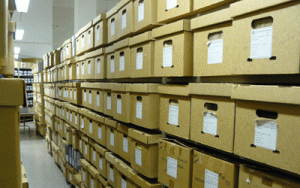 As funding budgets shrink, many historians face increased pressure to make the most of their time in distant archives. For a number of years now, a lot of researchers have favored a good digital camera, which (theoretically) allows for a faster gathering of primary source materials than traditional note-taking methods. Of course, as historian Larry Cebula humorously observed, failure to exercise good digital stewardship with your own personal archives can have disastrous consequences.
 The Junto