Winslow Homer, “The Country School,” 1871
Looks like #VastEarlyAmerica just got even vaster—and that’s a good thing. Here’s our fall preview of new titles. Please share your books/finds in the comments! Continue reading
Winslow Homer, “The Country School,” 1871
Looks like #VastEarlyAmerica just got even vaster—and that’s a good thing. Here’s our fall preview of new titles. Please share your books/finds in the comments! Continue reading

Diego Rivera and Bertram D. Wolfe, “Portrait of America,” 1934
When John Adams looked back on the American Revolution (something he liked to do), he reflected that, “The Revolution was in the Minds and Hearts of the People.” The colonists’ drive to independence marked a new era of American history, Adams thought, when “Thirteen Clocks were made to Strike together; a perfection of Mechanism which no Artist had ever before effected.” Scholars have struggled to frame the experience of the Revolution in picture and on the page. How can we use digital tools to curate collections of revolutionary culture and #vastearlyamerica for use in the classroom?
Today, The Junto chats with Darren Milligan, Senior Digital Strategist at the Smithsonian Center for Learning and Digital Access, about the Smithsonian Learning Lab, which encourages us to make, use, and share new galleries of history. Continue reading
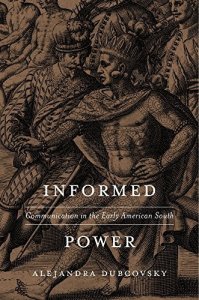 Alejandra Dubcovsky’s Informed Power: Communication in the Early American South is an ambitious book. She analyzes how information was communicated throughout the early South, a region that was without a regular mail system or print culture prior to 1730. The “early South,” as Dubcovsky acknowledges, is an “ambiguous” term (3). Her “early South” includes much of the lands from the Jamestown settlement south, and from the Mississippi River east. The result is a vibrant blend of Native American peoples, Africans, and European interactions that both complicate and enrich her analysis. Her sources include not only English, French, and Spanish, but also a number of Native American sources, including Timucua. She draws not only on written sources, but linguistic and archaeological evidence as well. This interdisciplinary approach allowed for broader inclusion of non-European networks than appears in many studies. Networks, as Dubcovsky defines them, are a “pattern of ties connecting discrete places or peoples”(4) She discusses a number of different types of networks—economic, political, religious, diplomatic, subaltern—but depicts all nodes as uniform in size. While some might take issue with this approach, the uniformness of the nodes makes sense, given the book’s goal of decentralizing European power structures, and does not detract. Continue reading
 On Sunday, the United States Postal Service introduced a stamp commemorating the 250th anniversary of the repeal of the Stamp Act. Today we are pleased to present an interview with Zachary Hutchins, editor of a new collection of essays from Dartmouth College Press that challenges traditional understandings of the Stamp Act Crisis as (in the words of the USPS) “setting [the colonists] on a path toward revolution and independence.” Zach is an Assistant Professor of English at Colorado State University. In 2014 he published his first book, Inventing Eden: Primitivism, Millennialism, and the Making of New England. A 2016 Fellow of the National Endowment for the Humanities, Hutchins is currently completing his second monograph, Before Equiano: A Prehistory of the North American Slave Narrative. Continue reading
 Students of the early American republic: I urge you to apply to SHEAR 2016’s Graduate Research Seminars!
The program, which debuted last year, brings together grad students and senior faculty clustered around four “hot” themes in the field for an hour and a half or so of small-group discussion. Lunch is free. The sessions are open to current graduate students and those who earned a Ph.D. during the 2015-16 academic year. A one-page dissertation abstract is all it takes to apply. Best of all, this year’s lineup of topics and faculty is just as wonderful as 2015’s was. Continue reading
This post is the second in a two-part report on a roundtable session at this year’s Organization of American Historians annual meeting in Providence, Rhode Island, entitled, “Open Question: What’s the Relationship Between Slavery and Capitalism?” The panelists were James Oakes, Craig Wilder, Sven Beckert, and Caitlin Rosenthal. Yesterday’s post focused on Beckert’s comments, today’s looks at Rosenthal’s.
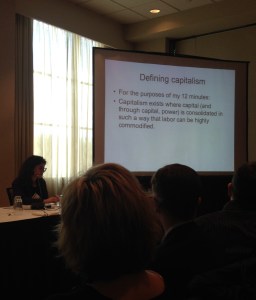 The new historians of capitalism have sometimes been criticised for refusing to offer a definition of their object of study. At the OAH panel, Caitlin Rosenthal (an assistant professor at the University of California, Berkeley) responded to that criticism directly. The refusal to start out with a strict definition has been, on one level, an asset to recent scholarship—freeing it from earlier dogmatic approaches. But the downside, Rosenthal said, is that it leads to misunderstandings among historians, and between historians and economists. Her tentative definition, then: “Capitalism exists where capital (and through capital, power) is consolidated in such a way that labor can be highly commodified.” Capital is at the centre, but so is labour; and what connects them is the process of commodification. Continue reading
Robert Taber, a postdoctoral associate with the University of Florida Writing Program, wrote his dissertation on the connection between family life and grassroots politics in colonial Saint-Domingue and is the author of Navigating Haiti’s History: Saint-Domingue and the Haitian Revolution.
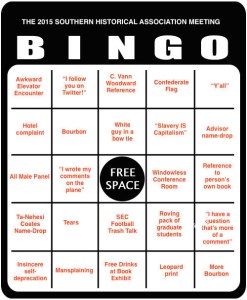
Mr. Wolf’s Bingo Card. Historista Blog
According to The Junto archives, this post is the first-ever recap of the Southern. I’m a Yankee by birth but undertaking graduate studies at Florida all-but-guaranteed my attending at least one Southern, and I now have four of the last five under my belt. The Southern is, perhaps, a unique conference, with qualities that make it one of my favorite annual gatherings.
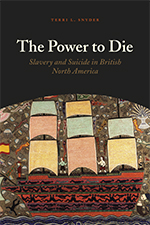 Terri Snyder is Professor of American Studies at California State University at Fullerton who specializes in slavery and gender. She received her PhD in 1992 from the University of Iowa. In 2003, Cornell University Press published her first book, Brabbling Women: Disordered Speech and Law in Early Virginia. The Power to Die: Slavery and Suicide in British America is her second book.
Edward E. Baptist is the author of The Half Has Never Been Told: Slavery and the Making of American Capitalism. He would like to “thank Joshua Rothman, Jefferson Cowie, Louis Hyman, and David Silbey for advice on this piece of writing, and The Junto for letting me publish in their space.”
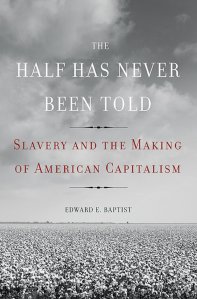 How was an immense increase in the “efficiency” of cotton production achieved in the nineteenth century? The question cuts to the heart of the debates over the history of U.S. slavery.
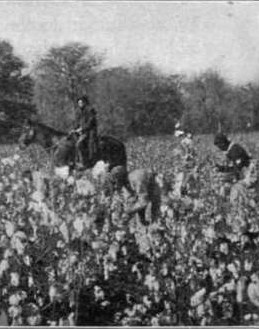
Last week, The Junto linked to sociologist John Clegg’s review in Critical Historical Studies, which considered several recent books on slavery and capitalism. This blog reported Clegg’s take on The Half Has Never Been Told as a “corrective.” Clegg attacks my argument that intense coercion drove a 400% increase in the efficiency of cotton-picking slave labor in the U.S. South between 1800 and 1860. His critiques directly build on the work of economists Alan Olmstead and Paul Rhode. In a series of essays, they asserted that efficiency actually increased because of improved seeds. In a recent issue of the Journal of Economic History, Olmstead appears somewhat displeased that I disagree with their assertions. Continue reading
 It’s been two and a half years since the new history of capitalism marked its arrival with the full red carpet treatment in the New York Times. So it’s about time we saw some serious and constructive critiques of the project. Robin Blackburn’s lengthy review of Empire of Cotton goes some way to bringing that Bancroft-winner back down to earth, particularly by scrutinising the concept of “war capitalism.” But what I particularly want to share with Junto readers today is an article by the NYU sociologist John Clegg recently published in the Chicago-based journal, Critical Historical Studies. Continue reading
 The Junto