Manufacturing Bodies: A Review of Slavery at Sea

Sowande’ Mustakeem, Slavery at Sea: Terror, Sex, and Sickness in the Middle Passage (Urbana: University of Illinois Press, 2016).
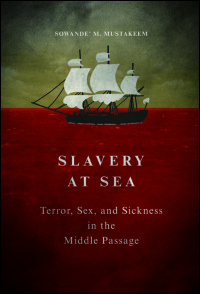
slavery-at-seaWriting a book review a day after Karin Wulf’s entertaining analysis of what makes for a good review might be hubris at its worst, or simply bad timing. And, while I will never have the expertise, style, and prose that made Annette Gordon-Reed’s review of Robert Parkinson’s The Common Cause: Creating Race and Nation in the American Revolution so good, I do hope this review will explore the central ideas of Slavery at Sea in anticipation of a Q&A between the author and The Junto’s own Rachel Hermann tomorrow. Stay tuned for that!

In the introduction of her new book, Assistant Professor of History and African and African American Studies, Sowande’ Mustakeem, writes that, “not all slaves endured the transatlantic passage in the same way.” That statement serves as the driving force behind an unflinching exploration of the “multiplicity of sufferings” endured by aged, infirm, and infant Africans carried across the Atlantic and into slavery. Despite the simplicity of that premise, Mustakeem’s concise monograph exposes how the focus on young and able-bodied African men as the predominant population of captives held in slave ships overshadows the experiences of the “forgotten” of the transatlantic slave trade. As a result Mustakeem’s narrative lingers on the painful details of what she describes as “a massively global human manufacturing process” that commodified the bodies of young and old, healthy and infirm, female and male (9). Continue reading
Reading Race in Early America

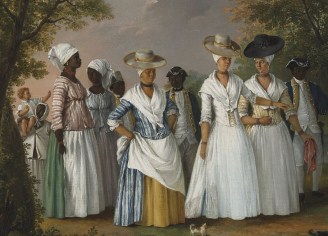
1280px-brunias_cropped_detail-1024x738.jpgIn the past 10 years, we have seen an embarrassment of riches in scholarship that considers race in Early America (broadly understood). The list below is not exhaustive, but highlights some of the recent scholarship. Feel free to add your own favorite recent scholarship in the comments, and keep your eyes out next month, for our CFP for a roundtable on race in Early America.
Continue reading

My Favorite Books from 2016; or, a Christmas Book List for Your Early American History Nerd Friends

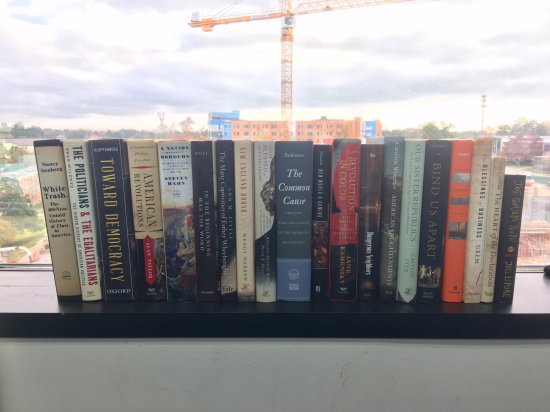
2016 sucked in a lot of ways. Future historians will likely give lots of attention to this year and its events, and not with a positive assessment. But while we cope with this new reality, we at least can console ourselves with the fact that it was an excellent year in historical scholarship, especially in the field of early America. This post is a sequel to my Christmas Book List I posted last year, and may very well become an annual tradition. Below you’ll find some of my favorite books from the past twelve months.

2016-books

Just a few of my favorite books from the past year.

However, I should quickly add, these were far from the only excellent volumes to be released. (Like I said: it was a very strong year.) These books reflect my own interests and background. I hope others will share their favorite books, whether mentioned or not, in the comments. Continue reading

Q&A: Ibram Kendi, Stamped From the Beginning

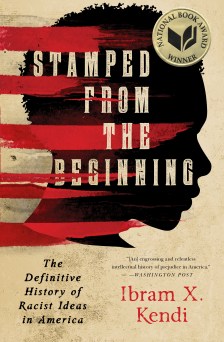
stampedbeginningnbawinnerToday, we are pleased to offer an interview with Dr. Ibram Kendi on his National Book Award winner, Stamped from the Beginning: the Definitive History of Racist Ideas. Kendi is an Assistant Professor of African-American History at the University of Florida, and Associate Editor of the African-American Intellectual History Society blog. You can find his blog posts here. Continue reading
The Global and the Hemispheric

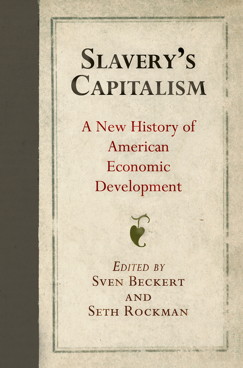
Slavery's CapitalismIn their introduction to Slavery’s Capitalism, Sven Beckert and Seth Rockman write that the accumulation of scholarship about early American economic development necessitates “a fundamental rethinking of American history itself” (2). And, for someone who works on the seventeenth-century Caribbean, those words nonetheless resonated with debates very current in my own field of research. In 2011 – the same year that the conference that resulted in Slavery’s Capitalism was held – Latin Americanist John Tutino declared that, “We face a fundamental rethinking of the rise of capitalism” in response to the work of individuals like Dennis Flynn, Arturo Giráldez, and Kenneth Pomeranz. For Tutino, a global perspective on the development of capitalism amends the “enduring presumptions … that capitalism was Europe’s gift to the world,” and “historically antithetical” to places like Spanish America and the Caribbean.[1] Beckert and Rockman recognize in their description of Dale Tomich’s “Second Slavery” the importance of new scholarship in “weaving together transnational and imperial frameworks, the history of capitalism, and the study of slavery as a profit-seeking enterprise” (11).  Continue reading

Q&A with Steve Pincus, author of The Heart of the Declaration

Following on from Ken Owen’s review of Steve Pincus’s The Heart of the Declaration: The Founders’ Case for an Activist Government (New Haven: Yale University Press, 2016), we continue our Review/Q&A format with an interview with the author. Steve Pincus is the Bradford Durfee Professor of History at Yale University and author of 1688: The First Modern Revolution (2009) and Protestantism and Patriotism: Ideologies and the Making of English Foreign Policy, 1650-1668 (1996), editor of England’s Glorious Revolution 1688-1689: A Brief History with Documents (2005), and co-editor of A Nation Transformed: England After the Restoration (2001) and The Politics of the Public Sphere in Early Modern England (2007). Continue reading

The Continental Toehold Dilemma

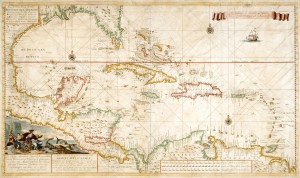
nouvellecarte

“The heart of the English Empire in the seventeenth-century Americas was Barbados,” according to Justin Roberts in his recent William and Mary Quarterly article.[1] That claim is perhaps not surprising—Richard Dunn established the social and economic importance of the island over thirty years ago in his seminal work, Sugar and Slaves. However, Roberts takes that point further by exploring the political ramifications of all of that Barbadian wealth in the West Indies. His article also speaks to a larger sea change in the historiography of the seventeenth-century Caribbean. Continue reading

The Strange Death(?) of Political History

The Strange Death(?) of Political History
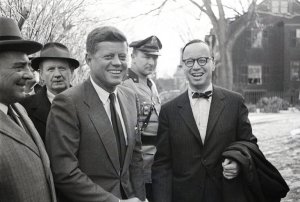
The glory days

The glory days of American political history?

Historians are back in the news, this time not as a scolds (“this bit of history in popular culture isn’t historical enough”) but as Cassandras. Recently Fredrik Logevall and Kenneth Osgood, writing under the New York Times print edition headline “The End of Political History?,” bemoan the collapse political history as an area fit for study by professional historians.[1] Jobs in political history have dried up, fewer courses in the subject are offered in universities, few people are entering graduate school to specialize in the subject and hence “the study of America’s political past is being marginalized.” To Logevall and Osgood this marginalization has two tragic effects. Firstly, it denies American citizens’ access to the intellectual tools necessary to historicize our contemporary politics and “serve as an antidote to the misuse of history by our leaders and save us from being bamboozled by analogies, by the easy ‘lessons of the past.’” It also denies historians access to political power, the ability to influence policy and policymakers in the mode of C. Vann Woodward and Arthur Schlesinger Jr. Continue reading

Autumn Reads

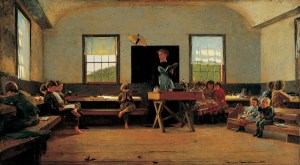
the-country-school

Winslow Homer, “The Country School,” 1871

Looks like #VastEarlyAmerica just got even vaster—and that’s a good thing. Here’s our fall preview of new titles. Please share your books/finds in the comments! Continue reading

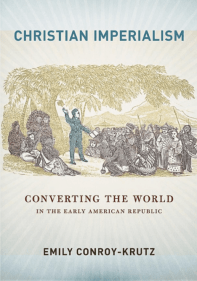
Review: Emily Conroy-Krutz, Christian Imperialism: Converting the World in the Early American Republic

Emily Conroy-Krutz, Christian Imperialism: Converting the World in the Early American Republic (Ithaca: Cornell University Press, 2015)

Christian Imperialism

In February 1812, eight American missionaries—five ordained clergymen and three of their wives—set sail for India as representatives of the recently established American Board of Commissioners for Foreign Missions (ABCFM). Though the specifics of their mission were ill defined, and none of the eight lasted long in India, their mission marked the propitious beginnings of the foreign mission movement in America. Over the course of the next four decades, more than one thousand men and women were commissioned by the ABCFM to missionize non-Christian peoples far beyond the borders of the early American republic. In Christian Imperialism, Emily Conroy-Krutz analyzes the experiences of the ABCFM missionaries from roughly 1812 to 1848. She argues, as the title of her book implies, that the missionaries were agents of “Christian Imperialism,” a vision and effort to convert (and civilize) “heathen” peoples around the globe that variously worked in concert with and in contest against other forms of early American imperialism. Continue reading