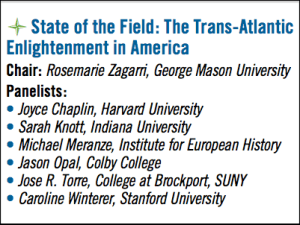
 Thanks to John Fea’s live-tweeting and subsequent reflections on OAH panels this past weekend, I would like to address some of the points and comments made during the panel entitled, “State of the Field: The Trans-Atlantic Enlightenment in America.” Since Twitter is problematic in getting across complex ideas due to its 140-character limitation, I have chosen a few of the tweets in which the comments seemed to me to be common arguments or perceptions that I have previously encountered.
Is Blogging Scholarship? Reflections on the OAH Panel
 On Sunday, at the 2014 OAH Annual Meeting, I was part of a roundtable discussion entitled “Is Blogging Scholarship?” Several other participants have posted their thoughts on the subject; there was also a great deal of live-tweeting, and our own Joe Adelman has also joined (and developed!) the conversation. The discussion itself was fantastic, and was videotaped for later broadcasting. But in reflecting on the panel, I’ve found there are some points I wish to re-emphasize, and some problems I have with the way the entire roundtable was framed. Continue reading
A MOOC Confession
 I have a confession to make: I have been watching MOOCs. I feel guilty about it, honestly, I do—not so much about the fact that I have been watching them, but more about the fact that I have also been enjoying them.
The Week in Early American History
 We begin with sad news. The Junto learned a few days ago that Stephanie Camp, professor at the University of Washington and author of Closer to Freedom: Enslaved Women and Everyday Resistance in the Plantation South, died on April 2 after a battle with cancer. The Seattle Times published an obituary this week, quoting Drew Gilpin Faust: “Students heard her courage and saw her integrity and learned from it in ways they never forgot. Her scholarship did the same.” The Rice University History Department, where Camp worked for two years, has posted a brief tribute. Caleb McDaniel, who worked with Camp at Rice, has also posted a longer personal reflection. The University of Washington is soliciting donations in her honor for the Stephanie M. H. Camp Lecture Fund for the History of Race and Gender.
Guest Post: Dramaturging The Tower: A Historian’s Cannibalistic Adventures in Theater
Today’s guest post come from Maya Rook, a writer and artist living in Brooklyn, New York. She is pursuing her PhD in American Cultural History at Drew University. Collaborating on The Tower has inspired her to write her dissertation about the Donner Party. If she were to eat a piece of human flesh, it would likely be from the belly or rear—braised until the meat is tender and then broiled so the skin reaches crispy perfection. Check out her food blog and personal website.
 Just over a year ago, I was at a celebration with friends and overheard someone talking about the Donner Party. My interest was piqued, as it isn’t everyday you hear people casually chatting about this group of California emigrants who resorted to cannibalism during the winter of 1846-47. I’d always been fascinated by the topic and was soon deep in a conversation with Adam Scott Mazer about his plans to write a play called The Tower based on the history and mythology of the Donner Party. Strangely enough, I’d recently wanted to get involved in theater but didn’t know how, so the timing seemed quite auspicious. When Adam discovered I was a PhD student in American Cultural History we decided to work together on the project and I was brought on board as the dramaturg. Continue reading
Stonecutting and Religion in America
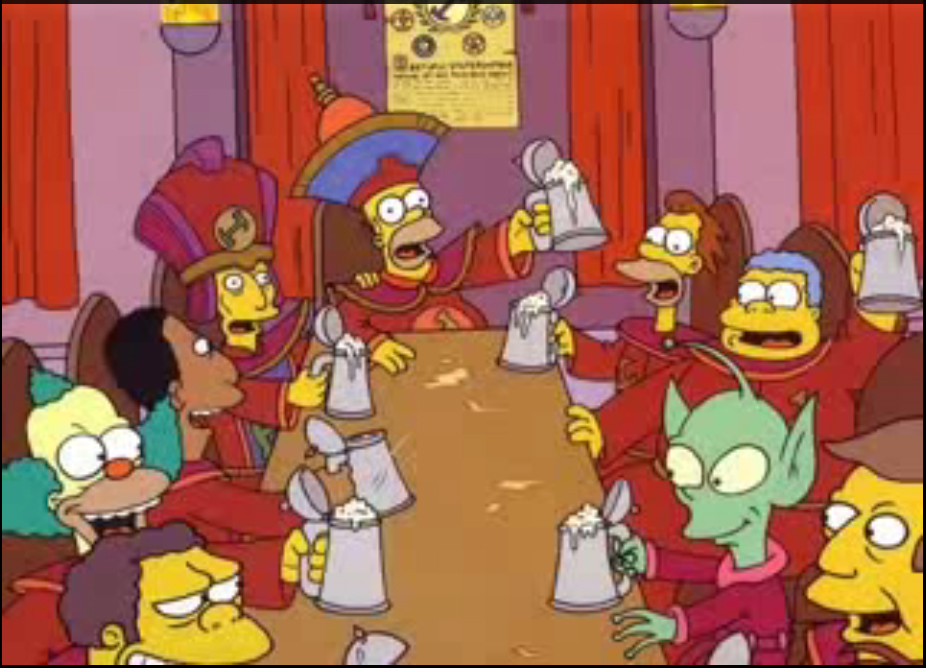 I’ll just admit it: Freemasonry is one of those things in American history that I have trouble getting my head around. I suppose I understand the importance of guy-time, but many of my closest friends are women. The very idea of secret societies, with initiations and special rings, just seems boyish to me. I would suppose that the boyishness is the point–a search for wonder and enchantment and all of that–except that early in the nineteenth century the Masons banned alcohol at meetings: no stein hoists here. The largest group at midcentury actually required its members to be teetotalers, making enchantment a much harder sell, for my money. More to the point, in the same period enchantment without booze could be had at a Methodist camp meeting, which seems like it would have been quite a lot more interesting, what with women there. Continue reading
Interview with Michael Jarvis, Junto March Madness 2014 Champion
 We here at The Junto would like once more to thank everyone who participated in this year’s March Madness tournament, including those who nominated books, all of the voters, and the authors who made some of these match-ups very close indeed.
To close out this year’s lunacy, we thought it would be fun to check in with the winner. Michael Jarvis, a professor of history at the University of Rochester, took home top honors this year for his 2010 book In the Eye of All Trade: Bermuda, Bermudians, and the Maritime Atlantic World, 1680-1783. The Junto caught up with Jarvis by email to get his thoughts on the tournament, his book, the field of Atlantic history, and the challenges of a major research project.
The Week in Early American History
 Happy Sunday! With the excitement from March Madness still ringing through the halls at The Junto, we look forward to bringing you more great content on a wide range of issues in early American history in the coming weeks (including an interview with Mike Jarvis, our champion!). In the meantime, let’s head right to this week’s links!
Continue reading
Junto March Madness 2014: And The Winner Is…
 Over 600 votes were cast in the Championship Game of Junto March Madness 2014—an NCAA Tournament-like bracket that pitted some of the best books in early American history against each other (or, at least, those published since 2000). Unlike last year, when Edmund Morgan’s American Slavery, American Freedom was the runaway winner from start to finish, this year’s tournament provided a nonstop series of upsets, with no number-1 seed making the Final Four, and the championship game involving a 6-seed squaring off against a 13-seed. Continue reading
Junto March Madness 2014: Championship Game!
It started off with 64… now only 2 remain. It’s the day you’ve been waiting for—the time when the ultimate champion of Junto March Madness will be decided. Strong challengers have fallen by the wayside; now your votes will decide who walks away with the fame, fortune and accolades for being recognized as the best early American history book since 2000. Final Four results, and the final poll, all after the jump!
 The Junto