This is the second post in The Junto’s roundtable on the Black Atlantic. The first was by Marley-Vincent Lindsey. Mark Dixon is a PhD candidate in Church History at Princeton Theological Seminary writing a dissertation on the interaction and exchange between German Pietists and enslaved Africans in colonial South Carolina. He spent the past year (2015-16) as a Fulbright Graduate Fellow researching in Pietist archives in Halle and Herrnhut, Germany. He produces Church History Chat, a podcast featuring interviews with historians of Christianity, which will begin publishing episodes in February 2017.
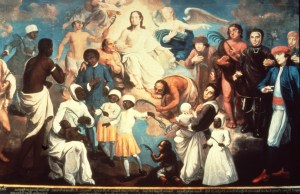
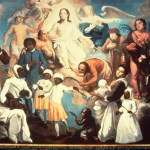
A painting depicting the first Moravian converts. Johann Valentin Haidt, “First Fruits” (1747). Source.
If it sounds strange to speak of a German Atlantic in the first place, it must sound even stranger in a conversation dedicated to new scholarship and understandings of the Black Atlantic. After all, Germany was not an Atlantic colonial power, and German speakers were not as deeply involved in the slave trade as their British, Dutch, Portuguese, or Spanish neighbors. Indeed, Aaron Fogleman’s 2015 keynote lecture, “A German Atlantic, or Germans in the Atlantic?” delivered at the McNeil Center’s spring workshop, questioned the label’s usefulness for historians.[1] I want simply to assert the reality of the German Atlantic, and more importantly speak to its surprising utility for scholars interested in the experiences of Africans and people of African descent in the eighteenth-century Atlantic. In particular, the activities of German Pietists (and their surviving sources) can enrich Black Atlantic studies. Continue reading
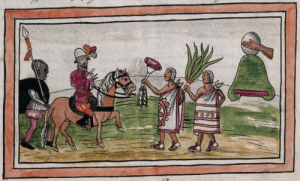
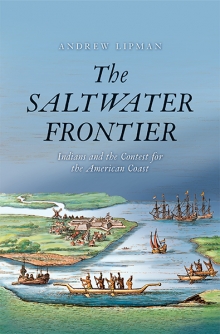
 One of the trending themes in Native American history is “Settler Colonialism.” From Patrick Wolfe’s foundational essay, to recent works by historians and literary scholars—Bethel Saler, Jodi Byrd, Gregory Smithers, David Preston, and Lisa Ford, for instance—this theoretical model has attracted significant attention within the field.
 More than 30 scholars from three continents gathered at the Williamsburg Inn from October 16th through the 18th to present

 Like many of you, I find myself teaching the first half of the U.S. history survey this fall. The first few times through the course, I used a textbook and appreciated the clear organizational structure and built-in pacing. Teaching with a textbook felt like teaching with training wheels, and I certainly needed them for my first few laps. But as my confidence grew, so did my desire to assign primary sources, articles, monographs, museum catalogs, and other readings. While I am impressed with the quality of many texts – Eric Foner’s Give Me Liberty, and Kevin Schultz’s HIST are among my favorites – I cannot justify assigning an (often outrageously) expensive textbook if it is not going to be the cornerstone of my course. But my course evaluations often include requests for textbooks, particularly among athletes or other students with serial absences. I have tried placing a textbook on reserve, but in the three semesters of doing so, no one has ever checked out the book. It seems like our discipline could use an affordable, synthetic safety net for students who would like one.

 The Junto