Craig Bruce Smith, American Honor: The Creation of the Nation’s Ideals during the Revolutionary Era (Chapel Hill: University of North Carolina Press, 2018).
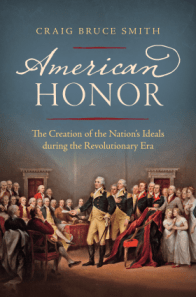 In American Honor, Craig Bruce Smith places morals, virtue, and ethics at the center of the American Revolution. Smith argues that in the late-colonial period, understandings of honor transformed. Instead of something hereditable, honor became based on merit. That “ethical transformation” helped bring about the Revolution. Independence then allowed Americans to realize its potential. In a phrase, you might say the American Revolution was “made on honor, sold on merit.”[1] Continue reading
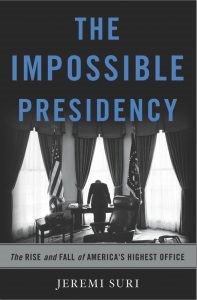 The question of whether the office of the Presidency is too unwieldy with its ever-expanding duties has once again engaged pundits. Most recently, journalist Scott Dickerson’s article raised the issue, a piece which includes the recent study by Jeremi Suri, The Impossible Presidency (New York: Basic Books, 2017). Presidents often used similar rhetorical messages–from Washington to Franklin D.Roosevelt. Suri views one of the mounting obstacles to the presidency as being a discursive problem. Interestingly, the use of language, so central to the presidency, with its surprisingly similar messaging overtime, produced unintended, and often times, inverted outcomes in its collision with capitalism and technology. Suri is currently Mack Brown Distinguished Chair for Leadership in Global Affairs and Professor in the Department of History and the LBJ School of Public Affairs at University of Texas, Austin.
 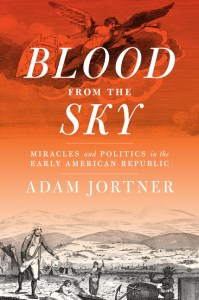 The role of religion in the early republic has received a fair amount of attention in the recent decades. And though there are competing narratives concerning how ministers and denominations took advantage of the post-revolutionary era—the “
 At a time when political events seem to place the very meaning of American democracy under the microscope, it is perhaps unsurprising that so many recent works have looked to re-evaluate the American Founding. Books focusing on the mid-1770s in general have included Kevin Philips’s 1775, Richard Beeman’s Our Lives, Our Fortunes, & Our Sacred Honor, and Joseph Ellis’s American Quartet. Recent books that have looked more specifically at the Declaration of Independence itself include Danielle Allen’s Our Declaration. Robert Parkinson’s The Common Cause, too, has called for a re-evaluation of what motivated those who fought for Independence, though his work calls for a much less celebratory conclusion. Such a list demonstrates the importance of the mid-1770s to America’s national identity. With The Heart of the Declaration, Steven Pincus throws his hat into the ring, too.
 In April, Tom Cutterham
 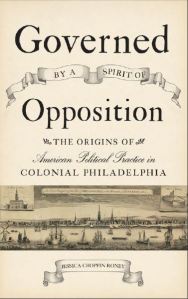 In recent years, early American political history has received considerable attention. A range of historians have enriched our understanding of how Americans participated in and contributed to politics in the early republic.
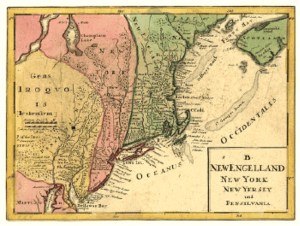 States’ rights looms large in discussions of both historical and contemporary American politics and its federal union. For good reason, the ante-bellum states’ rights movement of the South is often the first to come to mind, but such a narrow focus does not do justice to the topic as a dynamic historical phenomenon, nor does it provide adequate context for the more modern manifestations of states’ rights movements. In the early republic, New Englanders promoted their own brand of states’ rights, to protect a type of near-sovereignty they attributed to their legislatures, as the best way to promote their interests and shield individuals from distant oppression.
 Two weeks ago, 175 historians descended upon the Massachusetts Historical Society (MHS) in Boston for a three-day conference that considered the political, social, economic, and global parameters of the American Revolution. The conference consisted of eight panels (with pre-circulated papers), two keynotes, and some special presentations on digital projects. The conference proceedings were live-tweeted under #RevReborn2, and fellow Juntoist Joseph Adelman provided some
  The Junto