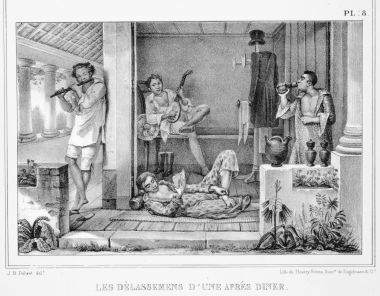
Jean-Baptiste Debret, “Les dèlassemens d’une aprés diner,” from Voyage Pittoresque et Historique au Brésil, vol. 2 (Paris: Firmin Didot Frerès, 1835)
Today’s guest post comes from Rachel Zimmerman (Ph.D., University of Delaware), Assistant Professor of Art History at Colorado State University-Pueblo. She has been studying the art and architecture of the Brazilian town of Minas Gerais since her first trip to the region in 2006. She began examining consumption in colonial Brazil for her dissertation, “Global Luxuries at Home: The Material Possessions of an Elite Family in Eighteenth-Century Minas Gerais, Brazil,” and is continuing research for a book project on elite material culture in the city of Mariana. Follow her work here.
According to the early nineteenth-century English merchant John Luccock, it was customary for Brazilian men to discard stiff outer layers when at home and wear only a cotton shirt, often unbuttoned, knee-length breeches, and clogs.[1] Brazilian standards of decorum permitted informal dress in domestic settings, even when receiving guests. Examination of colonial-era probate inventories from Minas Gerais, the gold mining district, reveals that a small number of educated elite men transformed their state of undress from ordinary to stylish with the addition of a nightgown. Continue reading

 When
When  As we continue to learn more about the seizure and internment of migrant infants and children, both along the U.S.-Mexico border and in ICE raids throughout the nation, historians have asked us to wrestle with our
  In August 2017, I virtually attended and
  “My friends and I might still be 11, and we might still be in elementary school, but we know . . . that we have seven short years until we too have the right to vote.”

 In a certain village of vast early America, whose name I do not recall, a book fell open. Then another. And another. By 1860, many generations’ worth of American readers had imbibed the two-volume work of Spain’s early modern master, Miguel de
  The Junto