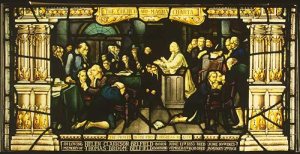
 Joseph Yesurun Pinto, a 31 year-old Anglo-Dutch émigré in the autumn of 1760, had led New York’s Shearith Israel synagogue for barely a year when the second notice appeared in the papers. To re-commemorate the British conquest of Canada, all “Christian societies” and “houses of worship” would celebrate a day of thanksgiving on Thursday, October 23d. Over the past decade, New Englanders and their neighbors had held at least 50 fast days, many to lament God’s judgments against America, or to reform their wayward behavior. The proclamation of a thanksgiving day likely brought some measure of relief and joy.
Monthly Archives: November 2014
The Story of “Evacuation Day”
 A century after the end of the War for Independence, New Yorkers continued to celebrate a holiday known as “Evacuation Day,” commemorating the leaving of the last British troops from New York City on November 25, 1783. It marked the end of a seven-year occupation by the British army who used the city as the headquarters for its North American operations during the war. But it also marked the beginning of a holiday that would be enthusiastically celebrated by New Yorkers for a century to come. On this anniversary, I offer the following narrative account of a day that played a large role in the city’s historical memory of the Revolution for more than a century, but was eventually displaced when it became incompatible with contemporary circumstances. Continue reading
A Beginner’s Guide to Mapping Early America with Basic GIS
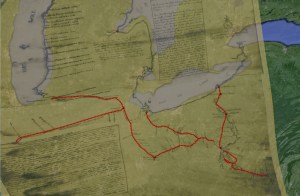 Over the past couple years, friends have asked me a lot about maps and mapping software—questions I probably have no business fielding. I’m not truly formally trained in GIS, I’ve picked up a lot of things online, from books, in workshops, but mostly through trial-and-error, and half the time I still prefer to draw my maps by hand. (Yes, I like to draw.) It’s sort of like the four-eyed leading the blind.
There’s a reason, though, that my friends have few other places to turn. Workshops at universities, as well as many guides online, are still largely geared towards those working on more contemporary history, and to those looking to manipulate census and other large data sets. For those of us working on colonial America—especially those working on frontiers, borderlands, and native grounds—our materials rarely support this kind of work.
As I thought about my post the last couple days, I realized I wanted to write something less to those also working on spatial-intensive projects, and something more for those—like my friends—looking to find quick and simple ways to add maps to presentations and papers. In other words, those who aren’t about to download ArcGIS, run windows on their mac, enroll in a series of workshops, lose days (weeks and months) to inputting vector and raster data, and become geospatial pros. Those who are more interested in manipulating a historic map than creating a new one from historic data. Casual mappers and prospective weekend warriors of geohistorical analysis, this is for you. Continue reading
The Week in Early American History
 Whether writing or grading term papers has kept you from all things early American, here’s a quick recap of some of the top news stories of the week(s)!
On to the links! Continue reading
Guest Post: Keeping the “Human” in the Humanities
Hannah Bailey is a PhD candidate in History at the College of William & Mary, where her research examines the interconnectivity between developing notions of race and the expansion of the African slave trade in the early modern French Atlantic. This is her second guest post at The Junto. Be sure and read her earlier post on French archives and entangled histories here.
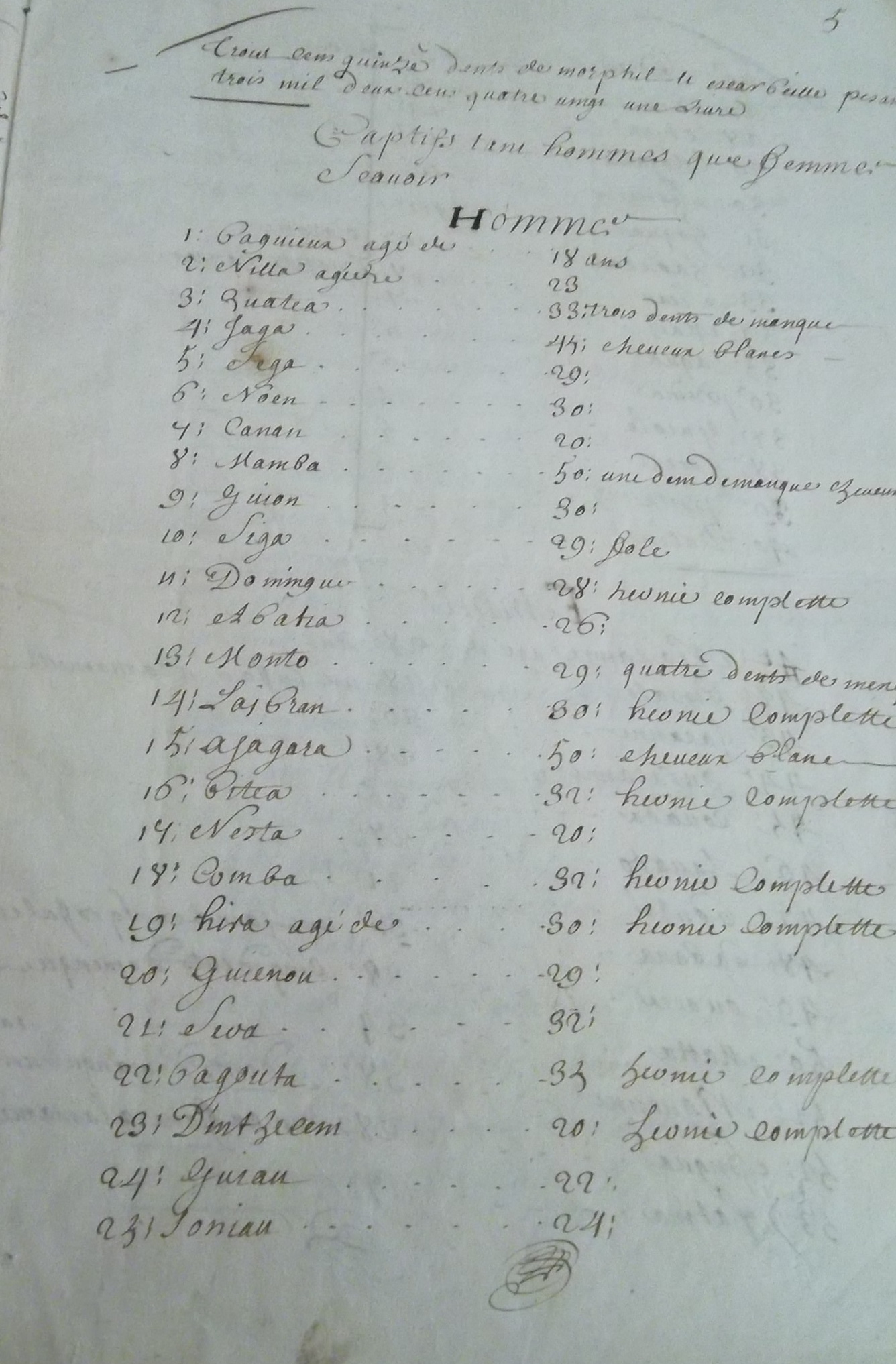 As someone who is also leaping into an entirely new historiography in preparation for dissertation writing, I could commiserate with Casey Schmitt’s brilliantly astute post on the costs and benefits of comparative projects. It can be terrifying to move from a historiography with which one is relatively comfortable to, as she puts it, “a [new] field where innumerable scholars have dedicated entire careers.” I took one undergraduate class on West African history (which was a survey course that occurred five years ago), and yet my dissertation focuses heavily on early modern histories of West Africa and the Atlantic networks of knowledge (and ignorance) that shaped them. The body of exemplary secondary source material on West Africa is vast, and working with it for the first time is more than a little daunting. Continue reading
Skype in the Classroom: Applications for the History Classroom
 Depending on whom you ask, the introduction of technology into the classroom is either a blessing or a curse. The proliferation of technology has provoked some good discussions, in addition to expletives involving use (abuse?) of Powerpoint slides in lecture. For one senior (non-UNH) colleague, who shall remain nameless, the mere mention of the word “Powerpoint” is akin to a bell ring for Pavlov’s dog, though with incarnadine face and froth at the mouth the outcome rather than drooling. Continue reading
Guest Post: “Fear in the Revolutionary Americas” Conference Recap
Elizabeth M. Covart is an early American historian, writer, and podcaster. Presently she is working on her first book manuscript about cultural community creation in Albany, New York, 1614-1830. Liz also writes a practical blog about history and how to make it more accessible at Uncommonplacebook.com and her new podcast, “Ben Franklin’s World: A Podcast About Early American History,” seeks to bring the work of academic and public historians to history lovers everywhere.
 October 31, 2014. On the most fearsome day of the year, Tufts University convened “Fear in the Revolutionary Americas, 1776-1865,” a one-day conference designed to explore the question: What role did fear play in the revolutions that occurred in North and South America between 1776 and 1865? Continue reading
The JuntoCast, Episode 13: Education in Early America
 We’re happy to bring you the thirteenth episode of “The JuntoCast.” Continue reading
Economic Growth and the Historicity of Capitalism
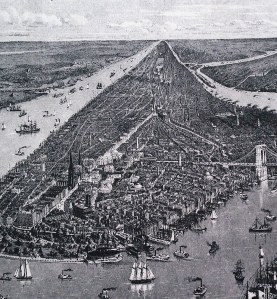 One of the central characteristics of the new history of capitalism has been its tendency to defer the question of just what “capitalism” is. The project’s enquiry starts with the question, not with a predetermined answer. But in order to know where to look, historians have to start with some idea about what makes a place and a time capitalist. As Tim Shenk points out in a recent article in The New Republic, the clue around which they converge is economic growth. Continue reading
Guest Post: Megan Brett on the Papers of the War Department, 1784-1800
Today’s guest poster is Megan R. Brett. Brett is a doctoral student in History at George Mason University where her dissertation will focus on the challenges faced by early American diplomatic families stationed overseas. She is also a Digital History Associate at the Roy Rosenzweig Center for History and New Media.
 The Papers of the War Department, 1784-1800, is a rich resource, not only for its content but also as a community transcription project. Only a small percentage of the transcribers identify as educators or academics; what draws people to volunteer their time deciphering 18th century handwriting? Continue reading
 The Junto