This is the first entry in our series on Teaching Amid Political Tension. Today’s post is by Tara Strauch, who is an Assistant Professor of History at Centre College in Danville, KY. You can find her blogging at Teaching United States History, and Centre Trail (where she will soon also have podcasts.) Find her on Twitter @historian_tara.
I teach at a small liberal arts college in Kentucky. Like many academics, I spend most of my time teaching, thinking about teaching, and mentoring. I genuinely enjoy my students; they are smart, thoughtful, engaged, and generally eager to learn new things. And while the past year has been an interesting one to spend on a college campus, my students haven’t seemed remotely surprised about the political, racial, and class tensions that have occasionally swept across campus.
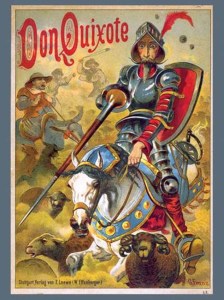 In a certain village of vast early America, whose name I do not recall, a book fell open. Then another. And another. By 1860, many generations’ worth of American readers had imbibed the two-volume work of Spain’s early modern master, Miguel de
  The NEH Doing Digital History Institute took place at the George Mason University School of Law, over two weeks in July. The primary instructors, Sharon Leon and Sheila Brennan conceptualized the Institute as a means to aide mid-career scholars to learn digital tools both to serve as “ambassadors” for DH, and also because digital tools can allow historians to ask new research questions of sources. [1] This Institute in part, answers calls made by William Cronon, Cameron Blevins, and others.[2] Even as the interest in Digital History grows, there still remains the challenge of accessing digital history training for those outside of elite research universities. There is also a need to expand the number of historians who are qualified to peer review digital projects and to assess them in tenure portfolios. [3]
 Last week, in
  The Kinder Institute is currently inviting submissions for presenters at the 2016-17 meetings of the Missouri Regional Seminar on Early American History (MRSEAH), which will be held on October 7, 2016, and April 21, 2017, in Columbia, MO, and on November 4, 2016, and February 17, 2017, in St. Louis. We welcome work on all aspects of early American history, broadly defined to extend throughout the Americas geographically and forward in time through the 19th century, and we are especially eager for submissions relating to political development, political thought, constitutionalism, and democratization. All MRSEAH submissions will also automatically be considered for the Kinder Institute’s Friday History Colloquium Series, held on campus during the academic year. Please visit the link below for complete instructions on submitting a proposal to present at the MRSEAH.

 The Junto