 What are the rules for scholarly engagement online? Should there be any? Some of the great things about social media in the past few years have been its leveling effect, its irreverence, and its real-time discussion capability. That last in particular has become handy at conferences with the rise of live-tweeting, where participants create a backchannel discussion or broadcast to those not able to attend the occurrences of a conference. It’s been incredibly helpful and interesting for those of us on Twitter, but there’s also been pushback from non-users about what people may be saying about their work outside their field of vision. So should tweeting have rules?
Guest Post from Vaughn Scribner: “Fabricating History: The Curious Case of John Smith, a Green-Haired Mermaid, and Alexandre Dumas”
Vaughn Scribner is a Visiting Assistant Professor at the University of Central Arkansas. He has published on topics ranging from early American tavern culture to the commodification of slaves in Tidewater Virginia, and also has a forthcoming article on early American mineral springs and spas. His book manuscript (in progress), Beyond Bacchus: Colonial Taverns and the Golden Age of the British Empire in America utilizes the colonial tavern space to realize how urban colonists realized the full potential of the British Empire in America from 1744 to 1765. He is also currently researching for an article on early modern conceptions of mermaids and tritons. For more info or to contact Vaughn, please visit www.vaughnscribner.com.

Figure 1: “Captain Hailborne at St. Johns Newfoundland, 1655,” from Ludwig Gottfriedt, Newe Welt und Americanische Historien (Frankfurt/ Bey denen Merianischen Erben, 1655). The Mariners’ Museum.
I originally planned for this piece to be a brief investigation into a number of articles that appeared in the Gentleman’s Magazine from 1750 to 1775. The articles, it must be added, consisted of in-depth analysis of mermen and mermaids. Yes, a number of early modern Britons—ranging from Cotton Mather to Benjamin Franklin—entertained, if not believed in, the existence of merfolk.[1] A deeper analysis of early modern conceptions of mermen and mermaids, my article would propose, provide a more nuanced understanding of Britons’ imperial imaginations. But that will have to wait, because my research for this piece led me down a different path that was both extremely frustrating and, ultimately, quite enlightening. Continue reading
The Many & the One
 Like many, Amos Doolittle struggled to turn in a decent first draft of American history. The 21 year-old engraver, later known as the “Paul Revere of Connecticut,” arrived in Lexington and Concord shortly after April 1775. Anxious to capture the battles’ action and aftermath, he chatted with local residents. He sketched terrain. For Doolittle, a trained silversmith, it was a chance to experiment with a craft he had yet to master. Part of what he produced, a set of four views storyboarding the “shot heard round the world,” hangs in the Boston Public Library’s new exhibit, “We Are One: Mapping America’s Road from Revolution to Independence.” By Doolittle’s lights, Massachusetts makes for a furious and frenzied tableau: gusts of redcoats’ gunpowder hazing the sky, and colonial ranks splintering on the advance. On the American side, it is hardly a picture of union. Patriots scatter, racing blindly to frame’s edge. In his rough draft of Revolution, Amos Doolittle demands that we unlock all hopes of what might come next. Continue reading
The Week in Early American History
 It has been another eventful week in early American history. Without further ado, here are the links! Continue reading
The Digital Antiquarian: Keeping It Old, Making It New
Today’s guest post is by Carl Robert Keyes, an associate professor of history at Assumption College in Worcester, Massachusetts. He recently began tweeting: @TradeCardCarl.
 On the Luddite to Early Adopter spectrum I fall somewhere around “Printing Presses Are Cool.” It was thus with a bit of trepidation that I approached the Digital Antiquarian Conference (May 29-30) and the accompanying Digital Antiquarian Workshop (June 1-5), hosted by the American Antiquarian Society in Worcester, Massachusetts. The conference was open to all (with nearly 200 people registering), but the workshop was restricted to eighteen participants selected from those who submitted applications in advance, not unlike the summer seminars in book history and visual culture sponsored by the AAS.
Review: Janet Polasky, Revolutions Without Borders
Janet Polasky, Revolutions Without Borders: The Call to Liberty in the Atlantic World. New Haven: Yale University Press, 2015.
 R. R. Palmer’s Age of Democratic Revolutions famously had no room in its two volumes for what many of us now recognise as the most revolutionary of them all—the one in Haiti between 1791 and 1804.[1] Janet Polasky has written a version for our own time, in which black men and white women mingle with the better-known protagonists of American, French, Dutch, and other, less successful revolutions in the last quarter of the eighteenth century. Revolutions Without Borders is no analytical, comparative account, but an histoire croisée in which people and texts are constantly on the move, interacting with each other in all sorts of ways, setting off unexpected sparks. Continue reading
The Maturing Blogosphere of Early America
 Next week, early Americanists will gather for the joint annual meeting of the Omohundro Institute and the Society of Early Americanists. On the first day of the conference (Thursday, June 18), I’ve organized a roundtable discussion on “The Maturing Blogosphere of Early America.” Here I’d like to introduce it and invite you to join us for the session.
Guest Post: The Foundations of New England States’ Rights as a Unique Entity
Today’s guest post comes from Jordan Fansler, who received his Ph.D. from the University of New Hampshire at Durham in May 2015. The following is based on his dissertation, “A Serious and Jealous Eye: Federal Union in New England, 1775 – 1821.”
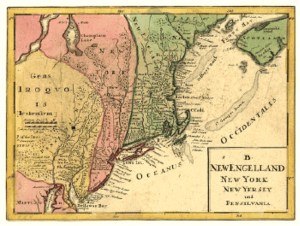 States’ rights looms large in discussions of both historical and contemporary American politics and its federal union. For good reason, the ante-bellum states’ rights movement of the South is often the first to come to mind, but such a narrow focus does not do justice to the topic as a dynamic historical phenomenon, nor does it provide adequate context for the more modern manifestations of states’ rights movements. In the early republic, New Englanders promoted their own brand of states’ rights, to protect a type of near-sovereignty they attributed to their legislatures, as the best way to promote their interests and shield individuals from distant oppression.
The Week in Early American History
 Welcome to another addition of The Week in Early American History! Continue reading
The Importance of Partisanship in New York City, ca. 1769–1775
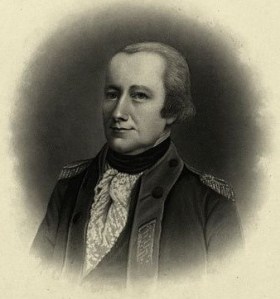 On April 25, 1775, hundreds of New Yorkers acknowledged receiving “a Good firelock, Bayonet, Cartouch Box, and Belt.” Six days after the Battles of Lexington and Concord, and three days after Israel (Isaac) Bissell told New Yorkers the news, Alexander McDougall mobilized support against the British. The War of American Independence had reached New York and, with hundreds of supporters, McDougall was ready to fight.[1] By April 1775, McDougall was a revered figure across colonial America, widely known as “the Wilkes of New York.” He was an individual who, like John Wilkes, was perceived as willing to fight for the liberties of the press, the people’s welfare, and against arbitrary rule.[2] McDougall’s popularity, by 1775, had been five years in the making. But, in 2015, historians are yet to fully appreciate the role he played in the coming of the Revolution. In this post, I want to reemphasize his influence in affecting New Yorkers’ allegiances. Continue reading
 The Junto