 This weekend it wasn’t just the swiftly-approaching independence referendum causing excitement in Edinburgh—it was also the annual conference of the British Group of Early American Historians (BGEAH: that’s “beggar” to some, “big-ear” to others), which brought together early Americanists from Southampton to Dundee and all points in between, plus a few from the far side of the Atlantic. In the stately setting of Edinburgh University’s Old Medical School, the theme we were given was “Better Together? Union and Disunion in the Early Modern Atlantic.” I couldn’t possibly cover everything, but in this post I’ll share a few of my personal highlights. Continue reading
Guest Post: American and Scottish Independence: Hearts and Minds
Simon Newman is Sir Denis Brogan Professor of American History at the University of Glasgow. His most recent book, A New World of Labor: The Development of Plantation Slavery in the British Atlantic, was published by the University of Pennsylvania Press in 2013. In this guest post, Newman draws parallels between the American campaign for independence in the 1770s, and the current campaign for Scottish independence.
 On September 18th millions of voters in Scotland will head to the polls to answer a simple question: “Should Scotland be an independent country?” As an historian of the American Revolution living and working in Scotland I am struck by the parallels not just between the two movements for independence, but more significantly between the ways in which the British government in the eighteenth century and the UK government in the twenty-first century have challenged those who sought and seek independence. Continue reading
The Week in Early American History
 Let them eat links!
Guest Post: The Value of Storytelling
We’re thrilled to welcome as our latest guest poster, Casey Schmitt. Casey is a PhD candidate in History at the College of William & Mary, where she is writing a dissertation on the Iberian roots of seventeenth-century Anglo-American slave law under the supervision of Brett Rushforth. Casey holds an MA in history from the University of Utah, where she wrote an excellent thesis on the British Asiento, illicit trade, and the limits of empire in the eighteenth-century Caribbean. Her teaching and research interests center on the inter-imperial nature of the early modern Americas.
 As a newly-minted ABD embarking on my first stab at teaching the early American history survey, I find myself buried beneath my own excitement for the material. No one warned me that the biggest obstacle to designing a course would be curbing my own unrelenting enthusiasm. Perhaps no part of that enthusiasm has proven more damaging to my syllabus than my passion for storytelling. Specifically, I approached teaching the early America survey with a litany of historical works of fiction and non-fiction that I wanted to familiarize undergraduates with: 12 Years a Slave, Benito Cereno, Poor Richard’s Almanac, Letters From an American Farmer, among many, many other titles. Before too long I was looking at a weekly reading word count over 150 pages. Yikes. Continue reading
Is the History of Capitalism the History of Everything?
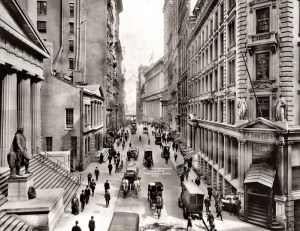 Seth Rockman begins and ends his recent essay on the “new history of capitalism” by describing capitalism as an economic system; but one of the features of the movement he describes is that it rightly treats capitalism as much more than that. As Rockman admits, “it is difficult to say what exactly it excludes.”[1] What’s most provocative and powerful about the new history of capitalism is precisely the fact that it recognizes and tries to historicize the pervasiveness of capitalism as a system that touches every aspect of our lives—everyone’s lives. Capitalism isn’t just in the workplace and the marketplace; as Jeffrey Sklansky has suggested, it’s in our very ways of being, seeing, and believing. But if the history of capitalism is an empire with no borders, just what kind of claims can it be making?[2] Continue reading
Another Kind of Blood: Edward Baptist on America’s Slaver Capitalism
Edward E. Baptist. The Half Has Never Been Told: Slavery and the Making of American Capitalism. New York: Basic Books, 2014.
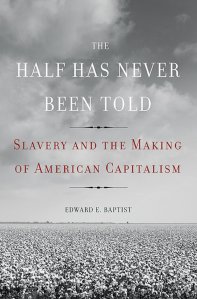 The Half Has Never Been Told attempts a difficult feat: to analyze slavery’s place in the history of American capitalism, but also describe it as a lived experience. This is a story about commodities, bonds, and blood.
To join the abstract and the concrete, Edward Baptist relies on extended metaphors. His narrative traces the form of a human body: the ten chapters move from “Feet, 1783-1810” through “Tongues, 1819-1824” to “Arms, 1850-1861.” Overall, the narrative book follows an image, adapted from a Ralph Ellison essay, of “slavery’s giant body,” stretched across the territory of the United States, serving as the stage on which the drama of American history is acted.[1]
The Week in Early American History
Savor summer’s finale weekend with an extra side of early American history news. Continue reading
Trials and Tribulations of Writing while Sleeping

 A few weeks ago, I dropped my iPhone in water. If you were wondering, those things do not float. As I pulled the phone out and dried it as best I could, all I could think about was my dissertation. I was in the throes of finishing a chapter, and I had a lot of really good ideas on that phone. In this post, I want to explain why my phone has become so important to my scholarly life. Continue reading
Review: Maura D’Amore, Suburban Plots: Men at Home in Nineteenth-Century American Print Culture
Maura D’Amore, Suburban Plots: Men at Home in Nineteenth-Century American Print Culture. Amherst: University of Massachusetts Press, 2014.
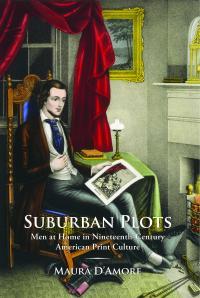 The world was a strange and startling place for Rip Van Winkle when he awoke from a twenty-year nap in New York’s Catskill Mountains. He had ventured to the woods to find a moment’s peace from “the labour of the farm and the clamour of his wife.”[1] Now well rested, bountifully bearded, and slightly disoriented, Van Winkle returned to his village anxious to understand the changes that left him “alone in the world,” but pleased that he was now part of a “more fraternal, organic domestic order.”[2] In the time since his fateful game of ninepins mixed with moonshine, Van Winkle, along with his male village compatriots, was now free to exercise his own masculine alternatives to traditionally female forms of domesticity. Maura D’Amore opens her book Suburban Plots: Men at Home in Nineteenth-Century American Print Culture with this unconventional reading of Washington Irving’s well-known tale. Seeking to understand the emergence of what she terms “male domesticity” in the nineteenth century—defined (somewhat inconsistently) as an ideology of “self-nurture in suburban environments [that provided] an antidote to the malaise of urban life and the strictures of feminine self-sacrifice”—D’Amore presents Rip Van Winkle as a prototype of various middle- and upper-class men who attempted to implement domesticity “on [their] own terms” in the midst of a quickly industrializing and alien world.[3] Continue reading
Guest Post: Lowell & the Executive
Today’s guest post is from Lindsay Schakenbach, a Ph.D. candidate in history at Brown University. Her dissertation, “Manufacturing Advantage: War, the State, and the Origins of American Industry 1790-1840,” explores the development of the arms and textile industries in the context of national security, diplomacy, and territorial expansion.
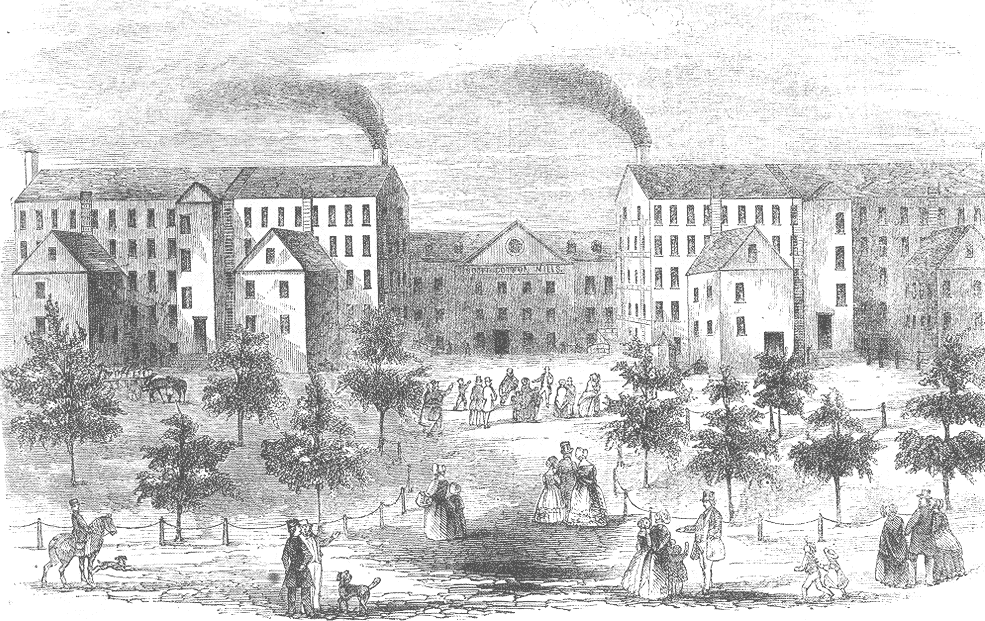 Look through any opinion section of The Wall Street Journal and you’ll almost certainly find condemnations of government intervention in business or a lambasting of the inefficiencies of bureaucratic meddling. Too much government, these commentators say, is bad for the economy. A reexamination of America’s origins as an industrial superpower, however, suggests a different mantra. Take the founding of Lowell, Massachusetts, for example. Even if we debate the birthplace of the American Industrial Revolution–Pawtucket, Rhode Island?, Patterson, New Jersey?–the fact remains that Lowell was the site of the first large-scale integrated factory system in the United States and stands as a symbol of the birth of industrial capitalism. And its rise to prominence depended on federal meddling. Continue reading
 The Junto