Rebecca Brannon, From Revolution to Reunion: The Reintegration of the South Carolina Loyalists (University of South Carolina Press, 2016).
 In her award-winning Liberty’s Exiles, Harvard University’s Maya Jasanoff offered a lively account of the Loyalist diaspora, those individuals who left the newly formed United States as a consequence of their Loyalism. In her highly anticipated appendix, Jasanoff stated that over 60,000 Loyalists left in search of a new home—but what of those who stayed? Until recently, the reintegration of some 400,000 Loyalists into American society has been an overlooked topic. As James Madison University’s Rebecca Brannon notes, “Historians of American Loyalism have long favored those who left . . . over those who stayed” (p. 5), and with her well-researched From Revolution to Reunion: The Reintegration of the South Carolina Loyalists (University of South Carolina Press, 2016), Brannon takes a major step to address this obvious historiographical oversight. Continue reading

 Guns are ever-present in American life. Gun culture, though frequently ridiculed by opponents for its fetishization of firearms, is inescapable in the 21st century. Visual media demonstrates the logical outcome of an individual’s unfettered right to bear arms. AMC’s The Walking Dead places gun violence at the heart of its dystopian, zombie-plagued world, while Zombieland normalized the double-tap, or, the necessity of shooting the undead in the head twice to ensure further reanimation. Although recent Supreme Court decisions have fundamentally altered how most Americans understand the Second Amendment, these legal changes followed a larger, more fundamental shift. Indeed, if the crooning of Johnny Cash in 1958, entreating his listeners to leave their guns at home, did not convince Americans, then what chance do well-reasoned, logical arguments have?
 On May 21, 1796, as George and Martha Washington ate their supper in the Philadelphia Executive Mansion, their twenty-two year old house slave, Ona Judge, walked out of the house and into freedom. With the help of the free black community in Philadelphia, Judge made her way to Portsmouth, New Hampshire where the free black community and white supporters provided refuge.
 On December 8, 1747, Gov. George Clinton (1686–1761) told a British statesman that the Assembly of New York “treated the person of the Governor with such contempt of his authority & such disrespect to the noble family where he had his birth that must be of most pernicious example.” He thought he might have to “give it [i.e., his position] up to a Faction.” The extant copy of this letter, held within Clinton’s
  Alejandra Dubcovsky’s
  Right after I agreed to review Sam Haselby’s The Origins of American Religious Nationalism for the
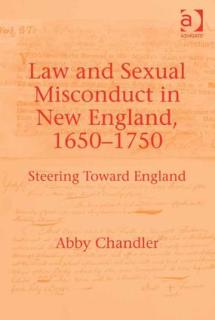 Between 1650 and 1750, the courts of Maine, Rhode Island, and Essex County, Massachusetts heard 1,843 cases concerning sexual misconduct. These suits, which concerned matters including rape, sodomy, adultery, and sex outside of marriage, are the subject of
 The Junto