John M. Dixon, The Enlightenment of Cadwallader Colden: Empire, Science, and Intellectual Culture in British New York (Ithaca: Cornell University Press, 2016).
 On December 8, 1747, Gov. George Clinton (1686–1761) told a British statesman that the Assembly of New York “treated the person of the Governor with such contempt of his authority & such disrespect to the noble family where he had his birth that must be of most pernicious example.” He thought he might have to “give it [i.e., his position] up to a Faction.” The extant copy of this letter, held within Clinton’s papers at the William L. Clements Library in Michigan, was written by his most trusted advisor and ally—Cadwallader Colden, the subject of John M. Dixon’s first book, The Enlightenment of Cadwallader Colden: Empire, Science, and Intellectual Culture in British New York, published in 2016 by Cornell University Press.[1]
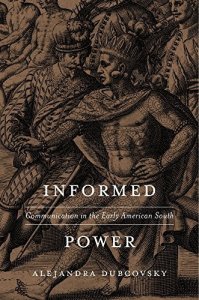 Alejandra Dubcovsky’s
 On Sunday, the United States Postal Service
 In his now classic study of early nationalism, historian Benedict Anderson wrote “I propose the following definition of the nation: it is an imagined political community—and imagined as both inherently limited and sovereign. It is imagined because the members of even the smallest nation will never know most of their fellow-members, meet them, or even hear of them, yet in the minds of each lives the image of their communion…. Communities are to be distinguished, not by their falsity/genuineness, but by the style in which they are imagined….”[1] While Puritan society was not a “nation” in the sense that Anderson meant it, his reflections nonetheless are evident in Ric Burns’ documentary, The Pilgrims. Burns seeks not to merely retell the Thanksgiving story, but to understand why Plimouth Rock and the popular Thanksgiving story (much of which is inaccurate) is such a pervasive part of the American origins story.
 Yesterday, Chris Minty

 The Junto