Francis J. Bremer is Professor Emeritus of History at Millersville University of Pennsylvania and has been a visiting scholar at Oxford and Cambridge universities in England, and Trinity College in Dublin, among other institutions. He has published numerous books and articles on puritanism in the Atlantic World, most notably John Winthrop: America’s Forgotten Founding Father (Oxford, 2003); Building a New Jerusalem: John Davenport, a Puritan in Three Worlds (Yale, 2012); and Lay Empowerment and the Development of Puritanism (Macmillan, 2015). He is editor of the Winthrop Papers for the Massachusetts Historical Society and Coordinator of New England Beginnings, a partnership to commemorate the cultures that shaped New England.
 New England Beginnings is a partnership of New England historical organizations and museums, ancestry organizations, and participating scholars formed in 2015 to plan efforts to commemorate the cultures that shaped New England on the occasion of the four hundredth anniversaries of events such as the founding of Plymouth and the settlement of Massachusetts. The goals of the partnership are to 1) tell the stories of the region in the seventeenth century to a wide, general public audience and 2) to enhance accessibility of resources for future scholarship in the field. The website identifies the partners; offers narrative of what was happening “400 Year Ago;” provides information on events, programs, opportunities; podcasts and videos; and a bibliography.
While this is early days for the partnership, which is working to produce programs for 2020, some initiatives have come to fruition:
Programs to Facilitate scholarship:
The Massachusetts Historical Society has put an electronic, searchable edition of the first four published volumes of the Winthrop Papers online on their website. This will eventually be followed by the remaining published volumes, further correspondence, a collection of Winthrop religious writings, and an edition of John Winthrop Jr.’s medical notebook.
The Commonwealth Library has the manuscript of William Bradford’s Of Plymouth Plantation online. With the support of the Colonial Society a team has been put together to produce a new transcript and annotation reflecting both the Pilgrim and native points of view with Jeremy Bangs of the Leiden American Pilgrim Museum and Francis J. Bremer providing the former, and Paula Peters of the Wampanoag tribe providing the native perspective. A grant request for NEH funding is pending.
Programs to educate a wide public audience:
The Congregational Library and Archives has produced “Puritan Boston Tests Democracy,” a free app for phones and tablets. The app can be used anywhere to learn the basic history of the people, places, and events that shaped early Boston, but can also be used with its GPS feature to do a self-guided tour of those sites.
Participating scholars have agreed to offer talks and/or discussion to high school and university classes, as well as church and civic groups via tele-conference, Skype, FaceTime or similar technology. The scholars will donate a modest fee (probably $100) to New England Beginnings to cover partnership costs moving forward.
On Christmas Day the Associated Press released a story (“Scholars Team Up to Dispel 400 Year Old ‘Fake News’ About US”) which was picked up by well over a hundred media outlets in this country and abroad. The reaction by those who bothered to use online TV and newspaper “comment” opportunities was overwhelmingly hostile. Typical comments included:
- “’Leading scholars from around the globe are teaming up to shed more light on how America got its start.’ Translate to: We are coming to rewrite your history for you, U.N. style!”
- “Liberal army assault continues unabated. The only way to stop liberals from their agenda is to treat this as a war and they are the enemy.”
- “Any time I hear ‘scholars say …’ I take it with not just a grain of salt but a whole spoonful.”
- “President Trump is a very wise man. ‘Common Core’ will be, in fact, rescinded. History will once again be taught in our schools. ‘Angry White Men’ know history. Liberal professors and liberal public teachers will now be held accountable for truth. ‘Indoctrination’ of our young will leave with the Obama legacy. State-run schools will now have the power to keep education unblemished from liberal trash.”
- “The story will be, no doubt, shedding ‘new’ light on how White People screwed over everybody. It started with Columbus, and will no doubt end when liberals get tired of crapping on White People.”
- “Suggestion, read Rush Limbaugh’s book ‘The Brave Pilgrims.’ It will enlighten most ‘scholars,’ were that possible.
Some will be quick to discount such comments as coming from the same element of the population that are Biblical literalists denying evolution, those who reject climate change, and groups promoting white nationalism. But these comments come from citizens, and citizens who are a significant enough element in our society to help explain the election of Donald Trump. If our goal as educators is to develop in our students an ability to evaluate things with open and reflective minds and our task as historians to explain the complexities of the past—painting the picture with the warts, but not only focusing on the warts—we have clearly failed with this segment of the population. The adherence of these commentators (and rest assured, many who didn’t bother to write) to the old black hat (natives)/ white hat (settlers) story speaks to the need for us to do a better job of explaining the past. But in doing so we should recognize that many scholars have fallen into a comparable paradigm whereby puritans are simplistically depicted as black hats (intolerant, misogynist, religious fanatics, racist—in other words warts only) and natives as white hats (victims, proto-environmentalists, etc.).
What is necessary, and what the goal of New England Beginnings is, is to develop nuanced appreciations of all the cultures that shaped New England scholars that rejects all faith as fanaticism and judges too much of the past by modern values. Challenging as this will be, what makes success even more problematic is the widespread rejection of expertise by many of our fellow citizens. How can we persuade people who reject our claim that years of studying the sources gives us a greater insight into the past? The identification of the scholarly community as something that needs to be discarded and its members purged (Professor Watch Lists) threatens us individually but more than that threatens the integrity of academe. One can laugh at the idea of learning about the Pilgrims from a children’s book written by Rush Limbaugh, but it is in its own way the same as people turning to and relying on only the news outlets that reinforce their existing beliefs.






 in early American history/literature/architectural history/art history/etc. or a related field, and have you chosen a career outside of the professoriate? The Junto wants to hear from you! There’s still time to participate in our conversation, “Where Historians Work: A View from Early America.”
 James Alexander (Alec) Dun
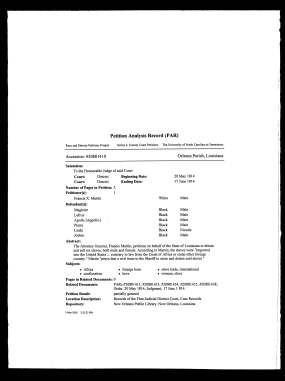 In Antebellum America, Southern municipalities generated revenue by confiscating and reselling illicit slaves through public auctions.[1] In 1807, Congress prohibited the international slave trade, a year later, Louisiana followed suite, but this did not stop the trade. An illicit trade from Africa across the Atlantic continued to supply the America South with slaves. Illegal slaves were forfeited to the state. The Sheriff’s department placed these slaves in prison to await resale to the public. These findings raise questions about the role of the state in the slave trade, property laws, municipal revenues, and contributions of the sale of slaves at “property auctions” to modern city infrastructures.
 The Junto