Junto March Madness 2019 Begins!

Junto March Madness 2019It’s once again March and that can only mean one thing at The Junto: our March Madness tournament. We skipped last year to welcome our new members, so in case you’ve forgotten: you nominate, we bracket, and you vote. In previous years, we have hosted tournaments of books, articles, and primary sources in early American history.
This year, our tournament will focus on digital projects on early America.

Nominations open now and will close on Wednesday, March 6 at 5 p.m. eastern time. Consult the rules and add your nominations in the comments section below. Join in the conversation using the hashtag #JMM19. Voting will commence next week. Continue reading

Call for Papers: Early American Music and the Construction of Race

Co-organized by Glenda Goodman (University of Pennsylvania) and Rhae Lynn Barnes (Princeton University)
Oct. 11-12, 2019 at the University of Pennsylvania

Racial ideology is baked into the cultural and music history of early America. Native peoples and colonists heard each other’s music as indicators of difference, friendliness, or danger. The regulation of song and dance was integral to the subjugation of enslaved people. And, in the United States, a vested interest in forming a nation of white citizens was underpinned by pious and genteel repertoire. This workshop seeks to provide a space for the cultivation of new areas of inquiry into the intersection of race, music, and American cultural history. While the interrelated relationship between race, modernity, and American music is of enduring interest to scholars–especially those focused on the twentieth century to today–this workshop is dedicated to tracing these long-term themes in the earlier period from colonial encounter to the Civil War.

We encourage papers from scholars at all career stages. We especially welcome those using a wide variety of sources, including archival and/or ethnographic work, material artifacts like historical instruments, sheet music, theatrical ephemera, photography, journals, and all forms of print media. Participants will be asked to pre-circulate their 20-page paper and respond to another presenter’s work in this intensive two-day workshop. Bonnie Gordon (University of Virginia) is scheduled to give a lecture for participants on Friday.

Submit a 300-word abstract of a proposed paper by April 15: EarlyAmericanMusicAndRace@Gmail.com.

Questions may be directed to organizers Glenda Goodman and Rhae Lynn Barnes: EarlyAmericanMusicAndRace@Gmail.com

Support for travel and lodging will be provided for accepted participants.

Sponsored by the McNeil Center for Early American Studies; the University of Pennsylvania Department of Music; the Kislak Center for Special Collections, Rare Books, and Manuscripts; the University of Pennsylvania Office of the Vice Provost; and School of Arts and Sciences.

My Experience at OxEARS 2019

2019 began with a bang when I traveled across the pond to become the first graduate student studying in the U.S. to present at the University of Oxford’s Early American Republic Seminar (OxEARS). Without the work of my new intellectual family members and OxEARS co-conveners, Grace Mallon and Stephen Symchych, along with the love, support, and prayers of my family and friends stateside, my overall experience at Oxford would not have been as amazing as it was. Continue reading

Announcing the Launch of Freedom on the Move

fugative add

An ad placed in the Charleston Mercury, Charleston, SC, on July 11, 1829. Accessed via: Freedom on the Move 

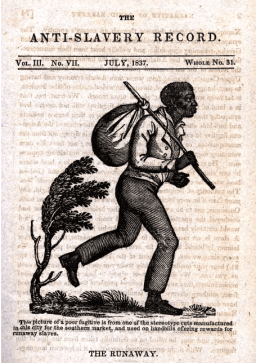
Thousands of enslaved African Americans emancipated themselves by taking flight and escaping their enslavers. One way that this form of resistance to slavery can be studied is through the advertisements that enslavers and jailers placed in newspapers in hopes of turning those who had run away back into “property.” The ads allow us a glimpse of both enslavers’ desires and the defiance of the enslaved. In them, it is possible to read pain and suffering in the record of scars and maimed bodies. The ads hold both the grief of separation from kin left behind and the relief of family mentioned at possible destinations. Historians have long used advertisements for fugitives from slavery to study the institution of slavery and the lives of enslaved people. But it can be difficult for the public to access them because the ads exist in multiple formats across multiple archives.

download

“The Runaway” Anti-slavery record. New York: Published by R.G. Williams, for the American Anti-Slavery Society, 1835-1837. Accessed via The Fels African Americana Image Project at Library Company of Philadelphia

Freedom on the Move (FOTM), an online project devoted to fugitives from slavery in North America, launches today, February 14, 2019. FOTM asks the public to help in creating a database that makes the stories and lives of fugitives from slavery in North America accessible. The website is designed for use by scholars, researchers, educators, students, genealogist, and the public. After quickly setting up an account, users can begin transcribing digitized versions of advertisements and recording important information included in each ad. Participants can even choose to work on ads from specific time periods or geographic locations. Users can also search for and browse through digitized ads.

Currently, FOTM has about 12,000 newspaper advertisements ready for crowdsourced transcription. The project will include additional ads soon and its organizers hope for future collaborations with additional scholars, archives, and organizations.  FOTM promises to be an invaluable resource in the classroom and for researchers. But beyond the academic applications of the project, organizers hope that the site will facilitate greater access to members of the public outside of the academy. By transcribing and working with the advertisements, participants can both contribute to a growing database of searchable ads and engage with the rich history that each ad presents.

FOTM is a joint project between Cornell University’s Department of History and the Cornell Institute for Social and Economic Research (CISER). Ed Baptist of Cornell University and William Block (Director of CISER) serve as the principal investigators for FOTM. Lead historians on the project include Vanessa Holden of the University of Kentucky, Hasan Jeffries of Ohio State University, Mary Niall Mitchell of the University of New Orleans, and Joshua Rothman of the University of Alabama. The project has received major funding from the National Endowment for the Humanities and the National Archives.

To learn more about the project or to begin contributing to FOTM’s crowdsourcing, visit freedomonthemove.org

Call for Blog Posts: Food and Hunger in Vast Early America

In February 2017, our colleagues at Nursing Clio issued a call for a series on nutrition, resulting in a variety of posts on nutrition, food, and hunger over the several months that followed. This call aims to build on that work by focusing specifically on Vast Early America. The co-editors (Carla Cevasco and Rachel Herrmann) welcome posts spanning the fifteenth thru mid-nineteenth centuries that cover a broadly defined Atlantic World. Topics might include (but are not limited to) agriculture, cookbooks, diplomacy, foodways, hunting, livestock, medicinal recipes, markets, pharmacopeias, dietetics, single-commodity foodstuffs, and warfare. Posts should be between 750 and 1,500 words; footnotes are strongly encouraged. We also recommend reading our contribution guidelines. Please send posts to both email addresses (Carla.Cevasco@rutgers.edu and HerrmannR@cardiff.ac.uk) by March 15, 2019. We will aim to respond by early April with an eye toward running this series in late April and early May.

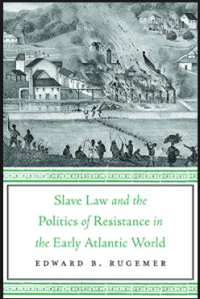
Q&A: Edward Rugemer, author of Slave Law and the Politics of Resistance in the Early Atlantic World

picture-155-1357242582

Today at The Junto, we’re featuring an interview with Ed Rugemer about his new book, of Slave Law and the Politics of Resistance in the Early Atlantic World, which Casey Schmitt reviewed yesterday. Ed Rugemer is an Associate Professor of History and African American Studies and the Director of Undergraduate Studies for the Department of History at Yale University. A historian of slavery and abolition, Rugemer’s first book The Problem of Emancipation: The Caribbean Roots of the American Civil War was published by Louisiana State University Press and his work has appeared in the William and Mary Quarterly, Journal of Southern History, Slavery and Abolition, and the Journal of the Civil War Era.

Continue reading

Review: Edward Rugemer, Slave Law and the Politics of Resistance in the Early Atlantic World

Today The Junto reviews Slave Law and the Politics of Resistance in the Early Atlantic World by Yale Associate Professor of African American Studies and History, Edward Rugemer. Stay tuned for a Q&A with the author tomorrow!

Historians have long argued that enslaved people’s resistance to bondage shaped the political economies, legal structures, and societies of the early Atlantic World. As a comparative history of slavery in Barbados, Jamaica, and South Carolina, Slave Law and the Politics of Resistance coheres around “the existential struggle between the master and the slave” that forms the core dialectic between control and resistance at the heart of slavery (1). Edward Rugemer places these slave societies in comparison because, as he argues, they developed out of the same legal genealogy rooted in seventeenth-century English imperial expansion but experienced the end of slavery in dramatically different ways. In just over three hundred pages, the book traces the dialectic between control and resistance in these societies “after an epic struggle of eight generations” (2). Rugemer’s approach combines a synthesis of a rich body of scholarship on the development of legal systems of bondage with strategic archival research. And, as the book demonstrates, the “combination of similarities and differences” between Jamaica and South Carolina yields “a novel approach to understanding the political dynamics of slave resistance and their relation to the law” (3).

Continue reading

Flashing Before My Eyes

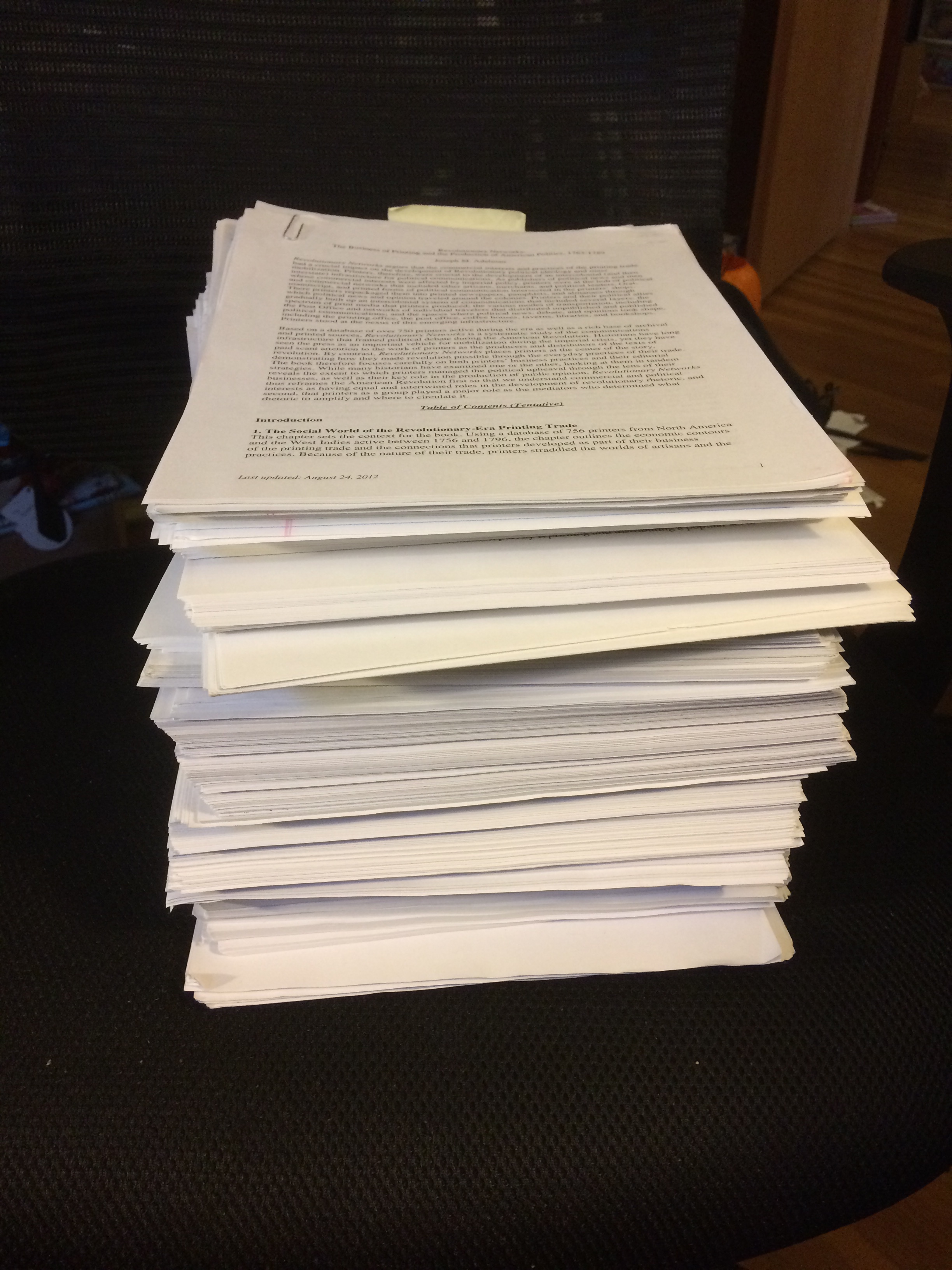
Some of the chapter drafts I’ve found in my office.

As I spent the final months of 2018 completing the copy editing and page proof process for my book, I found myself surprised at how easy it was to say goodbye to the book. Before last summer, I assumed I would find myself despondent at the thought of never being able to work on it again, that I would worry about finding typos or other errors, that I wouldn’t be able to make final decisions on anything. But other than the stress of actually going through the manuscript in a short period of time, I’ve instead felt excitement to check items off the final to-do list.

Continue reading

New Orleans at 300: A Year in Review and a Look to the Future

nola2018-Featured-Thumbnail.jpgAs 2018 comes to a close, I can’t help but reflect on this year and its meaning for a place that has become near and dear to my heart (and in-progress dissertation): New Orleans. Founded by the French in 1718, Louisiana’s largest city has been celebrating its tricentennial for months and in a way that only New Orleans can. Ranked number one on the New York Times “52 Places to Go in 2018” list, New Orleans continues to attract first-timers curious to discover “America’s most foreign city.” Repeat visitors, myself included, just can’t get enough, although my trips have taken me beyond Bourbon Street, from the attic of the city’s colonial-era Ursuline convent to the notarial archives of Orleans Parish, hidden within a twenty-story office building a stone’s throw from the Superdome. My own excursions aside, how exactly have we gone about celebrating, remembering, and thinking about the history of early New Orleans in 2018? What does the future hold?

Continue reading

CFP: The Fifteenth Annual Yale University American Art Graduate Student Symposium


Encounters, Entanglements, and Exchanges
Fifteenth Annual Yale American Art History Graduate Student Symposium
Yale University, New Haven, 6 April 2019
Proposals due by 1 February 2019

Points of encounter can occur across time and space. In colonial Mexico, blue and white earthenware vessels made in the city of Puebla responded to East Asian hard-paste porcelain. At the same time, ceramic manufacturers in China adapted designs that catered to pan-American tastes, and both John Bartlam’s South Carolina pottery and the American China Manufactory in Philadelphia produced their own soft-paste porcelain wares on the eve of the American Revolution. More recently, Carrie Mae Weems’s The Hampton Project reexamined a nineteenth-century vocational school that served as a cultural crossroads for formerly enslaved African Americans, American Indians, and white Americans to raise pressing questions of race, imperialism, and nationalism in the twenty-first century. These points of convergence between individuals, groups, places, and objects often instigate shifts in creative production with lasting and global resonances. The interaction of disparate cultures offers a rich nexus for artistic creation. Yet such encounters are also inseparable from the shifting dynamics of power that operate along gendered, racial, economic, and political lines. What can exchanges and entanglements reveal about the nature of encounter? How do encounters shape exchanges? In what ways do exchanges propagate new encounters?

The Fifteenth Annual Yale University American Art Graduate Student Symposium invites papers that interrogate the dialectical relationship between encounter and exchange and explore the legacies of cultural intersection. We invite submissions that address art across North, Central, and South America and the Caribbean, that engage a range of critical perspectives, and that speak to a variety of time periods and artistic practices.

Possible topics include, but are not limited to:
• Micro-histories that address a specific instance of encounter
• Global encounters with the notion of ‘Americanness’
• Collaborations that problematize narratives of ‘influence’ across social, cultural, or political hierarchies
• Impact of religious proselytization and conversion in the arts
• Gift exchange, diplomacy, and trade
• Appropriation, fetishism, hybridity, and mimicry
• Contact zones, borderlands, intersectionality, and peripheries
• Power dynamics within systems of colonialism, racism, homophobia, or sexism
• Immigration, migrants, and refugees
• Authorship and ownership
• Tourism and travel narratives
• Activism, coalition building, and the arts
• Networks created via technology, globalization, and media

Interested participants are invited to submit an abstract of no more than 350 words along with a CV to americanist.symposium@gmail.com by 1 February 2019. Accepted participants will be notified in mid-February. Accommodations will be provided for all graduate student speakers in New Haven, Connecticut.