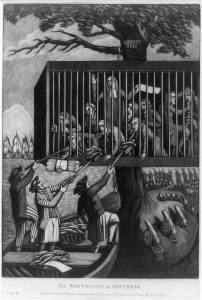
 Today, Rachel Herrmann concludes our food roundtable. You can read Carla Cevasco’s introduction here, Zachary Bennett’s post here, Bertie Mandelblatt’s here, and Rachel Winchcombe’s here. We hope we gave you some things to think about.
This week I spent three days reading three books, and I watched these posts go out into the world while thinking about my comps. I remember my comps year as the year of graduate school when I was more stressed than I can ever recall feeling, for such a protracted period of time, in my life.[1] But I think that it was the state of food history in 2009-10, when I was reading for my comps, that contributed to this feeling of panic.
I don’t mean the state of food studies; that discipline was already healthily expanding. I mean food history. I found comprehensive exams stressful because I knew that I wanted most to speak to early Americanists and early Atlanticists (and I think the distinction was more pronounced back then), but I was not convinced that there were very many early American food histories. There were food histories on other periods and other geographies; there were food studies books on single commodities like sugar and chicken and interdisciplinary food studies collections with foundational essays on method; there was some relevant work on alcohol, and on animals; and it felt like there was no roadmap for my dissertation.[2] Continue reading
 “My friends and I might still be 11, and we might still be in elementary school, but we know . . . that we have seven short years until we too have the right to vote.”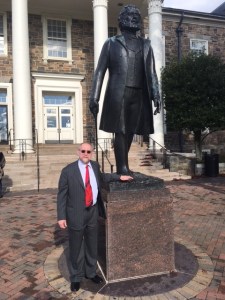
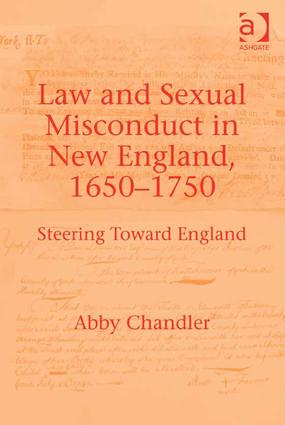 Between 1650 and 1750, the courts of Maine, Rhode Island, and Essex County, Massachusetts heard 1,843 cases concerning sexual misconduct. These suits, which concerned matters including rape, sodomy, adultery, and sex outside of marriage, are the subject of
  My forthcoming book,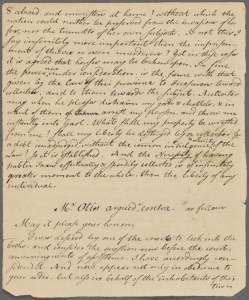

 Two weeks ago, 175 historians descended upon the Massachusetts Historical Society (MHS) in Boston for a three-day conference that considered the political, social, economic, and global parameters of the American Revolution. The conference consisted of eight panels (with pre-circulated papers), two keynotes, and some special presentations on digital projects. The conference proceedings were live-tweeted under #RevReborn2, and fellow Juntoist Joseph Adelman provided some
  The Junto