Guest Post: The Constitution, Slavery, and the Problem of Agency

Today we feature a guest post by Kevin Gannon (@TheTattooedProf), Professor of History and Director of the Center for Excellence in Teaching and Learning at Grand View University in Des Moines, Iowa. His scholarship has appeared in the Journal of the Early Republic, Ohio History, and several edited volumes. He is currently writing a continental history of the Civil War and Reconstruction.
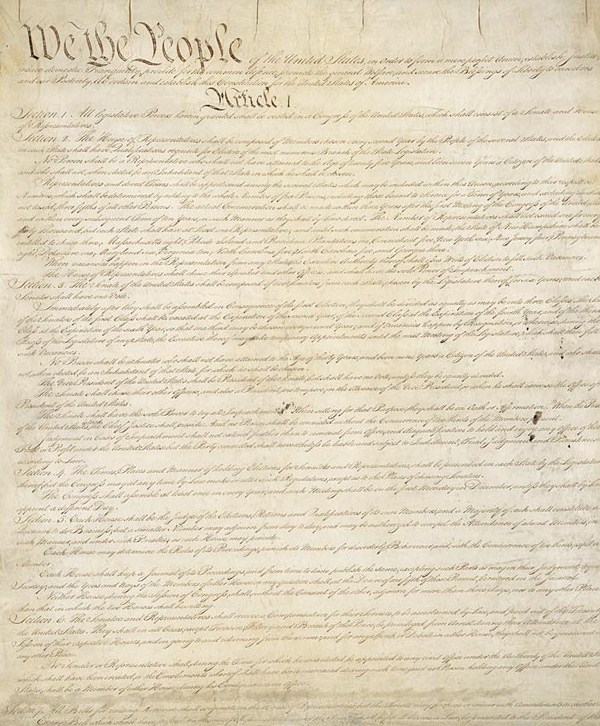
constitution_1_of_4_630Sean Wilentz’s op-ed in Wednesday’s New York Times was by turns baffling, infuriating, and sad. At its root, the essay is a narrow, technical argument trying to disguise itself as an overarching Big Answer to Important Questions. Wilentz claims “the myth that the United States was founded on racial slavery”—a myth embraced “notably among scholars and activists on the left”—is actually “one of the most destructive falsehoods in all of American history.” Continue reading

Q&A: Kathleen DuVal, Independence Lost: Lives on the Edge of the Revolution

9781400068951Yesterday, Chris Minty reviewed Kathleen DuVal’s latest book, Independence Lost: Lives on the Edge of the Revolution. Today, we continue with an interview with DuVal, who is a Professor of History at the University of North Carolina, Chapel Hill. Continue reading

Guest Post: The Art of Absconding: Slave Fugitivity in the Early Republic

Guest Poster Shaun Wallace (@Shaun_Wallace_) is an Economic and Social Research Council-funded Ph.D. candidate at the University of StirlingHis dissertation examines how reading and writing influenced and aided slave decision-making in the early republic. Shaun holds a B.A. (Hons.) and a MRes. from the University of Stirling and is president of Historical Perspectives, a Glasgow-based historical society run by and for graduate students in the United Kingdom.

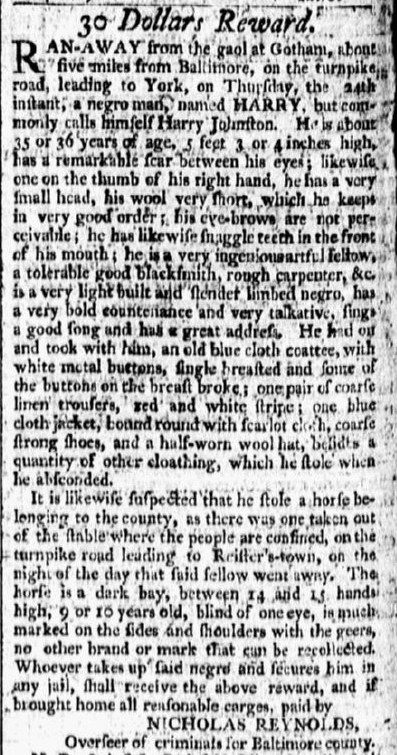
Screen Shot 2015-08-24 at 12.43.09 PMA “very ingenious artful fellow” appears a peculiar description of a runaway advertised for recapture. The advertisement, for Harry or Harry Johnstone, featured in Baltimore’s Federal Gazette newspaper, on May 2, 1800, at the request of Nicholas Reynolds, overseer of criminals for Baltimore County. Harry had absconded from Gotham gaol, near Baltimore. Reynolds described Harry as a “tolerable good blacksmith” and a “rough carpenter.” A “very talkative” slave, he was a man of “great address.” On first impression a relatively congenial description; in actuality, Reynolds’s use of the term “artful” condemned the runaway.[1]
Continue reading

Autumn Reads

Valley_of_the_Catawissa_in_Autumn.jpeg

“Valley of the Catawissa in Autumn,” Thomas Moran (ca. 1862)

Fall brings new early American titles to explore. Enjoy our Spring Reads 2015 list, too, and share your finds below!

Continue reading

Guest Post: Slave Horse: The Narragansett Pacer

Today, The Junto welcomes guest poster Charlotte Carrington-Farmer, Assistant Professor of History at Roger Williams University. Her current research focuses on framing dissent, deviance, and crime in early America in a wider Atlantic World context.

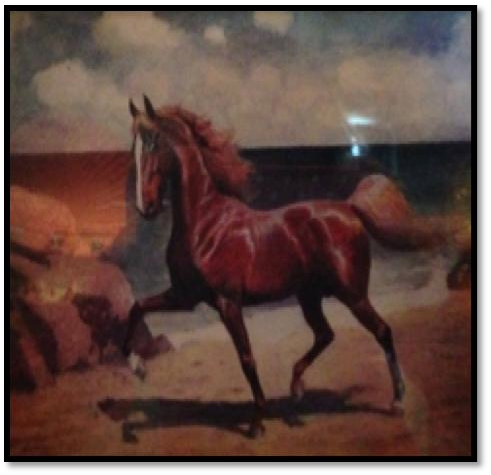
Image via Ann Holst and Pettaquamscutt Historical Society, Kingston, Rhode Island

Image via Ann Holst and Pettaquamscutt Historical Society, Kingston, Rhode Island

Once considered a breed of “no beauty,” the Narragansett Pacer moved fast enough for an 18th-century rider to cover 50-60 miles a day of rocky New England ground. As a natural pacer, its backbone moved through the air in a straight line without inclining the rider from side to side. Bred in and named for a southern community of coastal Rhode Island, the story of Narragansett Pacer horse is tightly entwined with the history of the early slave trade. Throughout the 18th and 19th centuries, these horses were traded for rum, sugar and slaves. Often, the horses were raised by slaves on the plantations of Narragansett, then shipped around the Atlantic World to work on sugar plantations alongside other slaves. Continue reading

SHEAR 2015: Conference Recap

IMG_3337

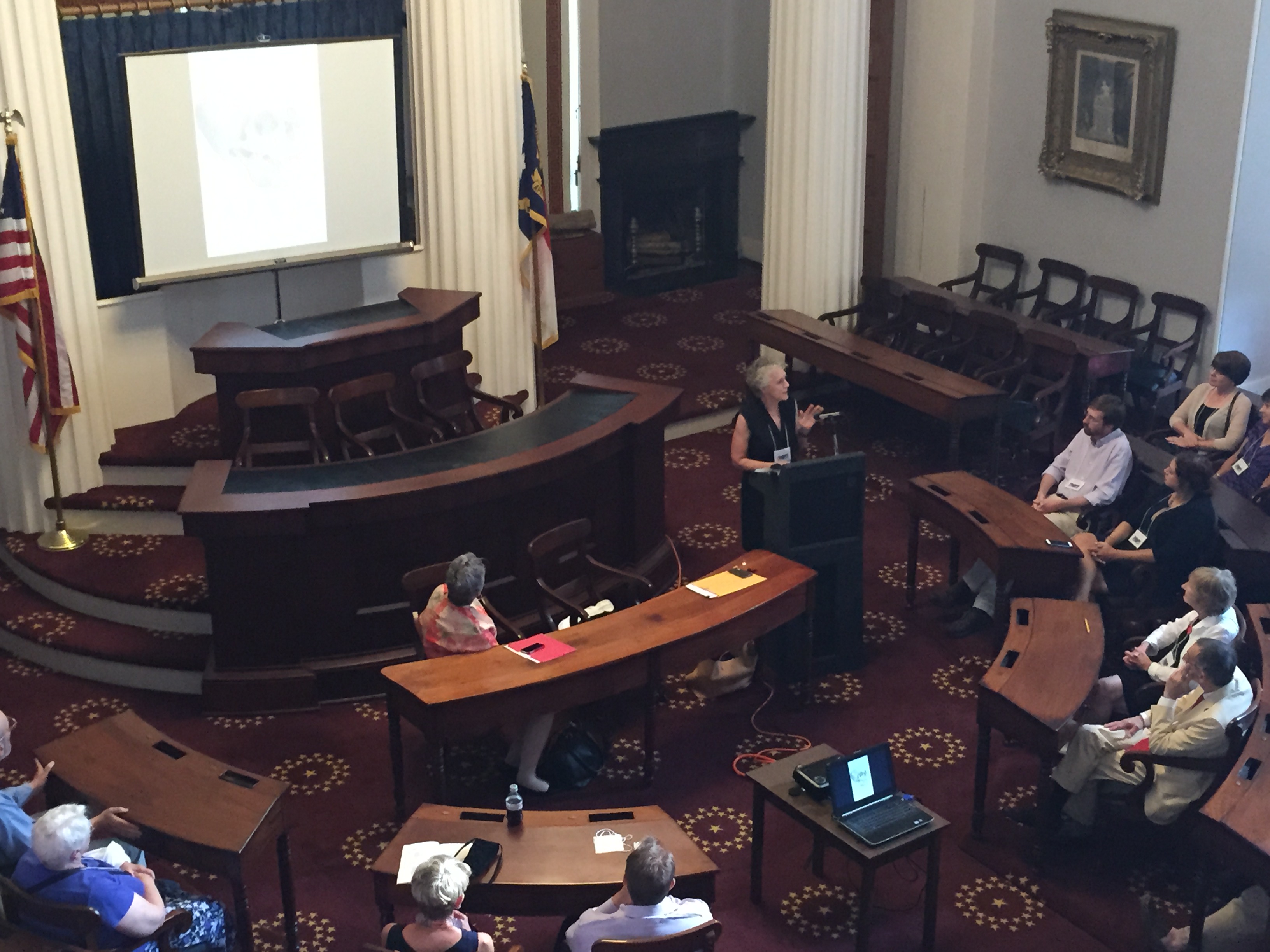
Ann Fabian’s SHEAR Presidential Address

The Society for Historians of the Early American Republic enjoyed three energizing days in Raleigh, North Carolina, last weekend. Lightbulbs went off—and, sometimes, sparks flew—in sessions centered on a vast range of questions about what Ann Fabian called the “complex and unmade world” of the early republic. The book exhibit was abuzz with talk of projects newly published and still in the works. And each evening, the sidewalks thronged with surprisingly large crowds of carousing local youths; we can only assume they were so lively because they knew that the early Americanists had brought the party to town. Continue reading

Graphic Novels Roundtable Q & A: Ari Kelman, Battle Lines: a Graphic Novel of the Civil War

We continue day three of our graphic novels roundtable with an interview with historian Ari Kelman, who co-authored Battle Lines: a Graphic History of the Civil War. Previously Jessica Parr discussed using graphic novels to explore painful histories and Roy Rogers reviewed Rebels from Dark Horse Comics

Battle-Lines-coverAri Kelman is the McCabe Greer Professor of History at Pennsylvania State University, specializing in the Civil War, Reconstruction, Memory Politics, and Environmental History. In addition to Battle Lines: a Graphic Novel of the Civil War, he is the author of two award-winning books. A Misplaced Massacre: Struggling Over the Memory of Sand Creek (Harvard, 2013) was the recipient of the Bancroft Prize, the Avery Craven Award, the the Tom Watson Brown Book Award, and the Robert M. Ultey Prize. A River and Its City: The Nature of Landscape in New Orleans (University of California Press, 2003) won the Abbott Lowell Cummings Prize. Continue reading

Teaching Trauma: Narrative and the Use of Graphic Novels in Discussing Difficult Pasts

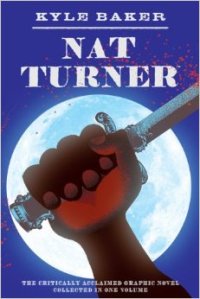
Roy Rogers kicked off yesterday’s 4-day roundtable with a review of the graphic novel, Rebel. For day two of our roundtable on graphic novels and history, I will discuss the use of graphic novels in teaching traumatic histories.

51m-NxiSLdL._SY344_BO1,204,203,200_As anyone who has taught the history of slavery knows, it can be challenging. It is an important, but also emotionally loaded subject that can provoke spirited responses from students. Some students are resistant to discussing what they view as an ugly event in the past. Others may become defensive. And, for others, the history of slavery may be personal. The challenge becomes presenting the history in a thoughtful way that will engage students, but does not whitewashing history. Other traumatic events—genocide, war, etc.—can present similar pedagogical challenges.

Continue reading

The Week in Early American History

TWEAHWelcome to another edition of This Week in American History. It has been a busy, yet troubling two weeks.

We would like to begin by offering our condolences to the family, friends, and colleagues of Christopher Schmidt-Nowara, of Tufts University. Dr. Schmidt-Nowara died suddenly in Paris on June 27th. Continue reading

The Many & the One

Lexington DoolittleLike many, Amos Doolittle struggled to turn in a decent first draft of American history. The 21 year-old engraver, later known as the “Paul Revere of Connecticut,” arrived in Lexington and Concord shortly after April 1775. Anxious to capture the battles’ action and aftermath, he chatted with local residents. He sketched terrain. For Doolittle, a trained silversmith, it was a chance to experiment with a craft he had yet to master. Part of what he produced, a set of four views storyboarding the “shot heard round the world,” hangs in the Boston Public Library’s new exhibit, “We Are One: Mapping America’s Road from Revolution to Independence.” By Doolittle’s lights, Massachusetts makes for a furious and frenzied tableau: gusts of redcoats’ gunpowder hazing the sky, and colonial ranks splintering on the advance. On the American side, it is hardly a picture of union. Patriots scatter, racing blindly to frame’s edge. In his rough draft of Revolution, Amos Doolittle demands that we unlock all hopes of what might come next. Continue reading