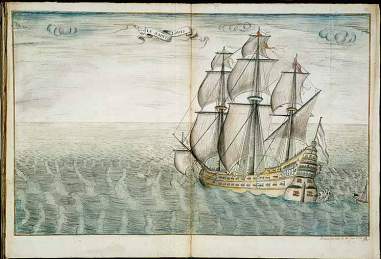
 For early Americanists, the past two decades have seen an increase in scholarship connecting the early modern Caribbean to colonial North America. The Caribbean adds significant depth and dimension to discussions of race, slavery, diplomacy, capitalism, gender, and imperial competition by expanding the historiographies and archival resources common to early American scholarship. Yet, when a colleague stopped by my office asking for readings on seventeenth-century Puerto Rico to assign for a class, I drew a blank. Despite the excellent scholarship on colonial Puerto Rico written in Spanish, English-language scholarship focuses primarily on the nineteenth and twentieth centuries.[1]
What made this worse was that last Thursday was the one-year anniversary of Hurricane Maria’s landfall in Puerto Rico. And, while the devastation and continued struggles on the island garner on-going media attention, the anniversary set me thinking about the place of the Caribbean in our scholarship and our teaching. It seems that, despite increased attention to the Caribbean within the field of vast early America, not all Caribbeans are created equal. And that unevenness demands our attention. Continue reading
 As we continue to learn more about the seizure and internment of migrant infants and children, both along the U.S.-Mexico border and in ICE raids throughout the nation, historians have asked us to wrestle with our
  With spring well underway, many of us are experiencing the satisfaction of marking the last grade on the final blue book of the semester, with an eye toward the approaching summer months and the freedom to work on our own research projects.
 I’ve had a blog, in one place or another, since 2002, and thus the distinction between “a blog” and “a blog post” is a hill on which I am willing to die. But before Ben Park approached me to be one of The Junto’s founding members, I hadn’t blogged extensively about history. Five years later, I still want to write about other topics in addition to history, but I firmly believe that my history teaching and history scholarship have benefitted from my membership here. That said, I think my role as a blogger for The Junto has changed since 2012, and will continue to transform in the future. Today, I want to reflect on some of these changes.
 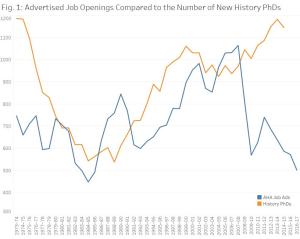 This week, the American Historical Association previewed a forthcoming report on the number of full-time history jobs. The post is entitled
  As I type, President Donald Trump is tweeting: “
 The Junto