Digital Pedagogy Roundtable, Part 1: Students’ Access to Sources

This week, The Junto will feature a roundtable on digital pedagogy, in which we discuss our different approaches to using digital sources in the classroom. Today, Rachel Herrmann talks about the challenge of access. Jessica Parr, Joseph Adelman, and Ken Owen will also contribute.
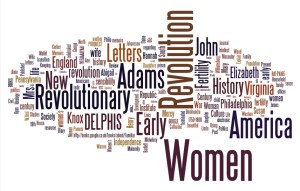
A Wordle made from sources my undergraduates located for our in-class source-finding competition

A Wordle made from sources my undergraduates located for our in-class source-finding competition

Let me preface this post by saying that I’d hesitate to call myself a digital humanist; I don’t code or map or mine texts. As Lincoln Mullen pointed out a while back, however, digital practices exist on a spectrum. There are some things I do for my own research and in the classroom—tweeting, running my department’s social media accounts, using Amazon’s “Look Inside” feature to chase up a footnote so as not to use up one of my precious Interlibrary Loan requests, and of course, blogging for The Junto—that digital humanists also do. These approaches have been helpful in my teaching for three problems related to access to sources. Continue reading
SHEAR 2015: Conference Recap

IMG_3337

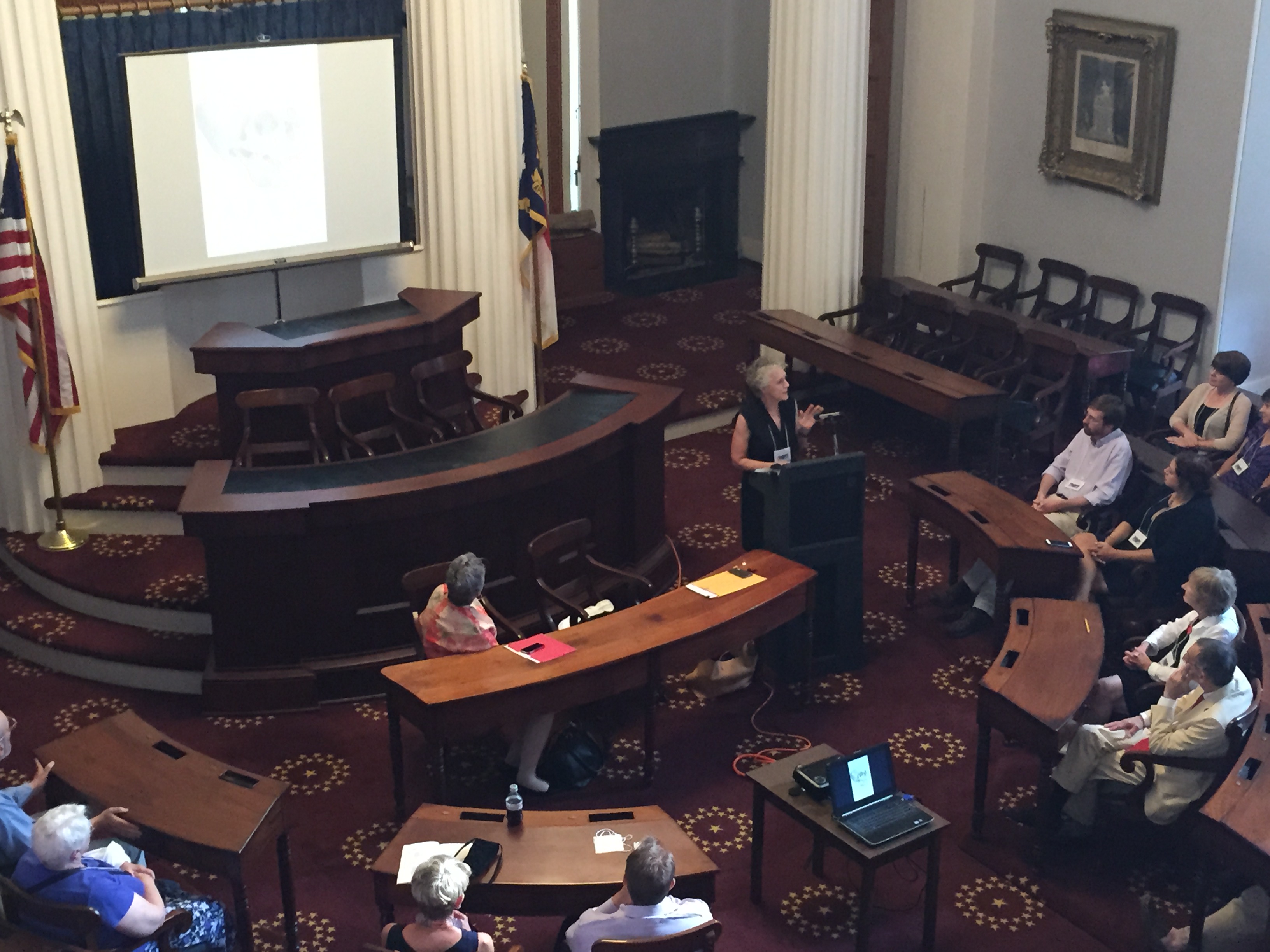
Ann Fabian’s SHEAR Presidential Address

The Society for Historians of the Early American Republic enjoyed three energizing days in Raleigh, North Carolina, last weekend. Lightbulbs went off—and, sometimes, sparks flew—in sessions centered on a vast range of questions about what Ann Fabian called the “complex and unmade world” of the early republic. The book exhibit was abuzz with talk of projects newly published and still in the works. And each evening, the sidewalks thronged with surprisingly large crowds of carousing local youths; we can only assume they were so lively because they knew that the early Americanists had brought the party to town. Continue reading

The Writer Assumes All Responsibility

For the week of July 13-17, The Junto is hosting “Graphic History: Sequential Art & History,” a roundtable examination of relationship between history and graphic novels. We will explore graphic novels as historical fiction, as histories, and their uses in the classroom. For our first entry, Roy Rogers reviews a new comic book series about the American Revolution from award-winning writer Brian Wood. 

What does a historical epic of the American Revolution look like in the twenty-first century? Continue reading

The Week in Early American History

TWEAH

Last week’s edition of our weekly roundup opened with our collective condolences to the family, friends, and colleagues of Christopher Schmidt-Nowara (Tufts University), who passed away on June 27th. Unfortunately, the early American historical profession has lost an additional two stalwarts this week: Lois Green Carr, the noted historian of colonial Chesapeake society, died on June 28, 2015. She was 93.  And yesterday morning was met with the unfortunate announcement of Dallett Hemphill’s passing. In addition to her fine scholarship and responsibilities as editor of Early American Studies, Dr. Hemphill was a mentor, supporter, and friend to several junior scholars. Just two weeks ago, she authored a guest post here at The Junto on publishing journal articles. We’ve pinned that post at the top of our front page, and invite any who have not yet read it to do so. We extend our deepest condolences to the families, friends, and colleagues of both Dr. Carr and Dr. Hemphill.  Continue reading

Seriously, though, was the American Revolution a Civil War?

On February 18, 2014, Tom Cutterham asked, “Was the American Revolution a Civil War?” According to Cutterham, understanding the Revolution that way might be useful. If we did, he suggested, “we’d better understand the way the modern world—the nexus of state, citizen, and property—was born in and determined by violence.”[1] Continue reading

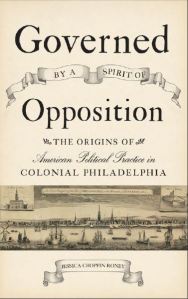
Q&A: Jessica Roney, Governed by a Spirit of Opposition

RoneyYesterday, Chris Minty reviewed Jessica Choppin Roney’s book, Governed by a Spirit of Opposition: The Origins of American Political Practice in Colonial Philadelphia. Today, she speaks with The Junto about the book project and the process of turning the dissertation manuscript into a book. She received her MA at the College of William and Mary and her PhD at The Johns Hopkins University. She is currently Assistant Professor of History at Temple University in Philadelphia and is organizing a global early modern conference this November: Port Cities, 1500-1800, hosted by Temple University, the Program in Early American Economy and Society, and the McNeil Center for Early American Studies. Continue reading

Review: Jessica Choppin Roney, Governed by a Spirit of Opposition

Jessica Choppin RoneyGoverned by a Spirit of Opposition: The Origins of American Political Practice in Colonial Philadelphia (Baltimore: Johns Hopkins University Press, 2014).

CaptureIn recent years, early American political history has received considerable attention. A range of historians have enriched our understanding of how Americans participated in and contributed to politics in the early republic.[1] Popular politics during the colonial period has received less attention.[2] But in Governed by a Spirit of Opposition, part of Studies in Early American Economy and Society from the Library Company of Philadelphia, Jessica Choppin Roney focuses on politics in Philadelphia prior to the American Revolution. In so doing, she makes an important contribution to the field of early American history. Continue reading

The Many & the One

Lexington DoolittleLike many, Amos Doolittle struggled to turn in a decent first draft of American history. The 21 year-old engraver, later known as the “Paul Revere of Connecticut,” arrived in Lexington and Concord shortly after April 1775. Anxious to capture the battles’ action and aftermath, he chatted with local residents. He sketched terrain. For Doolittle, a trained silversmith, it was a chance to experiment with a craft he had yet to master. Part of what he produced, a set of four views storyboarding the “shot heard round the world,” hangs in the Boston Public Library’s new exhibit, “We Are One: Mapping America’s Road from Revolution to Independence.” By Doolittle’s lights, Massachusetts makes for a furious and frenzied tableau: gusts of redcoats’ gunpowder hazing the sky, and colonial ranks splintering on the advance. On the American side, it is hardly a picture of union. Patriots scatter, racing blindly to frame’s edge. In his rough draft of Revolution, Amos Doolittle demands that we unlock all hopes of what might come next. Continue reading

The Importance of Partisanship in New York City, ca. 1769–1775

Alexander McDougallOn April 25, 1775, hundreds of New Yorkers acknowledged receiving “a Good firelock, Bayonet, Cartouch Box, and Belt.” Six days after the Battles of Lexington and Concord, and three days after Israel (Isaac) Bissell told New Yorkers the news, Alexander McDougall mobilized support against the British. The War of American Independence had reached New York and, with hundreds of supporters, McDougall was ready to fight.[1] By April 1775, McDougall was a revered figure across colonial America, widely known as “the Wilkes of New York.” He was an individual who, like John Wilkes, was perceived as willing to fight for the liberties of the press, the people’s welfare, and against arbitrary rule.[2] McDougall’s popularity, by 1775, had been five years in the making. But, in 2015, historians are yet to fully appreciate the role he played in the coming of the Revolution. In this post, I want to reemphasize his influence in affecting New Yorkers’ allegiances. Continue reading

Historical Charts and David Ramsay’s Narrative of Progress

A while back Slate’s “The Vault” blog ran a piece on John Sparks’s “Histomap” from 1931. I was recently reminded of that post as I came across a number of eighteenth-century historical charts during my dissertation research on eighteenth-century American history culture.[1] In the eighteenth century, there were conflicting understandings of historical time. Some understood time to be cyclical, as evidenced by the rise and (inevitable) fall of empires throughout history. Increasingly, however, historical time was coming to be understood as linear (in a mechanical, Newtonian sense). With the linear conception came the idea of historical time as being fundamentally progressive. This conception was further distinguished by those who understood it in terms of a narrative of social and political progress and those who understood it in millennialist terms, i.e., time progressing toward the end-of-days. These ideas shaped the ways in which one thought about history, and, in a time when historical distance was far more truncated than today, they had a profound effect on how one viewed their contemporary world. Historical understanding and, hence, historical writing were undergoing significant shifts in the eighteenth century. One of the by-products of these developments was the historical chart.

Continue reading