 Here’s our seasonal roundup of new and forthcoming titles. Share your finds below! Continue reading
Tag Archives: religion
Review: Shelby M. Balik, Rally the Scattered Believers
Shelby M. Balik, Rally the Scattered Believers: Northern New England’s Religious Geography. Bloomington: Indiana University Press, 2014.
 At the beginning of February, Wake Forest University hosted a symposium marking the 25th anniversary of the publication of Nathan Hatch’s The Democratization of American Christianity (Yale University Press). The list of participants was a “who’s-who” of American religious history: Catherine Brekus, Sylvester Johnson, Mark Noll, Amanda Porterfield, Harry Stout, Grant Wacker (on more of a “who’s-that?” note, I was there, too, feeling honored but absurdly under-credentialed in that company). Each offered reflections on the book’s influence and reach, on his or her personal experience with it, on how its arguments have aged. Hatch, now the president of Wake Forest, offered an eloquent response. (Video of the event is available here.) Continue reading
Maryland’s Protestant Revolution and the Problem of Religious Freedom
 Maryland’s religious history is unique in colonial British North America. We largely remember Maryland as the Catholic colony that embraced religious toleration and religious freedom, in contrast to New England’s stodgily Puritan establishment or Virginia’s scattered Anglican church. Scholars and commentators looking for sources or influences on the First Amendment are consistently drawn to the colony’s justifiably famous 1649 “Act concerning Religion.” This act made it a crime to “declare call or denominate any pson or psons whatsoever inhabiting” Maryland “an heritick, Scismatick, Idolater, puritan, Independant, Prespiterian popish prest, Jesuite, Jesuited papist, Lutheran, Calvenist, Anabaptist, Brownist, Antinomian, Barro-wist, Roundhead, Sepatist, or any other name or terme in a reproachfull manner relating to matter of Religion.” “[T]he free exercise” of Christian religion was explicitly protected by the act, with repeat violators of their fellow colonialists’ conscience were to be “severely punished by publick whipping & imprisonmt.”[1] The “Act concerning Religion” places Maryland next to Rhode Island and Pennsylvania as one of the colonial regimes committed, for European Christians at least, to religious freedom in the seventeenth century.
The problem, and what makes the colony unique, is that Maryland’s experiment in religious freedom failed.
The Junto Guide to Early America at #AHA2015
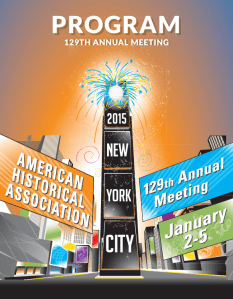 Happy New Year from all of us at The Junto! We hope you had a restful and enjoyable holiday break. For historians, the turn of the calendar to 2015 means that many of us are en route to the AHA Annual Meeting in New York City. Having grown up in the area, I’d like to welcome you all to New York, where the bagels and pizza are really just better, and we stand “on line” for coffee, not “in line.”
A Junto Birthday Party: Whitefield at 300 Roundtable
Today’s guest poster, Thomas S. Kidd, is professor of history at Baylor University and the author, most recently, of George Whitefield: America’s Spiritual Founding Father (New Haven: Yale University Press, 2014).
A Long Afterlife (Jessica Parr)
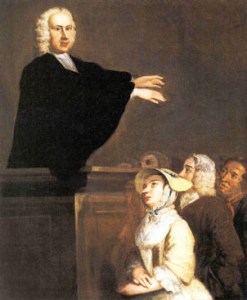 Those familiar with the first great awakening will undoubtedly recognize George Whitefield as a key figure of eighteenth century evangelical culture in Britain and its American colonies. Like many associated with the Methodist movement in Whitefield’s time, the prolific preacher and publisher saw himself as an Anglican in discussion with the Church of England about reform and an allowance for a broader religious experience. However, his theology, the new birth doctrine, the gathered church, etc., all alienated Whitefield from the Anglican hierarchy within the first few years of his missionary career.
Guest Post: Strange Constitutional Bedfellows: The First and Third Amendments in the Mormon Quest for Religious Liberty
Today’s guest post comes from Spencer W. McBride, who has blogged with us before. Dr. McBride received his PhD at Louisiana State University in 2014 and is now a historian and documentary editor at the Joseph Smith Papers. His research examines the politicization of clergymen during the American Revolution and in the early American republic.
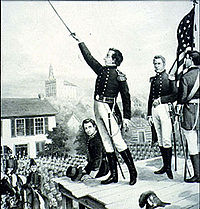 Of the ten amendments that comprise the United States Bill of Rights, the third amendment is arguably the least controversial. Go ahead, think back to your high school civics class and try to remember what rights are protected by the third amendment. Can’t remember? Don’t feel too bad. It is rarely invoked by politicians and political activists, it does not often spark heated debates in the media, and the U.S. Supreme Court has never heard a case in which it was the primary basis. Let’s face it, since the adoption of the first ten amendments to the Constitution, Americans have not been overly concerned that the government will quarter troops in the homes of private citizens without their consent. Continue reading
Q&A with Kyle T. Bulthuis, Author of Four Steeples over the City Streets
 The following is an interview with Kyle Bulthuis, an assistant professor of history at Utah State University. Jonathan Wilson’s review of Kyle’s recently-released book, Four Steeples over the City Streets: Religion and Society in New York’s Early Republic Congregations, appeared on the blog yesterday. Kyle agreed to sit down and answer a few follow up questions about the book and his future research plans, which we are happy to post today. Continue reading
Winter Reads
Just in time for your holiday shopping list, here’s our preview of new titles—share your finds in the comments! Continue reading
Contested Rites
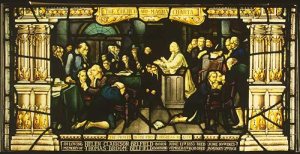 Joseph Yesurun Pinto, a 31 year-old Anglo-Dutch émigré in the autumn of 1760, had led New York’s Shearith Israel synagogue for barely a year when the second notice appeared in the papers. To re-commemorate the British conquest of Canada, all “Christian societies” and “houses of worship” would celebrate a day of thanksgiving on Thursday, October 23d. Over the past decade, New Englanders and their neighbors had held at least 50 fast days, many to lament God’s judgments against America, or to reform their wayward behavior. The proclamation of a thanksgiving day likely brought some measure of relief and joy.
The Week in Early American History
 Welcome to your weekly roundup of early American headline news. To the links! Continue reading
 The Junto