 “Had a map been drawn . . . of Mr. Smith’s movements through the streets of New-York. . . a tangled hydra indeed would have been revealed,” begins the second chapter of Francis Spufford’s book Golden Hill (53). As my fellow Junto reviewers have discussed, Spufford’s exhilarating read follows Mr. Smith through the escapades and perils of mid-eighteenth-century New York as he attempts to convince those he encounters of his “credit worthiness.” As he meanders through the tangled web of city streets, Smith’s journey from the island’s southern tip to its northern outposts is filled with adventures and twists at every turn. The reader soon learns that many of the men and women he encounters have secrets to hide. There is much to like about Golden Hill. For this urban historian, one of the most enjoyable aspects is the book’s sense of place. Continue reading
Golden Hill Roundtable: Courage and Cowardice?
This guest post is the third entry in our week-long roundtable on Francis Spufford’s novel, Golden Hill. Its author is Hannah Farber, an assistant professor at Columbia University. Her scholarship has appeared in the New England Quarterly, Early American Studies and the Journal of the Early Republic; she is at work on a monograph on marine insurance, tentatively titled Underwriters of the United States.
 What a pleasure it is to wander around mid-eighteenth-century New York City with Francis Spufford, admiring the city’s homes with their “stepped Dutchwork eaves” (17) and their “blue-gray pediment[s] of Connecticut pine” (11). What a pleasure, too, to join him in pawing through the humbler artifacts of daily life in the colonial city. Pap (1). Milk punch (42). A bog-wig (2). Every page of Golden Hill overflows with weird stuff like this, and it’s just great. Continue reading
Golden Hill as Historical Historical Fiction
Francis Spufford’s historical novel Golden Hill introduces us to mid-eighteenth century New York City through the eyes of a London visitor named Richard Smith. For Smith, it’s a strange place. In the book’s first scene, as Tom discussed yesterday, he exchanges some of his own currency for local money. But he is baffled to receive an irregular stack of paper from around the continent divided into various denominations.
I immediately empathized. Only a few days before I began the novel, I had been trying to untangle what I had initially thought would be a fairly straightforward problem for an article manuscript involving colonial wage rates and commodity prices. But I had quickly found myself waist-deep in conversion charts, glossaries, and historical data about the foreign, colonial, and metropolitan currencies that circulated in eighteenth-century Anglo-America. Old tenor, new tenor, pounds, shillings, pence, halfjoes, Spanish dollars—it was a world of currency only slightly less confusing than blockchain. Continue reading
Golden Hill Roundtable: “Commerce is Trust”
This week at The Junto, we’ll be featuring a roundtable on Francis Spufford’s 2016 novel, Golden Hill (London: Faber & Faber, 2016). Set in colonial New York city, and written in self-conscious homage to eighteenth-century literary style, Golden Hill has plenty of resonance for anyone interested in the period. Following my post today, we’ll hear from Junto members Jordan Taylor and Katy Lasdow, as well as Hannah Farber, and a Q&A with Spufford himself. We will warn you if a post contains plot spoilers!
 Many novels are about struggles to know the truth, and to live in a world of ambiguity, secrets, and false pretences. In Golden Hill, those themes are given eighteenth-century specificities. They appear in all sorts of symbolic guises, but none more frequently and clearly stated than the murky, miscellaneous substance of eighteenth-century money. If Golden Hill is a novel about what it means to take something—or somebody—at face value, that metaphor is made literal when the protagonist Richard Smith walks into a merchant’s office in the book’s opening pages and presents “a paper worth a thousand pounds.” Continue reading
Wonder and Historical Knowledge: Reflections from the Omohundro Institute Annual Conference
Today’s guest post is by Lindsay Chervinsky, a postdoctoral fellow at the Center for Presidential History at Southern Methodist University. She received her Ph.D. from the University of California, Davis in January 2017 and her book, The President’s Cabinet: George Washington and the Creation of an American Institution, will be published by Harvard University Press in fall 2019.

View of the sunset from Jamestown, June 16, 2018
Over the weekend of June 14-17, historians of Early America gathered in Williamsburg, Virginia to attend the Omohundro Institute for Early American History and Culture’s annual conference and to celebrate the OI’s 75th anniversary. While I always come away from this conference feeling inspired, this year I returned home thinking about audience, historical knowledge, and wonder.
Part of the Long History of Child Trafficking: 18th-Century French Louisiana
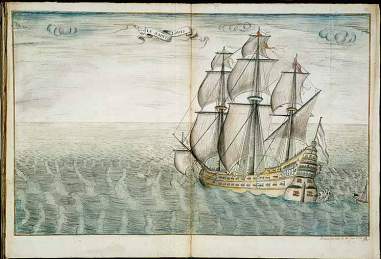 As we continue to learn more about the seizure and internment of migrant infants and children, both along the U.S.-Mexico border and in ICE raids throughout the nation, historians have asked us to wrestle with our long history of child-snatching, family separation, and child trafficking. I’ve read these pieces with a keen sense that while this is a particularly acute theme in American history, separating and abducting children from their families has been a tactic that many regimes have used for centuries to bolster their power. Whether we’re discussing slavery, the expulsion of Moriscos from Spain, or even pronatalist policies to populate early modern colonies, trafficking children has been an enduring state tactic. As a historian of #VastEarlyAmerica, with a focus on the French context, I keep thinking about the growth of the Louisiana colony in the eighteenth century. In addition to the forced migration and abduction of thousands of enslaved Africans, many of whom were children and adolescents, eighteenth-century French Louisiana was also populated with trafficked French children. Continue reading
Assigning the Unessay in the U.S. Survey
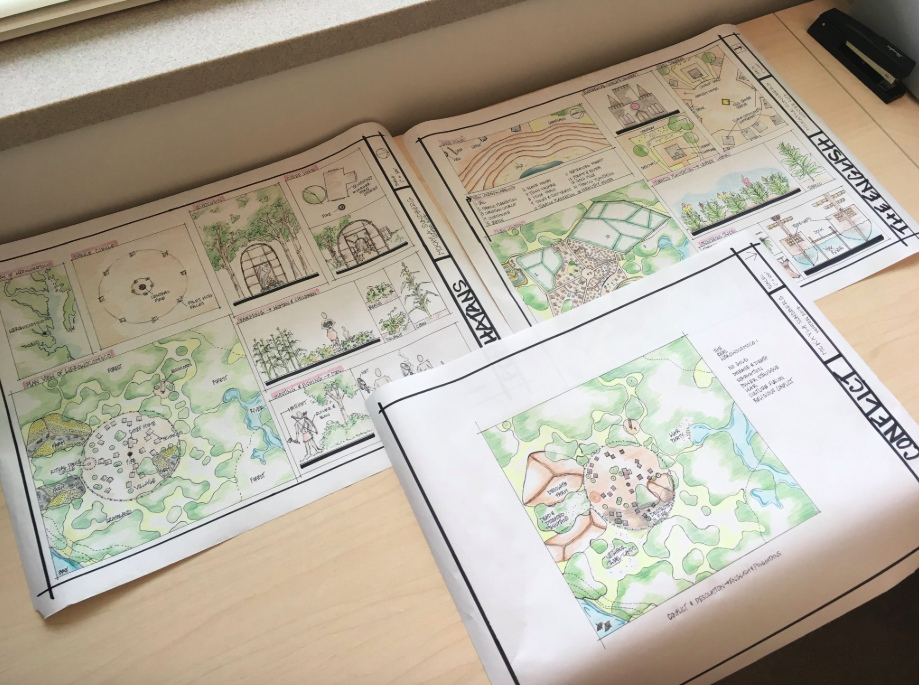 For the past several semesters, I’ve offered students in my US History to 1877 survey the option of completing an “unessay” in place of a traditional research paper. Like almost all of my pedagogical innovations, the “unessay” was borrowed and adapted from someone else. Emily Suzanne Clark introduced me to the concept of the unessay in a January 2016 post at Religion in American History (a more detailed description of the assignment is available here). As Emily notes, she in turn borrowed and adapted the idea from Ryan Cordell, who borrowed and modified it from Michael Ullyot and Daniel Paul O’Donnell. The core aim of the assignment is to free students from the constraints of the traditional essay and to spur them to think, research, and write (or not write!) more creatively. Continue reading
The Marriage of Angelica and John
Two hundred and forty-one years ago on Saturday—23 June, 1777—Angelica Schuyler ran off to be married. Today’s post is excerpted from the draft first chapter of my biography of Angelica. I will be presenting Chapter 4 at SHEAR’s second book workshop in Cleveland next month, and talking about Angelica at a panel on women and ideas in the Age of Revolutions. The research for what follows owes a lot to Stefan Bielinski’s Colonial Albany project, a brilliant resource for the people and spaces of Angelica’s childhood.
 Of course, John Carter was an utterly unsuitable match for a daughter of Catherine and Philip Schuyler. Like the other old families of Albany, the Schuylers were deeply intertwined with local and provincial oligarchies. Marriage was the most important means by which these bonds were maintained. Thus had Catherine’s brother Jeremiah married Judith Bayard, granddaughter of a mayor of New York City. Philip’s sister Geertruy was first married to her cousin Pieter Schuyler. Only as a widow might a woman in Albany’s elite consider marrying a man of lesser status. Geertruy’s second husband was a physician, John Cochran. Catharina Livingston, who first married Stephen Van Rensselaer II, spent ten years a widow before she married the church minister, Eilardus Westerlo. These patterns were not the result of strict enforcement. They were naturally occurring. Children of great families grew up with one another. They shared common points of reference, expectations, and desires. When the time was right, they married. That was how it went for Philip and Catherine—that was what they expected for Angelica. Except now she was twenty-one, and her country was at war. John Carter was unsuitable, but he was there.
At length, the snow began to melt. The wide Hudson ran higher and faster. The new year would bring renewed campaigning—soon enough, the British army would cross Lake Champlain, and then the defence of the Hudson Valley would begin in earnest. This was what preoccupied Angelica’s father. His mind was as much at Crown Point and Ticonderoga as it was in Albany that winter. But if he did not keep watch over Angelica and the young man from Congress, surely her two sisters did. Elizabeth and Peggy must have known, they were so close they formed a little unit of their own. Perhaps they were enlisted in the project, helping to distract their mother from the courtship going on under her own roof—as if three boys and an infant child weren’t enough distraction along with a troubled, distant husband. Whatever jealousy there was among the sisters was soothed and diminished by Angelica’s seniority. She was the trailblazer. They would have vicarious excitement, and without the risk. For there was something risky in what she was doing. She was waging a rebellion. That spring, as the green buds emerged, she and John Carter made their plans.
On June 12th 1777, general Schuyler rode north to inspect the forts and garrisons on Lake Champlain. Reports had come that John Burgoyne, the British general in command of the invasion, had assembled a fleet and begun embarking men. Schuyler was at Ticonderoga by the 18th. But he did not bring with him the man from Congress who was there to audit his accounts. John Carter stayed in Albany, making preparations of his own. Some time after Philip went north, his wife Catherine followed, on the way to meet him at the Saratoga house—just as she and Angelica had done almost exactly a year before, when the rumours at Albany had so alarmed them both. This time, though, Angelica did not accompany her. With both parents gone, she left Peggy in charge of the remaining household. Then she took John Carter to Van Rensselaer Manor. That was Angelica’s stroke of genius, for at that house was everyone she needed. There was the twelve-year-old Patroon, Stephen; his mother, Catharina; and her recent husband, Domine Westerlo, minister of the Dutch Reformed Church. All the ingredients to put on a respectable Albany wedding.[1]
Angelica and John were married on Monday, 23rd June. At twenty-one, she was already older than her mother had been on her own wedding-day. But she could not enjoy the same festivities her mother had done twenty-two years earlier. Even Catharina and her husband’s blessing could not make up for a marriage kept a secret from her parents. Even Brom Ten Broeck, Stephen’s legal guardian and Philip Schuyler’s oldest friend, could not make things right. He and his wife watched Angelica grow up—but much as they loved her, they could not condone her decision to marry without her father’s consent. The newlyweds had to leave, before Angelica’s parents returned. So on Thursday, they gathered themselves up again, said their goodbyes, and crossed the Hudson river, leaving Albany. They didn’t go far. On the east bank was Green Bush, the home of Angelica’s grandfather, Johannes Van Rensselaer, and his second wife, Gertrude. There, as John put it, “we were received by the amiable & venerable Proprietors with the greatest Friendship and Cordiality.” Johannes and Gertrude promised to use “all their influence” with Angelica’s parents.[2] Everyone knew there would be a reckoning when they returned.
To head off Philip and Catherine’s anger, warming them to the fait accompli, the newlyweds sent a letter to meet them on the road from Saratoga. It was not a success. For two days, Angelica’s parents refused to respond. When finally her grandfather relaxed his own pride, and sent them an invitation to dine at Green Bush on Sunday, a chance meeting of the two couples in Albany led the plan to unravel. Neither Angelica nor Catherine would allow herself to be the first to yield. Those three days were a struggle of will and affection. In the moment she acknowledged Angelica’s marriage, Catherine would have to recognise her daughter’s independence—a daughter who had been her closest confidante in every week and month that Philip was away; a daughter who had run off when her back was turned to marry a man she barely knew. On Monday, the Schuylers relented and arrived at Green Bush. Catherine “was in a most violent Passion,” but Johannes said something that cut his daughter deeply—he told her she did not take after her mother, Engeltie. Perhaps that put her grievance in perspective. She would not lose Angelica completely.
The next day, the Schuylers received Mr and Mrs Carter back into their home. If anyone expected a warm reconciliation, though, this was not it. The storm had passed, but left an atmosphere of tension in its wake. It would take time for Angelica’s mother to forgive her, not only for the subterfuge but for depriving her of taking any part in her own eldest daughter’s wedding. But there was no reversing what had happened. It was best to put aside the hurt. Philip “restored his daughter to his full confidence,” and told John that “he was now my father.” The general added, pointedly, that “he would take the Freedom of giving me his advice when he thought I stood in need of it with the Candour of a Parent.” Clearly, his son-in-law had a propensity for recklessness that would need curbing. It was Angelica, though, who had let down her parents’ expectations, she who suffered from their retaliation. “My charming Angelica is much distressed at their behaviour,” wrote John. The coming weeks were going to be difficult. “If they continue their coldness,” he concluded “we shall soon quit their house.”
If times had not been as they were, all this would have played out quite differently. John Carter would not have been in Albany, and Philip Schuyler would not have been away from home so much. He could have dedicated more attention to finding a suitor for his daughter. And for her part, would Angelica have been so ready to reject her parents’ rule over her life—to make her own decisions and to see them through against all obstacles? She lived in bold times, and dangerous ones: times of civil war, when brothers fought with brothers, and fathers fought their children. In the summer that Angelica married John Carter, prospects for the United States seemed poor. The city of New York had fallen to the British. John Burgoyne’s army was sailing down Lake Champlain. There had been a tenant uprising at Livingston Manor, a sign of the rebel gentry’s weakness. Hope and fear were intermixed. That is the nature of a revolution, in a family as much as in a country. These are strange times, bold and dangerous. Angelica Carter is only half afraid.
_________________________________
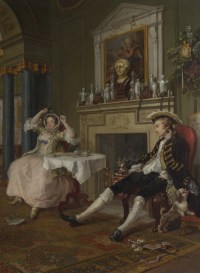
Image: Detail from William Hogarth, Marriage a la Mode, II, The Tête à Tête (1743-1745).
[1] Mary Gay Humphries, Catherine Schuyler (Charles Scribner’s Sons: New York, 1897), p.191, refers to the wedding taking place at the Patroon’s house. I think I’m the first to make a connection to the presence there of Domine Westerlo.
[2] John Carter to Walter Livingston, 3 July 1777, New York Historical Society. Subsequent quotations are also from this letter.
Review: Sharon Block, Colonial Complexions
Sharon Block, Colonial Complexions: Race and Bodies in Eighteenth-Century America (Philadelphia: University of Pennsylvania Press, 2018).

At the opening of Colonial Complexions: Race and Bodies in Eighteenth-Century America, Sharon Block poses two provocative questions: “What were the meanings of black, white, and red in the colonial eighteenth century; and how did Anglo-American colonists describe people’s appearance?” (1) To answer these queries Block presents a cultural history race in Britain’s 18th century American colonies. She makes a careful study of the descriptors advertisers and editors used in missing colonial persons adds for runaway African descent and their European and Native American servants. Continue reading
Black Women Intellectuals and the Politics of Dislocation
In light of the recent tragic stories of family separation occurring on the Mexico-United States border, what instantly came to my mind was America’s history of dislocation through American slavery. From the United States’s conception, the place of the country’s Black population, enslaved and free, was centered in debates on who this country was ultimately built for. There were factions that saw slavery as antithetical to the founding principles of “freedom, liberty, and the pursuit of happiness.” During the Revolutionary War, even British orators like Samuel Johnson, clearly saw this dichotomy. In his 1775 pamphlet Taxation No Tyranny: An Answer To The Resolutions And Address Of The American Congress, Johnson juxtaposed the colonist’s “Declaration of Rights,” and equivocated “If [s]lavery be thus fatally contagious, how is it that we hear the loudest yelps of for liberty among the drivers of negroes.”[1] Not all factions of the founding generation decidedly occupied one camp of pro-slavery or anti-slavery though. America’s first and third presidents denoted this friction. Washington and Jefferson’s stories denoted both held surface level anti-slavery positions, yet also owned hundreds of bondswomen and men; very similar to what Johnson characterized. This complication stemmed from the generation’s refusal to resolve the “slavery question” that plagued the new nation. Political compromises, like the counting of enslaved peoples as three-fifths a person, prolonged America’s reckoning, but only temporarily. However, a middle ground emerged by the early 19th century: colonization. Continue reading
 The Junto