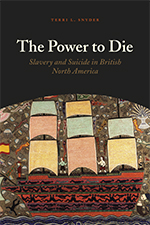
 Terri Snyder is Professor of American Studies at California State University at Fullerton who specializes in slavery and gender. She received her PhD in 1992 from the University of Iowa. In 2003, Cornell University Press published her first book, Brabbling Women: Disordered Speech and Law in Early Virginia. The Power to Die: Slavery and Suicide in British America is her second book.
 Social networks are having a moment in history. They are another approach to understanding how people came together either via proximity, social status, values, or goals, with the analytical focus on what serves as the bond in the relationship(s).[1] Social theorists have ascribed a 4-part process which entails a) similar people coming together, b) influence within these groups making its members more alike, c) people winding up in the same place, and d) shared space making people more alike.[2] In short, networks are primarily about building consensus. For historians, networks are “messy,” “fragile,” “fluid,” and disregard geographic boundaries.[3]


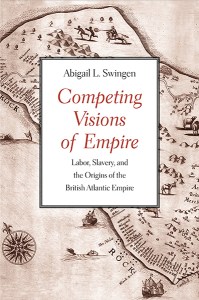 Abigail Swingen is an Assistant Professor of History at Texas Tech University (Lubbock, TX). She received her Ph.D. in History from the University of Chicago. She specializes in the Early Modern British Atlantic Political Economy. Competing Visions of Empire is her first book and was reviewed here yesterday. The following is part of our (relatively) new tradition of reviewing a book and then offering a Q & A with the author the following day. [NB: You can find my review from yesterday
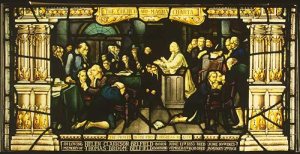 Joseph Yesurun Pinto, a 31 year-old Anglo-Dutch émigré in the autumn of 1760, had led New York’s
 The Junto