Guest Poster Shaun Wallace (@Shaun_Wallace_) is an Economic and Social Research Council-funded Ph.D. candidate at the University of Stirling. His dissertation examines how reading and writing influenced and aided slave decision-making in the early republic. Shaun holds a B.A. (Hons.) and a MRes. from the University of Stirling and is president of Historical Perspectives, a Glasgow-based historical society run by and for graduate students in the United Kingdom.
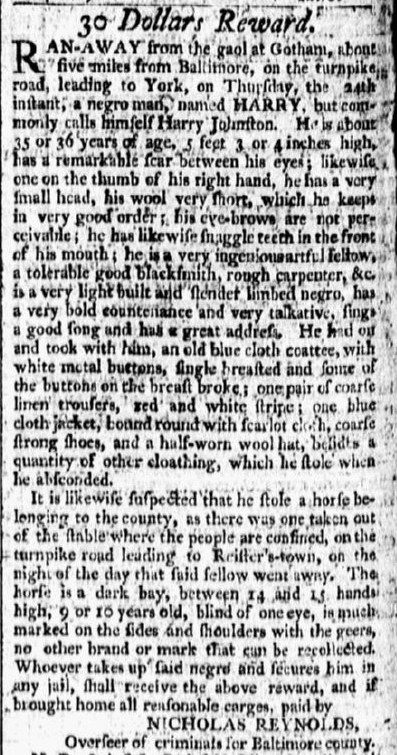 A “very ingenious artful fellow” appears a peculiar description of a runaway advertised for recapture. The advertisement, for Harry or Harry Johnstone, featured in Baltimore’s Federal Gazette newspaper, on May 2, 1800, at the request of Nicholas Reynolds, overseer of criminals for Baltimore County. Harry had absconded from Gotham gaol, near Baltimore. Reynolds described Harry as a “tolerable good blacksmith” and a “rough carpenter.” A “very talkative” slave, he was a man of “great address.” On first impression a relatively congenial description; in actuality, Reynolds’s use of the term “artful” condemned the runaway.[1]
Continue reading


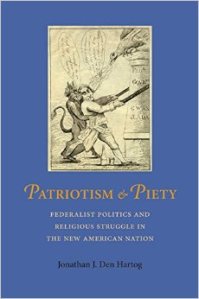 Religion was an “engine of politics” in the early American republic. Jonathan Den Hartog explains how religion energized (and then, ironically, diverted energy from) Federalist politics, and how the national vision of Federalists changed American religion. He considers northern evangelical Federalists such as John Jay (and his two sons), Caleb Strong, and Elias Boudinot, Unitarian Federalists including John Adams, and Federalists with a southern accent, Henry De Saussure and Charles Pinckney. These individuals are located, through impressive archival research, in a web of interpersonal relationships.
  Revolutionary America was a politicized society. All of the most important conflicts of the American Revolution, from the Stamp Act through Independence to the ratification of the Constitution, were sharply divisive events which demanded citizens take sides. Even neutrals were compelled to give outward displays of support to either patriots or loyalists (often both!). There were very little chances to avoid conflict over such weighty issues—they would reshape and redefine friendships, families, and communities.
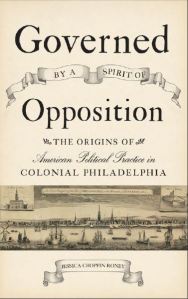 In recent years, early American political history has received considerable attention. A range of historians have enriched our understanding of how Americans participated in and contributed to politics in the early republic.
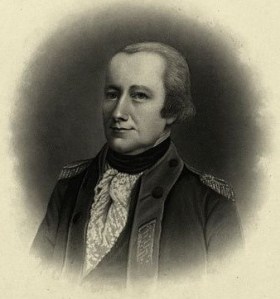 On April 25, 1775, hundreds of New Yorkers acknowledged receiving “a Good firelock, Bayonet, Cartouch Box, and Belt.” Six days after the Battles of Lexington and Concord, and three days after Israel (Isaac) Bissell told New Yorkers the news, Alexander McDougall mobilized support against the British. The War of American Independence had reached New York and, with hundreds of supporters, McDougall was ready to fight.
 It’s commencement season around the United States, so we wish a hearty congratulations to all of our readers (and our students) graduating this month. Now, straight on to the links!
 Here’s our seasonal roundup of new and forthcoming titles. Share your finds below!
  The Junto