 On February 18, 2014, Tom Cutterham asked, “Was the American Revolution a Civil War?” According to Cutterham, understanding the Revolution that way might be useful. If we did, he suggested, “we’d better understand the way the modern world—the nexus of state, citizen, and property—was born in and determined by violence.”[1] Continue reading
Monthly Archives: June 2015
The Week in Early American History
 Welcome to another edition of This Week in American History. It has been a busy, yet troubling two weeks.
We would like to begin by offering our condolences to the family, friends, and colleagues of Christopher Schmidt-Nowara, of Tufts University. Dr. Schmidt-Nowara died suddenly in Paris on June 27th. Continue reading
Q&A: Jessica Roney, Governed by a Spirit of Opposition
 Yesterday, Chris Minty reviewed Jessica Choppin Roney’s book, Governed by a Spirit of Opposition: The Origins of American Political Practice in Colonial Philadelphia. Today, she speaks with The Junto about the book project and the process of turning the dissertation manuscript into a book. She received her MA at the College of William and Mary and her PhD at The Johns Hopkins University. She is currently Assistant Professor of History at Temple University in Philadelphia and is organizing a global early modern conference this November: Port Cities, 1500-1800, hosted by Temple University, the Program in Early American Economy and Society, and the McNeil Center for Early American Studies. Continue reading
Review: Jessica Choppin Roney, Governed by a Spirit of Opposition
Jessica Choppin Roney, Governed by a Spirit of Opposition: The Origins of American Political Practice in Colonial Philadelphia (Baltimore: Johns Hopkins University Press, 2014).
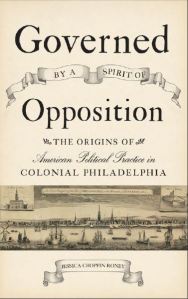 In recent years, early American political history has received considerable attention. A range of historians have enriched our understanding of how Americans participated in and contributed to politics in the early republic.[1] Popular politics during the colonial period has received less attention.[2] But in Governed by a Spirit of Opposition, part of Studies in Early American Economy and Society from the Library Company of Philadelphia, Jessica Choppin Roney focuses on politics in Philadelphia prior to the American Revolution. In so doing, she makes an important contribution to the field of early American history. Continue reading
Guest Post: On Publishing Journal Articles
Update: The Junto is sorry to report that C. Dallett Hemphill passed away on Friday, 3 July, after a brief illness. Hemphill received her BA from Princeton, and her PhD in American Civilization from Brandeis University. Through her own scholarly work, contributions to the McNeil Center for Early American Studies, and her position as Editor of Early American Studies, she was a big supporter of junior scholars. She is remembered both for her contributions to the field and profession and as a warm and generous scholar. This was her recent guest post for The Junto, in which she offered advice to junior scholars on publishing journal articles.
Guest Poster C. Dallett Hemphill is Professor of History at Ursinus College. She is also Editor of Early American Studies, which is published by the University of Pennsylvania Press for the McNeil Center for Early American Studies.
 I’m grateful to The Junto blog for inviting me to discuss how to publish a journal article. Although the views that follow are my own and the details of the process vary somewhat from journal to journal, I know from conversations with other editors that there is consensus on the essentials.
The Early American Digital World
This post builds on the conversation begun by Joseph Adelman’s post on early American history blogging the other day, and a panel on the topic at the OIEAHC/SEA conference yesterday. A version of these remarks were delivered at a panel entitled, “Early American Worlds: A State-of-the-Field Conversation” at the 2015 Organization of American Historians Annual Meeting on April 17, 2015 in St. Louis, MO.
 For longer than I’ve been alive, our field in a structural sense has been organized through the efforts of the main institutions in the field, i.e., the Omohundro Institute of Early American History and Culture and, later, the McNeil Center for Early American Studies and the Society for Historians of the Early American Republic. From fellowships to seminars to conferences, these institutions gave to the field the significant sense of community it had. And I would argue that the new early American “digital world” is not changing that but expanding upon (or around) it. Social media and blogs are adding an additional layer of social infrastructure within the field itself, creating spaces that foster an even broader and more inclusive sense of community in the field, largely through the ability to include people who for whatever reason don’t have access to or are outside the immediate orbit of those institutions and the field’s traditional channels of community-building. Continue reading
The Charleston Shooting and the Potent Symbol of the Black Church in America
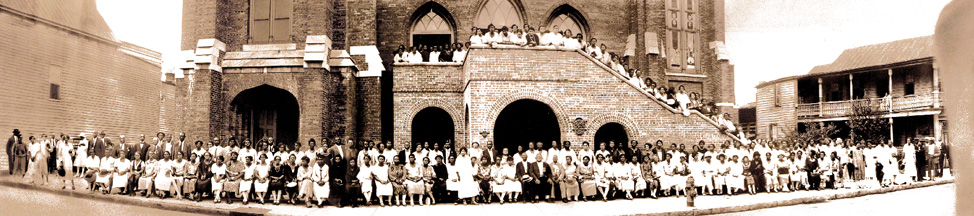 Last night, Dylann Storm Roof entered the historic Emanuel African Methodist Episcopal Church in downtown Charleston, South Carolina, sat through an hour-long meeting, and then opened fire on those in attendance. Reverend Clementa Pinckney, a state senator, was among nine individuals who were killed. Many are shocked at not only the grisly nature of the shooting, but also its location. “There is no greater coward,” Cornell William Brooks, president of the N.A.A.C.P, declared in a statement, “than a criminal who enters a house of God and slaughters innocent people engaged in the study of scripture.” Yet this experience is unfortunately, and infuriatingly, far from new: while black churches have long been seen as a powerful symbol of African American community, they have also served as a flashpoint for hatred from those who fear black solidarity, and as a result these edifices have been the location for many of our nation’s most egregious racial terrorist acts. Continue reading
On Twittiquette
 What are the rules for scholarly engagement online? Should there be any? Some of the great things about social media in the past few years have been its leveling effect, its irreverence, and its real-time discussion capability. That last in particular has become handy at conferences with the rise of live-tweeting, where participants create a backchannel discussion or broadcast to those not able to attend the occurrences of a conference. It’s been incredibly helpful and interesting for those of us on Twitter, but there’s also been pushback from non-users about what people may be saying about their work outside their field of vision. So should tweeting have rules?
Guest Post from Vaughn Scribner: “Fabricating History: The Curious Case of John Smith, a Green-Haired Mermaid, and Alexandre Dumas”
Vaughn Scribner is a Visiting Assistant Professor at the University of Central Arkansas. He has published on topics ranging from early American tavern culture to the commodification of slaves in Tidewater Virginia, and also has a forthcoming article on early American mineral springs and spas. His book manuscript (in progress), Beyond Bacchus: Colonial Taverns and the Golden Age of the British Empire in America utilizes the colonial tavern space to realize how urban colonists realized the full potential of the British Empire in America from 1744 to 1765. He is also currently researching for an article on early modern conceptions of mermaids and tritons. For more info or to contact Vaughn, please visit www.vaughnscribner.com.

Figure 1: “Captain Hailborne at St. Johns Newfoundland, 1655,” from Ludwig Gottfriedt, Newe Welt und Americanische Historien (Frankfurt/ Bey denen Merianischen Erben, 1655). The Mariners’ Museum.
I originally planned for this piece to be a brief investigation into a number of articles that appeared in the Gentleman’s Magazine from 1750 to 1775. The articles, it must be added, consisted of in-depth analysis of mermen and mermaids. Yes, a number of early modern Britons—ranging from Cotton Mather to Benjamin Franklin—entertained, if not believed in, the existence of merfolk.[1] A deeper analysis of early modern conceptions of mermen and mermaids, my article would propose, provide a more nuanced understanding of Britons’ imperial imaginations. But that will have to wait, because my research for this piece led me down a different path that was both extremely frustrating and, ultimately, quite enlightening. Continue reading
The Many & the One
 Like many, Amos Doolittle struggled to turn in a decent first draft of American history. The 21 year-old engraver, later known as the “Paul Revere of Connecticut,” arrived in Lexington and Concord shortly after April 1775. Anxious to capture the battles’ action and aftermath, he chatted with local residents. He sketched terrain. For Doolittle, a trained silversmith, it was a chance to experiment with a craft he had yet to master. Part of what he produced, a set of four views storyboarding the “shot heard round the world,” hangs in the Boston Public Library’s new exhibit, “We Are One: Mapping America’s Road from Revolution to Independence.” By Doolittle’s lights, Massachusetts makes for a furious and frenzied tableau: gusts of redcoats’ gunpowder hazing the sky, and colonial ranks splintering on the advance. On the American side, it is hardly a picture of union. Patriots scatter, racing blindly to frame’s edge. In his rough draft of Revolution, Amos Doolittle demands that we unlock all hopes of what might come next. Continue reading
 The Junto