Guest Post: A View from the Past: The Contingencies of Racialization in 15th- and 16th-Century Iberia

When Paul Gilroy wrote his now-classic critique of cultural nationalism in 1995, he conceived a Black Atlantic that was a geo-political amalgamation of Africa, America, the Caribbean, and Europe. Gilroy was particularly interested in the construction of a modern, post-colonial cultural space in which slavery remained a part of modern black consciousness. His book is particularly noted for the introduction of race as a critical consideration in exploring the Black Atlantic.

It is fitting then, that we kick off our week-long discussion of the Black Atlantic with a post by Marley-Vincent Lindsey, which explores considerations of race in the Iberian Atlantic. Subsequent posts will consider Black responses to freedom (and unfreedom), historical narrative, race, and of course, power. Marley-Vincent Lindsey is a PhD student at Brown University. He is interested in writing the history of a Medieval Atlantic, tracing connections of land and labor grants between fourteenth-century Iberia and sixteenth-century New Spain. He also writes about history and the web with Cyborgology, and can sometimes be found tweeting @MarleyVincentL

medieval-poc-image

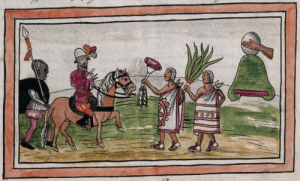
An early image of an African conquistador during Cortes’s invasion of Tenochtitlan. While the associated text makes no specific mention of Juan Garrido, historians have often associated this image with Garrido, one of the few known early black conquistadors. Fray Diego Duran, Historia de las Indias de Nueva Espana e Islas de la Tierra Firme (1581), 413. Image credit: People of Color in European Art History.

Juan Garrido was a typical conquistador: arriving in Hispaniola by 1508, Garrido accompanied Juan Ponce de León in his invasion of Puerto Rico, and was later found with Hernan Cortés in Mexico City. Yet his proofs of service, a portion of which was printed by Francisco Icaza in a collection of autobiographies by the conquistadors and settlers of New Spain, made a unique note: de color negro, or “of Black color.”[1] Continue reading
Q&A: Ibram Kendi, Stamped From the Beginning

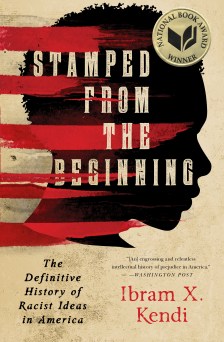
stampedbeginningnbawinnerToday, we are pleased to offer an interview with Dr. Ibram Kendi on his National Book Award winner, Stamped from the Beginning: the Definitive History of Racist Ideas. Kendi is an Assistant Professor of African-American History at the University of Florida, and Associate Editor of the African-American Intellectual History Society blog. You can find his blog posts here. Continue reading
Autumn Reads

the-country-school

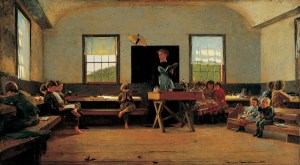
Winslow Homer, “The Country School,” 1871

Looks like #VastEarlyAmerica just got even vaster—and that’s a good thing. Here’s our fall preview of new titles. Please share your books/finds in the comments! Continue reading

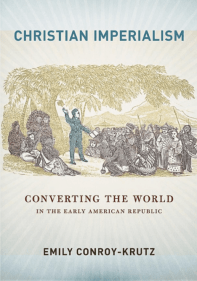
Review: Emily Conroy-Krutz, Christian Imperialism: Converting the World in the Early American Republic

Emily Conroy-Krutz, Christian Imperialism: Converting the World in the Early American Republic (Ithaca: Cornell University Press, 2015)

Christian Imperialism

In February 1812, eight American missionaries—five ordained clergymen and three of their wives—set sail for India as representatives of the recently established American Board of Commissioners for Foreign Missions (ABCFM). Though the specifics of their mission were ill defined, and none of the eight lasted long in India, their mission marked the propitious beginnings of the foreign mission movement in America. Over the course of the next four decades, more than one thousand men and women were commissioned by the ABCFM to missionize non-Christian peoples far beyond the borders of the early American republic. In Christian Imperialism, Emily Conroy-Krutz analyzes the experiences of the ABCFM missionaries from roughly 1812 to 1848. She argues, as the title of her book implies, that the missionaries were agents of “Christian Imperialism,” a vision and effort to convert (and civilize) “heathen” peoples around the globe that variously worked in concert with and in contest against other forms of early American imperialism. Continue reading

13 Revolutions +1

Diego Rivera and Bertram D. Wolfe, "Portrait of America," 1934

Diego Rivera and Bertram D. Wolfe, “Portrait of America,” 1934

When John Adams looked back on the American Revolution (something he liked to do), he reflected that, “The Revolution was in the Minds and Hearts of the People.” The colonists’ drive to independence marked a new era of American history, Adams thought, when “Thirteen Clocks were made to Strike together; a perfection of Mechanism which no Artist had ever before effected.” Scholars have struggled to frame the experience of the Revolution in picture and on the page. How can we use digital tools to curate collections of revolutionary culture and #vastearlyamerica for use in the classroom?

Today, The Junto chats with Darren Milligan, Senior Digital Strategist at the Smithsonian Center for Learning and Digital Access, about the Smithsonian Learning Lab, which encourages us to make, use, and share new galleries of history.  Continue reading

Building Intellectual Community at SHEAR

Students of the early American republic: I urge you to apply to SHEAR 2016’s Graduate Research Seminars!
The program, which debuted last year, brings together grad students and senior faculty clustered around four “hot” themes in the field for an hour and a half or so of small-group discussion. Lunch is free. The sessions are open to current graduate students and those who earned a Ph.D. during the 2015-16 academic year. A one-page dissertation abstract is all it takes to apply. Best of all, this year’s lineup of topics and faculty is just as wonderful as 2015’s was. Continue reading

Interview: Terri Snyder, The Power to Die

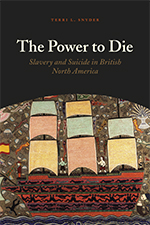
9780226280561-1Terri Snyder is Professor of American Studies at California State University at Fullerton who specializes in slavery and gender. She received her PhD in 1992 from the University of Iowa. In 2003, Cornell University Press published her first book, Brabbling Women: Disordered Speech and Law in Early Virginia. The Power to Die: Slavery and Suicide in British America is her second book.
Continue reading

Guest Post: The Art of Absconding: Slave Fugitivity in the Early Republic

Guest Poster Shaun Wallace (@Shaun_Wallace_) is an Economic and Social Research Council-funded Ph.D. candidate at the University of StirlingHis dissertation examines how reading and writing influenced and aided slave decision-making in the early republic. Shaun holds a B.A. (Hons.) and a MRes. from the University of Stirling and is president of Historical Perspectives, a Glasgow-based historical society run by and for graduate students in the United Kingdom.

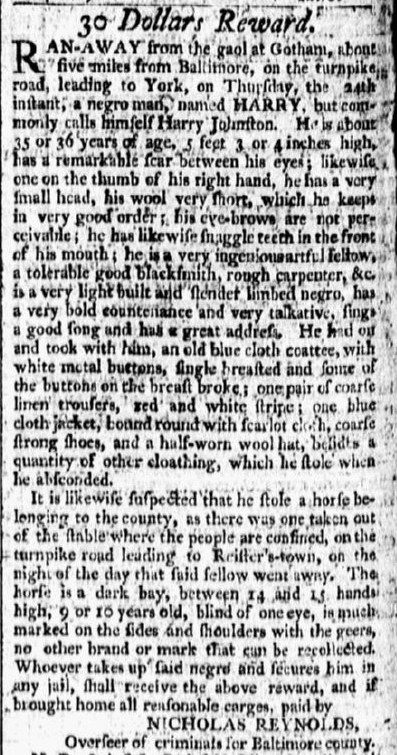
Screen Shot 2015-08-24 at 12.43.09 PMA “very ingenious artful fellow” appears a peculiar description of a runaway advertised for recapture. The advertisement, for Harry or Harry Johnstone, featured in Baltimore’s Federal Gazette newspaper, on May 2, 1800, at the request of Nicholas Reynolds, overseer of criminals for Baltimore County. Harry had absconded from Gotham gaol, near Baltimore. Reynolds described Harry as a “tolerable good blacksmith” and a “rough carpenter.” A “very talkative” slave, he was a man of “great address.” On first impression a relatively congenial description; in actuality, Reynolds’s use of the term “artful” condemned the runaway.[1]
Continue reading

The Charleston Shooting and the Potent Symbol of the Black Church in America

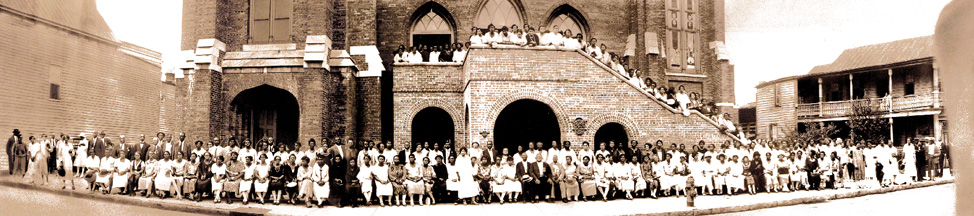
Emanuel landscapeLast night, Dylann Storm Roof entered the historic Emanuel African Methodist Episcopal Church in downtown Charleston, South Carolina, sat through an hour-long meeting, and then opened fire on those in attendance. Reverend Clementa Pinckney, a state senator, was among nine individuals who were killed. Many are shocked at not only the grisly nature of the shooting, but also its location. “There is no greater coward,” Cornell William Brooks, president of the N.A.A.C.P, declared in a statement, “than a criminal who enters a house of God and slaughters innocent people engaged in the study of scripture.” Yet this experience is unfortunately, and infuriatingly, far from new: while black churches have long been seen as a powerful symbol of African American community, they have also served as a flashpoint for hatred from those who fear black solidarity, and as a result these edifices have been the location for many of our nation’s most egregious racial terrorist acts. Continue reading

Race, Riot, and Rebellion: A Bibliography

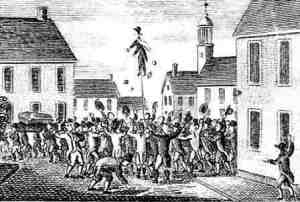
protesting-stamp-actThis morning on the other side of the Atlantic, I woke up early in preparation for a seminar on William Otter, whose History of My Own Times closes the list of our readings in my Revolutionary America class. Essentially, Otter was a brawling, violent, white man in the 1800s, living variously in New York, Pennsylvania, and Maryland. He jumped from job to job while engaging in various aggressive “sprees” against African Americans, Irishmen, and anyone else who seemed a likely candidate before becoming a burgess of Emmitsburg, Maryland.[1] And instead of getting up to prep this morning, I remained in bed, glued to the #BaltimoreUprising and #BlackLivesMatter hashtag on Twitter, as, I’m sure, were many of you during the late hours of the night. During times like these, it’s part of our jobs as historians to acknowledge that different types of violence have specific meanings that change over time. And so Juntoists have compiled a bibliography for our mutual education. Continue reading